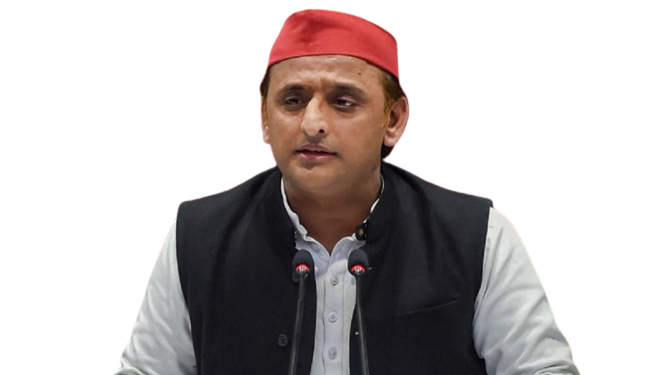
Lucknow: Uttar Pradesh has always been known for its bold political slogans, unconventional social coalitions, and startling ideological turns. Continuing this tradition, Samajwadi Party supremo Akhilesh Yadav has once again unveiled a new and emotionally charged interpretation of his much-discussed political formula, ‘PDA,’ in the current political atmosphere of August 2026. As all parties vie to sharpen their future strategies, Akhilesh Yadav announced through social media that the true and original emotional principle of PDA is actually “Love, Compassion, and Belonging.” Targeting the ruling Bharatiya Janata Party, he argued that while backward castes, Dalits, and minorities might find a place in the BJP, they cannot find true respect because of this missing emotional connection.
This is not the first time Akhilesh Yadav has rebranded his cherished slogan. Just days earlier, on the occasion of socialist thinker Janeshwar Mishra’s birth anniversary, he stunned political pundits by suggesting that ‘PD’ in PDA could also stand for ‘Pundit’ (Brahmin scholar). At that time, he attempted a new ‘Pundit Formula’ or ‘Brahmin Card,’ linking ‘P’ to the Suffering and the Pundit, ‘D’ to Dalits, and ‘A’ to half the population (women) and the ‘progressive upper castes.’ The sudden packaging of an otherwise sharp and aggressive political slogan in such emotional and all-caste-inclusive language doesn’t sit well. This shift reflects not only deep ideological ferment within the Samajwadi Party but also a significant strategic anxiety in Uttar Pradesh politics.

To understand this entire development, we must recall the original political context from which PDA emerged. During the 2024 Lok Sabha elections, Akhilesh Yadav unveiled the slogan ‘PDA’—Backward, Dalit, and Minority. This slogan was purely an attempt to build a concrete social bloc based on caste and religious identity. It expanded the traditional Samajwadi Party’s Yadav-Muslim (Y-M) equation to bring non-Yadav backward castes onto one platform. But politics never remains static. After the 2024 success, as the party moved toward future political challenges, Akhilesh Yadav perhaps realized that caste polarization alone cannot lead to power.
In contrast, the Bharatiya Janata Party’s politics has always transcended caste divisions, anchoring itself on the fundamental mantra of “development for all, trust in all, and effort from all.” The BJP has mainstream-ified every caste, class, and community without discrimination. The benefits of welfare programs like Ujjwala Yojana, Public Distribution System, PM Awas Yojana, and Ayushman Bharat have reached the person standing at the bottom rung without any caste-colored lens. This is why Akhilesh Yadav now finds himself forced to step out of his limited “Backward, Dalit, and Minority” image and is attempting to mimic the BJP’s very inclusive development narrative.
From a political perspective, Akhilesh Yadav’s new experiment creates serious ideological contradictions and political opportunism. The Samajwadi Party has for long been the most vocal advocate of ‘caste census’ and ‘representation proportional to population’ from Uttar Pradesh to Delhi. The demand for a caste census is entirely built on politics that divides society into fragments and spreads social discord. The demand assumes that resources and power in society should be distributed proportionally to caste populations—a direct attempt to marginalize and isolate a large section of society.
Yet, when Akhilesh Yadav suddenly begins defining this very slogan with deeply emotional terms like “Love, Compassion, and Belonging,” his ideological dilemma becomes clearly exposed. The question arises: How can a party that stands at every forum dividing society by castes and citing numbers suddenly play-act compassion and belonging? Are the exploited and backward classes remembered only during elections, only to have the definition changed to appease upper castes afterward? This contradiction runs deep because ‘compassion’ always flows downward from the powerful to the weak. When Akhilesh Yadav says ‘D’ means ‘Compassion,’ he unknowingly converts Dalits and the backward into objects of charity rather than rights-holders. Drawing lines through society via caste census on one hand and erasing those same lines through “love and belonging” on the other—this hollow ideological foundation of the SP’s strategy is laid bare.
This is why, when Akhilesh Yadav wraps PDA in the new garb of “Love, Compassion, and Belonging,” he encounters what remains etched in the memory of Uttar Pradesh’s people: the Samajwadi Party’s previous tenure in power. Neither political analysts nor the common citizen have forgotten how the rule of law deteriorated during the SP government’s reign. In that era, “might is right” was the governing principle, where organized crime, land seizures, and riots created an atmosphere that left businessmen, women, and ordinary citizens feeling unsafe.

In stark contrast, under Chief Minister Yogi Adityanath’s leadership, the Bharatiya Janata Party has set a precedent by making Uttar Pradesh a “riot-free” and secure state. The BJP government adopted a “zero tolerance” policy against criminals and mafia, restoring the supremacy of law in the state. Today, the women of Uttar Pradesh can venture out at night without fear, and industrialists invest without worrying about extortion. Against this backdrop, Akhilesh Yadav’s new narrative of “love and belonging” appears to be a desperate attempt to wash away the SP’s old image of “tyranny and appeasement.” The public understands perfectly that law and order is not reformed through sweet words, but through the administrative resolve of a strong government with unwavering willpower—something the BJP currently possesses.
Behind this ideological drift lies some practical compulsion within the Samajwadi Party that’s plainly visible. In Uttar Pradesh, Mayawati’s Bahujan Samaj Party continues to weaken, leaving a large section of Dalit votes in search of political moorings. Akhilesh Yadav wants to send this vast constituency a message: the Samajwadi Party is no longer a party of just one or two castes, but here they will find “belonging” and respect. Additionally, the SP finds it impossible to counter the BJP’s aggressive nationalism, cultural renaissance (like the magnificent Ram Mandir and Kashi Vishwanath Corridor construction), and strong law-and-order agenda. The BJP has made Uttar Pradesh “riot-free” and secure, which makes traders, women, and youth feel safe.
To counter this strong administrative image, the SP needed a narrative that wouldn’t frighten or alienate the majority society (including upper castes). Through “Love, Compassion, and Belonging,” Akhilesh actually aims to blunt the BJP’s developmental and cultural narrative—the one that portrays the opposition coalition as casteist or appeasing. He wants to create a hollow ideological line at the state level, following Congress’s nationally failed “shop of love” politics.
Whether Akhilesh Yadav’s ‘PDA experiment’ succeeds remains to be seen. Indian voters are remarkably discerning; they closely observe the real intent behind slogans and the parties’ workers’ past behavior on the ground. If the Samajwadi Party’s ground cadre still hasn’t moved beyond old thinking, casteism, and the politics of dominance, then this new definition of “Love, Compassion, and Belonging” offered by the leadership will remain merely a paper promise and a social media post.
In contrast, the BJP’s strong organization, commitment to nationalism, and disciplined workers on the ground have built unshakeable public trust. By repeatedly changing its own core definition, the SP risks sending a message of distrust even among its core constituency—the backward classes and Dalits. They sense that the struggle for their rights is being diluted merely to gain power and appease other groups. There are limits to political opportunism. Akhilesh Yadav is currently entangled in this very web, where on one side lies the demand for a caste census that divides society, and on the other, a hollow pretense of becoming inclusive like the BJP. The public understands this contradiction exceptionally well, and in the coming elections, they will deliver a precise verdict on this ideological inconsistency.