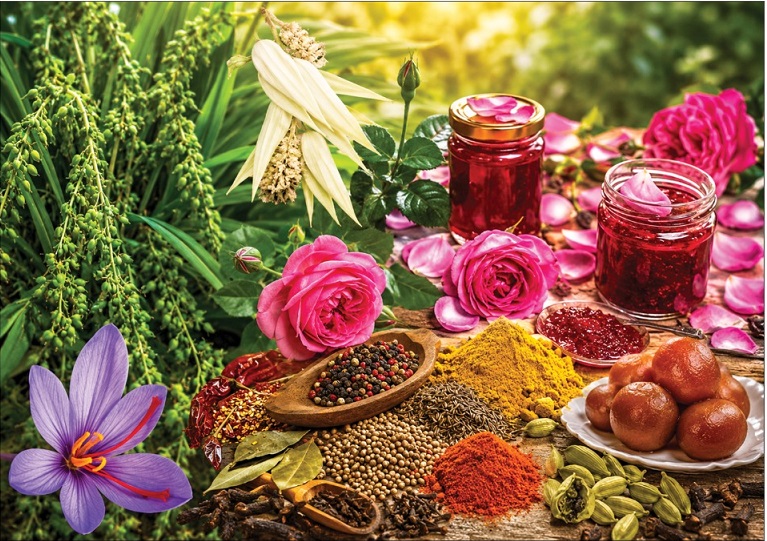
Lucknow: The fragrant ketki flowers (screw pine, Pandanus amaryllifolius) are a great favourite in worship as well as decorating ladies’ hairstyles. They form a vital part of auspicious festoons in gateways and doorways during festivals. But it is equally popular as a food flavouring in India and South East Asia. Pandan leaves and flowers are used to impart a delicious aroma to vegetable, rice and meat dishes in Malaysia, Indonesia and Sri Lanka and the flavour is well complemented with coconut milk and spices. It is a common practice to add pandan leaves to many dishes while cooking just as we add curry leaves or bay leaves and remove them before serving. Pandan leaf extract is prized in flavouring cakes, ice creams and desserts too.
In India the flowers are boiled to distill an aromatic liquid known as kewra or kewda. This is prized in cooking pulao, biryani, sweets and spicy gravy dishes with vegetables or meat. It is also used to flavour drinks such as Thandai, sherbets and desserts. The long leaves and leaf- like petals are braided into the plait by young girls and left overnight to impart a fresh, sweet fragrance to the hair after it is removed in the morning.

In Sanskrit literature it is often mentioned as Ketaki flower. In the Siva Puranam, there is the story of Brahma and Vishnu trying to fathom the extent of Lord Siva in the form of a huge column of blazing fire. Vishnu tried to fathom the foundations by burrowing below in the form of a boar but returned admitting defeat. Brahma soared upwards on his swan and after travelling for aeons, found a falling ketaki flower who said that it was coming from Lord Siva’s crest. Taking the flower as evidence, Brahma returned claiming that he had reached the top and seen the crest of Siva. Then Siva emerged from the column and called his bluff and also cursed the flower for participating in the falsehood, decreeing that it would never be used in the worship of Lord Siva. This form of Shiva is known as Lingodbhava, as He stepped out of the column of fire from within, depicted in many temple sculptures.
The Saffron, which is an exquisite spice obtained from the dried stamens and pistils of the saffron crocus or Crocus sativum, imparts a golden hue and delicious aroma to foods and is prized in flavouring sweets, payasam, milkshakes, kulfi, halwa as well as biryani, pulaos and spicy dishes. Believed to be a native of Iran or Mesopotamia, it has been grown in Kashmir since the early centuries CE and is called kashmira in Sanskrit literature. Considered auspicious, it is also used in temple worship, to add fragrance to the abhisheka water and other pooja materials. It is also valued in Ayurveda for its medicinal properties. In India, as turmeric and sandal have also been used widely in worship rituals, sometimes the names overlap.
Hence “kashmira” is a term sometimes used to mean “sindhur” or “kum kum” and hence the Tamil name of kumkum-poo (kumkum-flower) for saffron. The rose is believed to be a native of Europe and many parts of Asia and has come into India relatively later. It does not have a precise name in Sanskrit literature, although “japaa-kusuma” and “sthala jalaruha” (“land-lotus”) are believed to refer to the rose in addition to the primary meaning of Hibiscus or China rose. The gulkand, rose-petal preserve, is a delicious preparation with rose petals and sugar, prized for its health benefits as well as imparting a refreshing and delicious flavour to milk shakes and icecreams. Who does not enjoy the Gulab jamun, or ‘rose-jamun’ – a sweetmeat prepared of jamun-shaped khoya balls soaked in rose-flavoured sugar syrup!


Cloves are the aromatic flower buds of the tree Syzygium aromaticum, a native of Maluku Islands or Moluccas, in Indonesia. Clove is a popular food flavourant and spice, used in sweet as well as savoury dishes. Spicy gravies, biriyanis and festive feasts arenever complete without it. Cloves have great medicinal benefits too.
Aiding in digestion, it has anti-inflammatory properties and clove oil is widely used in Ayurvedic medicine. Research suggests that the compounds in cloves may have several health benefits, including supporting liver health and helping stabilize blood sugar levels.
We cannot speak about food flavourants without mentioning the cardamom, or Elaichi, known as Elaa in Sanskrit! Although not the flowers directly, but the seed pods of the plant Elettaria cardamomum, cardamom is a great favourite in sweets and savouries across the country. Known for its strong pungent odour, it has a soothing and calming effect on the mind, serveing to heal frayed nerves and bring a wonderful sense of wellness. Even a cup of cardamom tea is enough to rejuvenate a fatigued person!
The cardamom is related to the ginger and turmeric plants and is also a native of the East Indies, which is why those lands were known as the Spice Islands. Caradamom has come to India millenia ago and is widely grown in India and used in Ayurveda too. All spices are high in anti-oxidants and used in judiciously small quantities provide great benefits to good health.












 https://www.youtube.com/watch?si=RtToJsBhYBatUrym&v=mOuYNSdhjHA&feature=youtu.be