By Arvind Singh Bisht
Man has often been described as a social animal. Yet beneath the discipline of civilisation lies another instinct—the desire to be noticed, admired and recognised above others. This instinct is not evil in itself. Properly channelled, it inspires excellence, creativity and leadership. But when recognition becomes an obsession and self-restraint gives way to collective frenzy, civilisation begins to surrender to barbarism.
This distinction between disciplined faith and aggressive assertion has become increasingly relevant while reflecting upon the annual Kanwar Yatra.
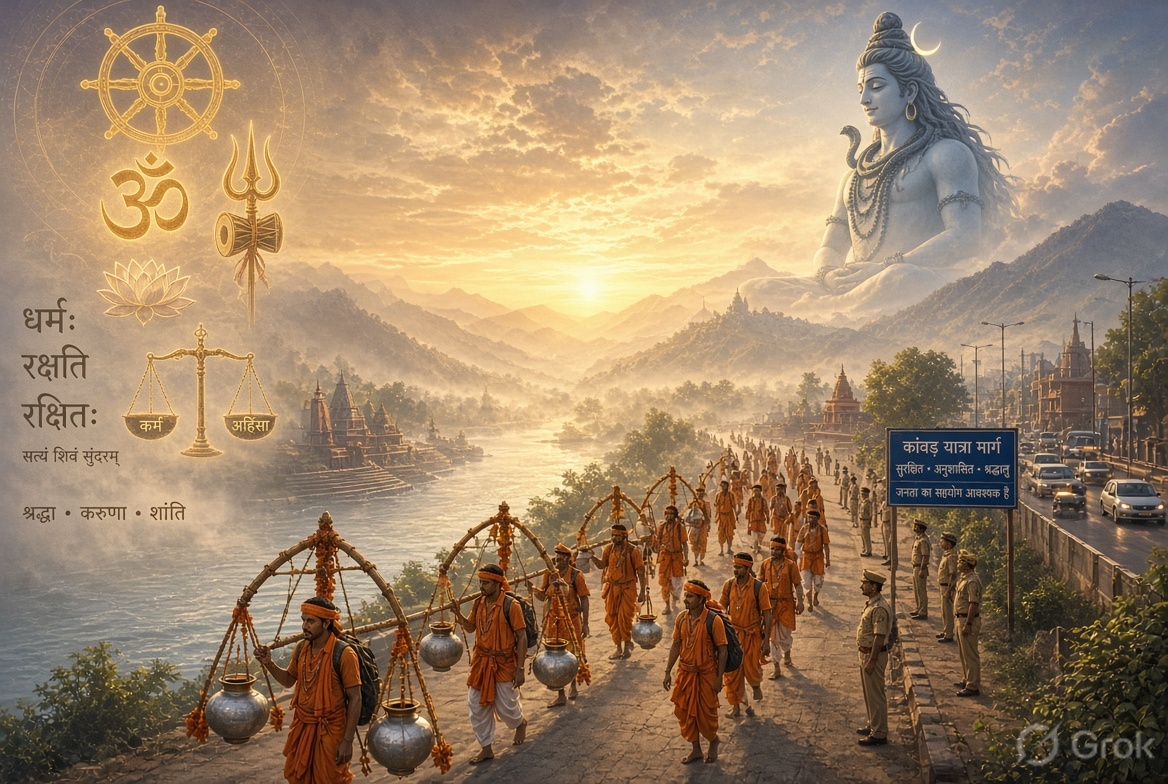
The Kanwar Yatra is one of the largest pilgrimages in the world. Every year, millions of devotees undertake an arduous journey, often barefoot, to collect the sacred waters of the Ganga and offer them to Lord Shiva during the holy month of Shravan. Popular tradition also associates the spirit of carrying the Kanwar with the story of Shravan Kumar, whose devotion towards his aged parents became an enduring symbol of duty and sacrifice. The pilgrimage concludes around Raksha Bandhan, a festival celebrating one of the most sacred human relationships.
At its heart, the Kanwar Yatra is a magnificent expression of faith. Thousands walk hundreds of kilometres in silence and discipline, carefully preserving the sanctity of the sacred water they carry. Their endurance deserves admiration. Their devotion deserves respect.
Yet every year another image also emerges.
Images of damaged vehicles, frightened commuters, blocked highways, reckless motorcycle processions, deafening music, traffic violations and occasional acts of vandalism raise uncomfortable questions. The overwhelming majority of pilgrims remain peaceful. That deserves acknowledgment without hesitation. Yet repeated incidents involving a small section of participants cannot simply be dismissed as isolated aberrations.
The real question, therefore, is not about the Kanwar Yatra.
It is about the transformation of devotion into display.
Lord Shiva is not merely one of the principal deities of Hinduism. He is Mahayogi—the supreme ascetic who conquered anger, desire and ego through meditation. His greatness lies in inner stillness rather than outward display. His silence speaks louder than slogans. His renunciation is greater than power.
How then does a pilgrimage dedicated to Shiva become associated, in some places, with noise, intimidation and public disorder?
Perhaps the most neglected aspect of this phenomenon is the changing profile of a section of the participants. Many of the most visible processions are dominated by young men. There is nothing objectionable about youth embracing religion. Indeed, every civilisation depends upon its younger generation carrying forward its spiritual traditions.
Yet devotion must never become performance.
One cannot help wondering what motivates some among these young participants. Why do certain processions resemble carnivals rather than pilgrimages? Why the obsession with overpowering sound systems, dangerous motorcycle stunts and aggressive displays of identity? Why should a journey meant to cultivate humility become an occasion for demonstrating strength?
It would be unfair to question the sincerity of every pilgrim. Millions undertake the Yatra with remarkable discipline, sacrifice and reverence. But it would be equally unwise to ignore the possibility that, for a small section, the pilgrimage has become an outlet for excitement, peer recognition or public visibility rather than inward spiritual growth.
This is not merely a question about religion. It is also a question about the values that society rewards.
Young minds naturally seek identity, purpose and recognition. When society celebrates humility, service and knowledge, those virtues flourish. But when noise attracts more attention than discipline, and public display earns greater admiration than quiet devotion, the very character of religious practice begins to change.
That is where the responsibility of the State becomes crucial.

A democratic government must facilitate every peaceful religious practice. It must protect every citizen’s freedom to worship according to conscience. But it must do so without compromising the rule of law. Religious freedom cannot become immunity from civic responsibility.
When governments shower flower petals from helicopters, organise elaborate official receptions and deploy enormous administrative resources to facilitate religious processions, they simultaneously owe society something even more important—a clear and unequivocal message that vandalism, intimidation and traffic indiscipline have no place in any pilgrimage. Respect for faith and respect for law must travel together.
Political patronage must never dilute constitutional responsibility. The State honours religion best not by overlooking misconduct, but by ensuring that every act of devotion remains worthy of the ideals it claims to represent.
The greatest irony is that such conduct contradicts the very philosophy of Sanatan Dharma.
Sanatan Dharma was never merely a collection of rituals. It is a way of life dedicated to self-realisation. Its highest aspiration is not public display but liberation through the knowledge of the Self.
The great sage Yajnavalkya, one of the towering philosophers of the Upanishads, taught that the ultimate truth cannot be realised through outward appearances alone. His celebrated doctrine of Neti, Neti—”Not this, not this”—reminds us that Brahman, the Infinite, cannot be confined within external forms. God is not discovered by making more noise outside. He is realised by creating greater silence within.
Measured against that standard, the success of a pilgrimage cannot be judged by the distance travelled or the quantity of sacred water carried. It must be judged by a far simpler question:
Has the journey transformed the pilgrim?
If the answer is no, then the feet may have reached the temple while the mind remains untouched.
The truest offering to Shiva is not merely Ganga water poured upon the Shivling. It is anger surrendered, ego conquered, compassion practised and discipline observed. Society itself is the living manifestation of the divine. To disturb it in the name of religion is to misunderstand religion itself.
As India prepares to celebrate another Independence Day, perhaps this is also a moment to remember that freedom and discipline are not opposing values; they are complementary ones. The strength of a civilisation is measured not merely by the passion of its faith but by the character with which that faith is lived. A nation that reveres Shiva must also strive to emulate his serenity, restraint and compassion.
India does not need less faith.
It needs deeper faith.
It does not need louder pilgrimages.
It needs quieter consciences.
For the ultimate destination of every pilgrimage is not the temple.
It is the transformation of the traveller.