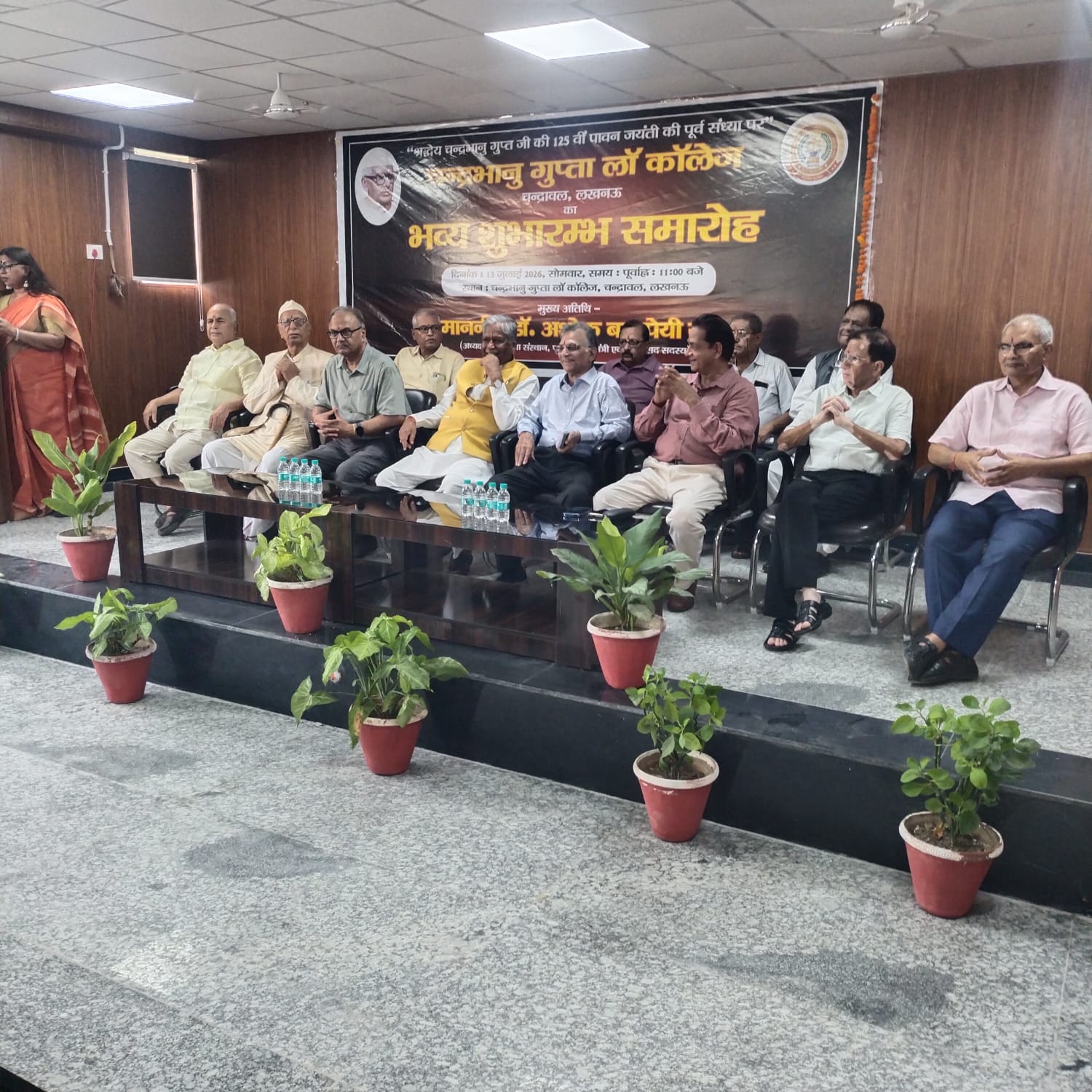
Lucknow: A new law college dedicated to the memory of veteran freedom fighter and former Uttar Pradesh Chief Minister Chandra Bhanu Gupta has been inaugurated in Lucknow as part of the centenary commemorations of the historic Kakori Train Action of August 9, 1925.
According to a press release issued by the Bharat Seva Sansthan, the institution’s Administrative Council unanimously resolved to establish Chandra Bhanu Gupta Law College under the leadership of its President, Dr. Ashok Bajpai, to pay tribute to Gupta’s contribution to India’s freedom movement. The initiative commemorates his courageous decision to file the first legal representation in support of the revolutionaries involved in the Kakori Train Action despite British colonial rule.

The college has been completed within a year of laying its foundation. It has received approval from the Bar Council of India and affiliation from Lucknow University to offer both the five-year integrated law programme and the three-year LL.B. course.
The inauguration ceremony was led by Dr. Ashok Bajpai, former Union Cabinet Minister, former Member of Parliament and President of Bharat Seva Sansthan. Admissions to the approved law programmes have now commenced.

The event was attended by several dignitaries, including Bharat Seva Sansthan General Secretary Dr. J.N. Mishra, Vice-President Arun Kumar, Treasurer N.K. Singh Chauhan, Rajesh Singh, Motilal Memorial Society General Secretary Rajesh Singh, Padma Shri awardee Dr. Rajendra Prasad, Dr. Madhu Gupta, Dr. T.P. Singh, Dr. Fida Husain Ansari, Dr. M.C. Bhatt, Narendra Mani Tripathi, Rajesh Agrawal, Principal Dr. Taj Mohammad, Assistant Faculty Member Kunwar Kushagra Srivastava, Garima, Sumit Kumar Singh, and College Manager Prof. S.P. Singh.
Speaking on the occasion, the organisers expressed confidence that Chandra Bhanu Gupta Law College would emerge as a leading centre for quality legal education in Uttar Pradesh. They said the institution aims to uphold the legacy of Chandra Bhanu Gupta while strengthening legal education and enhancing the state’s standing in the field of law.




 ---------------------------------------------------------------------------------------------------