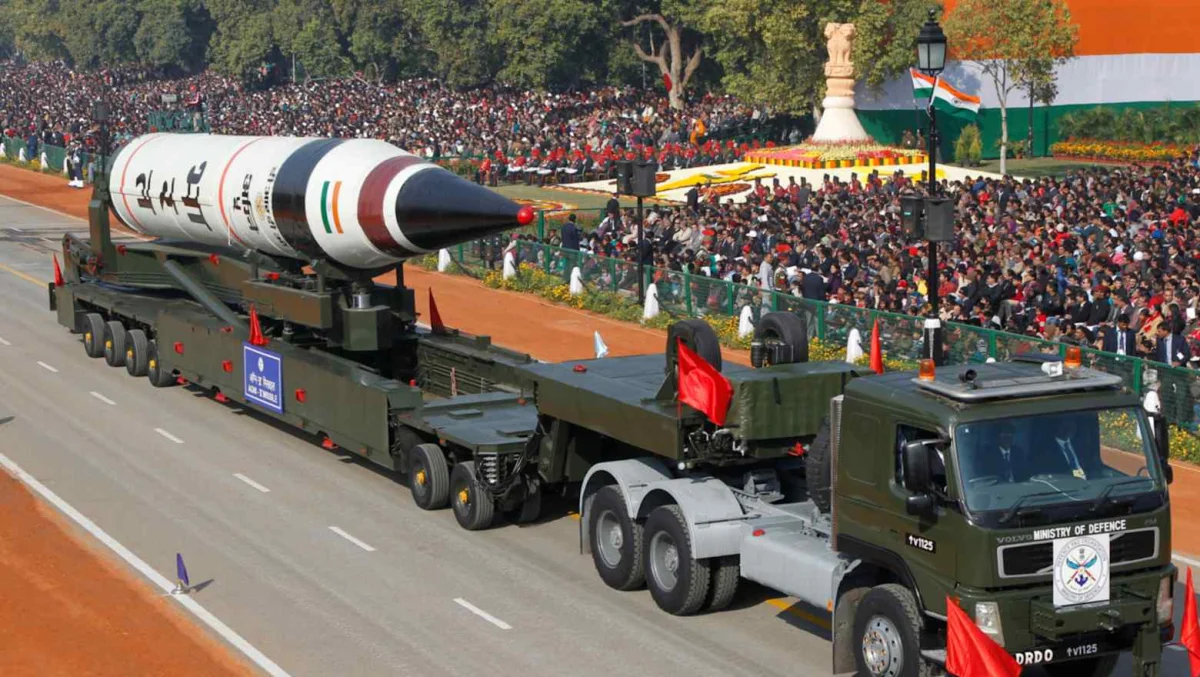
New Delhi: New Delhi’s strategic nuclear posture is undergoing a monumental shift. While Pakistan was historically the primary focus of India’s deterrence strategy, recent data from the Stockholm International Peace Research Institute (SIPRI) Yearbook 2026 underscores a different reality. The rapid expansion of China’s nuclear capabilities has become the primary catalyst driving India’s military modernization, prompting a decisive pivot toward long-range weapon systems capable of reaching deep into Chinese territory.
This evolving balance of power is starkly reflected in global inventories. According to the SIPRI Yearbook 2026, India’s nuclear stockpile has grown slightly to approximately 190 warheads, whereas Pakistan maintains a relatively stable arsenal of around 170. Meanwhile, China continues an aggressive expansion, possessing an estimated 620 nuclear warheads. This rapid buildup positions Beijing as the fastest-growing nuclear power globally, trailing only the United States and Russia. This disparity explains the evolution of India’s strategic deterrent over the past four decades. In the late 20th century, the Indian military relied on missiles with ranges under 2,000 kilometers to counter localized regional threats. However, by the 2010s, the focus shifted toward developing delivery systems with ranges exceeding 5,000 kilometers, effectively bringing the entire Chinese mainland within reach.
The China factor is a direct response to a complex and evolving security environment. Defense analysts frequently point to the historical legacy of the 1962 Sino-Indian War, unresolved territorial disputes along the Line of Actual Control, and Beijing’s deepening military ties with Islamabad. While Pakistan remains a permanent fixture in India’s defense planning, the imperative to deter China now shapes the development of advanced deterrents. The indigenous Agni missile series serves as the cornerstone of this modernization. While early iterations like the Agni-I and Agni-II countered regional threats, the Strategic Forces Command has increasingly inducted the Agni-IV and Agni-V. The Agni-V, a canisterized, solid-fueled missile with a range exceeding 5,000 kilometers, offers enhanced mobility and rapid launch capabilities, ensuring system survivability while holding distant strategic targets at risk.
Rather than pursuing a massive stockpile of warheads, India prioritizes technological superiority over raw numbers. Recent milestones include successful testing of Multiple Independently Targetable Re-entry Vehicle (MIRV) technology on the Agni-V platform under Mission Divyastra, with advanced tests conducted as recently as May 2026. This capability allows a single missile to strike multiple, distinct targets hundreds of kilometers apart, significantly amplifying its deterrence value. Simultaneously, India is reinforcing the maritime leg of its nuclear triad. The deployment of nuclear-powered ballistic missile submarines, such as the recently commissioned INS Aridhaman, ensures a highly survivable second-strike capability by keeping a portion of the arsenal undetected underwater.

This technological advancement aligns with a subtle change in operational posture. The SIPRI report highlights that India, which historically stored its nuclear warheads separate from delivery systems, may now occasionally deploy a small number of warheads mated to missiles during peacetime—estimated at around 12 warheads. While New Delhi strictly maintains its “No First Use” doctrine and credible minimum deterrence policy, this tactical adjustment reflects the realities of a changing regional security landscape. Despite these steps, India’s program remains distinct from global superpowers; the United States and Russia still control nearly 90 percent of the world’s nuclear weapons, and China’s arsenal remains over three times the size of India’s.
Ultimately, India’s defense strategy aims to maintain a credible, survivable force capable of inflicting unacceptable damage on an aggressor, avoiding a quantitative arms race in favor of sophisticated delivery mechanisms and long-range precision. This nuclear strategy forms part of a wider, multi-domain military modernization effort that includes conventional long-range precision weapons, aerospace platforms, cyber warfare capabilities, and advanced surveillance systems. As China expands its military footprint, New Delhi has adapted its priorities to view its strategic requirements through an Indo-Pacific lens, moving beyond the traditional South Asian security paradigm to establish a robust, integrated deterrence posture.