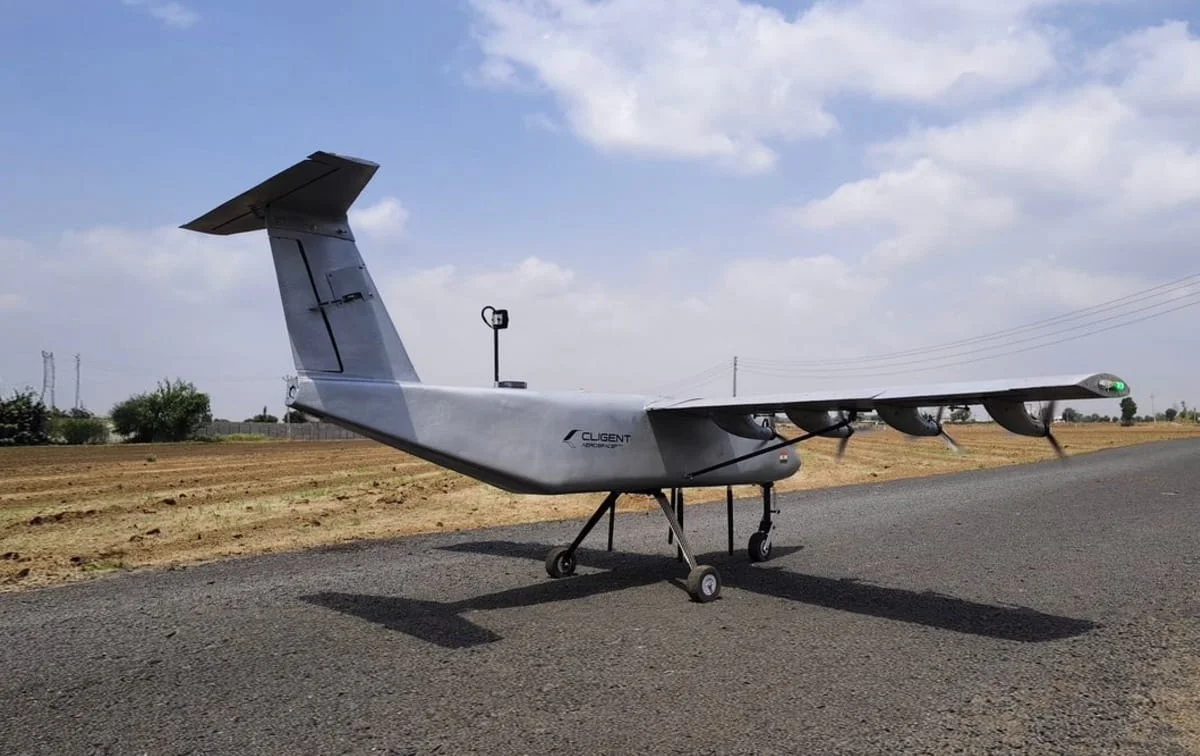
New Delhi: India’s aerospace sector has achieved a major milestone as Ahmedabad-based Cligent Aerospace successfully flight-tested a scaled version of its hybrid-electric eSTOL (electric Short Takeoff and Landing) aircraft. During the evaluation, the tech demonstrator took to the skies after rolling just 22 meters on an unpaved dirt track—a distance comparable to the length of two standard school buses.
While the platform currently serves as a technology demonstrator, this successful flight proves the viability of an innovative design aimed at reshaping regional civilian transport and introducing a brand-new class of tactical mobility for defense forces.
Uncompromising Performance in Harsh Conditions
The scaled model proved its ruggedness by performing flawless takeoffs and landings on raw, unprepared ground. Furthermore, it demonstrated high environmental resilience by operating in scorching 42-degree Celsius heat and navigating crosswinds of up to 30 kilometers per hour.
Early testing phases were supported by the aerodynamic infrastructure at Gujarat’s Parul University, where the startup first recorded its physical flight data. This trial highlights the immense capabilities of eSTOL technology, a rapidly advancing aviation category that merges distributed electric power with ultra-short runway capabilities. Traditional planes demand vast stretches of paved tarmac often spanning kilometers, whereas eSTOL aircraft are specifically built to utilize tiny airstrips, rough grass patches, unpaved tracks, and harsh environments completely lacking standard aviation infrastructure.
A Century of Collective Expertise
Cligent Aerospace was established by Parul University engineering graduates Harsh Joshi and Vivek Dhut, and incubated at the university’s PIERC facility. The company quickly assembled a highly skilled workforce featuring veterans from leading aviation and defense giants such as Airbus, Lockheed Martin, HAL, and ATR.
This collective pool of over a hundred years of aerospace expertise has allowed the budding company to fast-track the creation of complex aviation systems that typically take legacy institutions decades to develop.
The Vision for the Full-Scale CL1000
The ultimate goal for the startup is the mass production of the CL1000, a full-scale hybrid-electric aircraft designed to transport up to nine passengers or roughly 1,500 kilograms of freight across distances of nearly 1,000 kilometers. The most striking feature of the planned CL1000 is its target to operate from runways shorter than 150 meters, effectively unlocking air travel for countless remote locations that current regional planes cannot reach. The company aims to begin commercial operations of the CL1000 by 2029.
While purely electric planes are currently limited by the heavy weight and low energy capacity of modern batteries, the CL1000 circumvents this issue by using a hybrid-electric layout. The system relies on eight distributed electric motors for propulsion, backed up by an internal power generator to drastically extend flight time.
This engineering choice combines the environmental and efficiency perks of electric flight with the necessary range provided by traditional energy sources, directly solving the energy density problems holding back fully battery-powered aviation today. The startup anticipates that their hybrid approach will drastically lower the financial burden of flying, with early projections suggesting the CL1000 could eventually run at a fraction of a cent per mile. Given that fuel consumption makes up nearly 40 percent of a regional airline’s budget, this massive leap in efficiency promises to make short-haul flights much more profitable and accessible.

Activating Dormant Infrastructure
This recent dirt-track flight test marks the completion of a vital first step in Cligent’s long-term business plan. With the scaled-down model now proven, the engineering team is moving to build a full-size electric prototype. From there, they will incorporate the full hybrid system, aiming to secure certification and deliver a market-ready aircraft to customers worldwide.
More than just an engineering feat, this aircraft tackles a major physical barrier within the Indian aviation landscape. Despite India ranking as the world’s third-largest domestic aviation market and growing faster than any other, deep rural areas remain disconnected from the skies. High-altitude mountain zones, coastal islands, distant border settlements, and disaster-vulnerable regions are frequently cut off simply because building massive concrete airports in these areas is too expensive and logistically impossible.
Interestingly, India is already home to over 450 underutilized or completely abandoned small airstrips scattered nationwide. By deploying an aircraft that can safely take off and land on these forgotten, unpaved runways, India could instantly activate a massive new regional transport web without spending billions on laying new concrete.
Strategic and Tactical Applications
The CL1000 is custom-built to fill this exact gap in the market. Its versatile, modular interior is designed to handle passenger flights, heavy cargo hauling, urgent medical evacuations, and disaster relief—tasks that standard planes either cannot physically perform or cannot do without losing money. Validating this business model, the company has already secured significant pre-orders and multi-million-dollar memorandums of understanding from regional logistics firms eager for a viable short-runway solution.
Although the commercial aviation market offers massive revenue potential, the strategic defense applications for this hybrid-electric technology are just as critical and far-reaching. Today’s armed forces require flexible air assets that can launch from hidden, rough terrains rather than relying on vulnerable, well-known military airbases.
Because standard transport planes need long, smooth runways, they are often useless for directly supplying frontline troops. A rugged aircraft that can haul soldiers, ammunition, and medical gear in and out of tight, unpaved clearings gives military commanders a powerful new tool for tactical supply chains.
Beyond saving fuel, the hybrid-electric design provides unique tactical benefits on the battlefield. Because electric motors are significantly quieter than loud, traditional combustion engines, the aircraft possesses a much lower acoustic footprint, making it harder for hostile forces to detect during stealthy resupply runs. Additionally, electric powertrains have far fewer moving parts, which points toward fewer mechanical breakdowns and much easier maintenance in harsh combat environments.