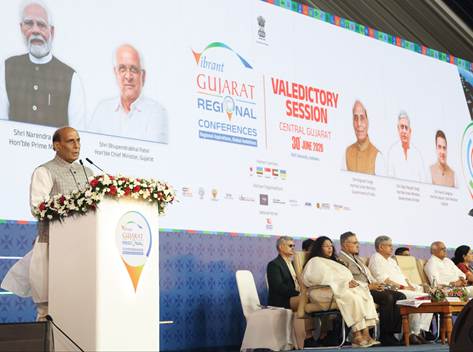
Vadodara: Defence Minister Rajnath Singh has called upon regional industries, entrepreneurs, innovators, and academic institutions to play a central role in India’s transformation into a developed nation, emphasizing that local strengths must be converted into national capabilities and global competitiveness.
Addressing the Vibrant Gujarat Regional Conference in Vadodara, the Defence Minister said that the vision of Viksit Bharat 2047 extends beyond economic growth and aims to create a technologically advanced, economically prosperous, and socially empowered nation.
“Regional industries must become active partners in the Viksit Bharat journey. Our goal is to transform regional strengths into national capabilities, local innovations into global competitiveness, and industrial growth into strategic national strength,” he said.
The event was attended by Bhupendra Patel, Union Minister Rajiv Ranjan Singh, and Gujarat Minister Manisha Vakil, among other dignitaries.
Economic Strength, Technology and Security Go Hand in Hand
Highlighting the changing global geopolitical environment, Rajnath Singh stressed that India’s future role on the world stage will depend on its ability to strengthen self-reliance, technological capability, and national resilience.
He described economic power, technological advancement, and national security as the three pillars upon which great nations are built.
According to the Defence Minister, economic prosperity fuels technological innovation, technological advancement strengthens national security, and a secure nation creates the stability necessary for industries and businesses to thrive.
He urged industry leaders and innovators to collaborate more closely with the government to build a strong and secure India capable of meeting future challenges.
Defence Sector Emerging as a Growth Engine
Rajnath Singh noted that the defence sector today is far more than a strategic necessity and has evolved into a major catalyst for economic growth, employment generation, and technological innovation.
He explained that defence corridors and manufacturing ecosystems are creating opportunities across infrastructure, logistics, research, advanced engineering, and industrial development.
The minister highlighted the remarkable transformation of India’s defence industry over the past decade, noting that the country has moved steadily from being one of the world’s largest defence importers toward becoming a significant manufacturing and export hub.
“India is no longer viewed only as a buyer of defence equipment. Today, indigenous platforms, private-sector participation, start-ups, and innovation-driven enterprises are helping build a robust defence ecosystem,” he said.
Indigenous Defence Production Reaches New Highs
Showcasing the impact of government initiatives under the Aatmanirbhar Bharat and Make in India programmes, Rajnath Singh said that domestic defence production has reached an all-time high of ₹1.78 lakh crore, compared to approximately ₹46,000 crore in 2014.
He also highlighted the sharp rise in defence exports, which have grown from less than ₹1,000 crore a decade ago to a record ₹38,424 crore, reflecting India’s expanding presence in the global defence market.
The Defence Minister credited policy reforms, industry-friendly regulations, and innovation-focused initiatives for this growth.
He pointed to measures such as the Technology Development Fund, reforms in defence procurement procedures, simplified licensing systems, liberalized foreign direct investment norms, and platforms such as the Srijan Portal and iDEX that have encouraged participation from MSMEs and start-ups.
Self-Reliance Does Not Mean Isolation
Addressing concerns that self-reliance could lead to protectionism, Rajnath Singh clarified that India’s approach to self-sufficiency is based on partnership rather than isolation.
“Aatmanirbharta does not mean shutting ourselves off from the world. It means standing firmly on our own feet and engaging globally as an equal and confident partner,” he said.


He emphasized that India continues to encourage technology transfers, joint ventures, and collaborations with global Original Equipment Manufacturers (OEMs) while ensuring that manufacturing capabilities and technological expertise are developed within the country.
Gujarat Positioned as a Defence Manufacturing Hub
The Defence Minister identified Gujarat as one of the states best positioned to contribute to India’s self-reliance ambitions due to its strong industrial ecosystem, skilled workforce, and entrepreneurial culture.
He cited the Tata-Airbus C-295 Aircraft Manufacturing Facility as a landmark project that is strengthening India’s aerospace manufacturing capabilities.
He also highlighted the production of the advanced K-9 Vajra artillery platform in Gujarat, describing it as a significant contribution to India’s defence preparedness.
According to Rajnath Singh, Gujarat possesses all the essential ingredients required to emerge as a major centre for defence production, aerospace technology, and advanced manufacturing.
Semiconductors and Emerging Technologies Key to Future Growth
The Defence Minister underlined the strategic importance of semiconductors, describing them as the foundation of future warfare and economic competitiveness.
He expressed confidence that the semiconductor ecosystem being developed in Sanand and Dholera would play a crucial role in strengthening India’s technological sovereignty.
From artificial intelligence and quantum computing to cybersecurity and space technology, he said, the growth of semiconductor manufacturing would support critical sectors across the economy and defence landscape.
Leveraging Gujarat’s Industrial Strengths
Rajnath Singh outlined several areas where Gujarat’s existing industrial capabilities could directly support the defence sector.
The state’s strong chemicals and petrochemicals industry, he noted, can contribute significantly to advanced materials, propellants, and defence-grade composites. Its electronics sector can support the development of avionics, sensors, and communication technologies, while Gujarat’s ports and shipbuilding infrastructure can strengthen naval manufacturing and maritime security initiatives.
He also highlighted opportunities in renewable energy and green hydrogen, which are expected to play an increasingly important role in next-generation defence technologies.
Industry and Academia Engagement
During the conference, the Defence Minister interacted with representatives from industry, academia, start-ups, and research institutions during a dedicated seminar on defence and aerospace manufacturing.
He reaffirmed the government’s commitment to creating a more supportive environment for innovation, research, and industrial growth, enabling Indian enterprises to contribute more effectively to national development and security objectives.
The event was attended by senior scientists and defence experts, including Chandrika Kaushik, who participated in discussions on strengthening India’s defence manufacturing ecosystem.
Vibrant Gujarat Continues to Expand
The conference forms part of a broader series of regional events being organized under the Vibrant Gujarat initiative, originally launched in 2003 under the leadership of Narendra Modi during his tenure as Chief Minister of Gujarat.
Over the years, Vibrant Gujarat has evolved into one of India’s premier platforms for investment promotion, business networking, innovation, and strategic partnerships.
The regional conferences aim to showcase local strengths, accelerate grassroots development, and align regional aspirations with the long-term goals of Viksit Bharat 2047 and Viksit Gujarat 2047, creating a roadmap for inclusive and sustainable growth across sectors.













 https://www.youtube.com/watch?si=RtToJsBhYBatUrym&v=mOuYNSdhjHA&feature=youtu.be