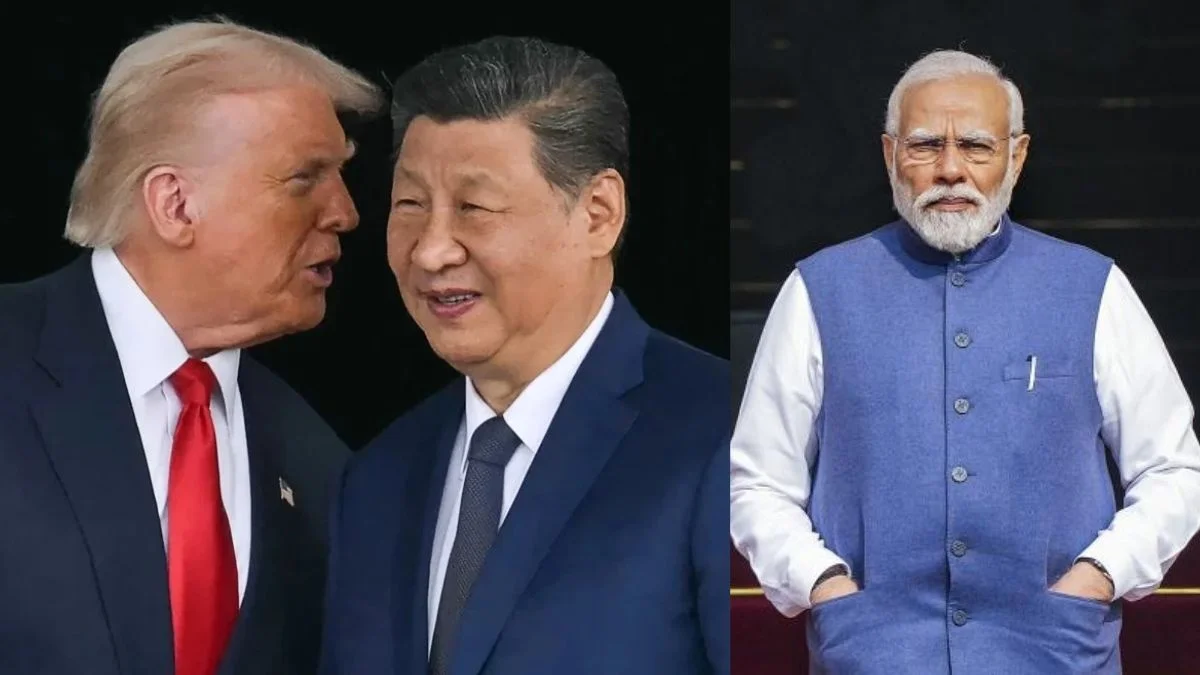
Beijing/ Washington: As diplomatic engagement between the United States and China gains momentum once again, global attention is increasingly focused on how improving ties between the world’s two largest powers could reshape international politics, trade and security dynamics. Discussions surrounding dialogue and possible understandings between Donald Trump and Xi Jinping have triggered both optimism and concern across the geopolitical landscape.
Many economists believe that easing tensions between Washington and Beijing could help stabilise the global economy by reducing trade disruptions, inflationary pressures and strategic uncertainty. However, several geopolitical experts also warn that closer cooperation between the two superpowers may gradually lead to a world order increasingly influenced by a handful of dominant nations, potentially limiting the strategic space available to developing countries such as India.

The United States and China together account for a significant share of the global economy and hold enormous influence over international trade, technology, finance, energy markets and geopolitical decision-making. In recent years, trade wars, tariff disputes, tensions over Taiwan and technology restrictions between the two nations created instability in global markets. The aftermath of the COVID-19 pandemic, the Russia-Ukraine conflict and continuing tensions in West Asia further intensified economic uncertainty worldwide.
Analysts believe that any reduction in hostility between the two powers could provide relief to global supply chains, improve investor confidence and lower manufacturing and technology costs. Yet concerns remain that a deeper strategic alignment between Washington and Beijing could lead to a “G-2” style global framework, where major economic and political decisions are increasingly shaped by the interests of the two superpowers.
For India, this evolving geopolitical scenario presents both opportunities and strategic challenges. New Delhi has consistently pursued a policy of strategic autonomy, maintaining strong ties with the United States while also managing a complex relationship with China despite longstanding border tensions.
India’s growing defence, economic and technological cooperation with the U.S., including its participation in platforms such as the Quad, has strengthened its global standing. At the same time, China remains one of India’s largest trading partners, making the balance between competition and cooperation particularly delicate.
Experts point out that India’s biggest opportunity lies in the “China Plus One” strategy being adopted by several multinational corporations seeking to diversify manufacturing and supply chains away from China. If India accelerates reforms in infrastructure, manufacturing, logistics and technology, it could emerge as a major global investment destination. However, delays in industrial and policy reforms may allow competing economies such as Vietnam and other Southeast Asian nations to capture these opportunities.

The technological race between the U.S. and China is also expected to have a direct impact on India. Areas such as artificial intelligence, semiconductors, cyber security, quantum computing and rare earth minerals are increasingly becoming central to global strategic competition. Analysts believe India has the talent and market potential to emerge as an alternative technology hub, but achieving that goal would require sustained investments in research, innovation and higher education.
Geopolitically, developments in regions such as Taiwan, the South China Sea, Eastern Europe and West Asia continue to shape the broader strategic environment. Improved U.S.-China understanding could reduce the risk of direct military confrontation, potentially stabilising global energy prices — a major advantage for energy-importing nations like India.
At the same time, strategic observers caution that any attempt by major powers to dominate global decision-making could weaken the role of emerging and middle powers in international institutions.
India’s foreign policy approach is therefore expected to remain focused on balancing strategic partnerships while reinforcing its leadership role among developing nations and the Global South. During its G20 presidency, India promoted the vision of “One Earth, One Family, One Future,” positioning itself as a supporter of multilateralism, dialogue and inclusive global development.
Experts note that unlike the power-centric rivalry often associated with Washington and Beijing, India’s global approach has largely emphasised cooperation, democratic values, economic development and strategic balance. In an increasingly uncertain international order, India’s ability to strengthen its economic resilience, technological capability and diplomatic influence is likely to play a decisive role in defining its future global standing.