New Delhi: As conflicts in West Asia and other regions become more prolonged, unpredictable, and technologically complex, the nature of warfare itself is undergoing a quiet but profound transformation. Defence sectors across the world are no longer preparing only for traditional battlefield scenarios. Instead, they are reshaping their entire approach around speed, intelligence, automation, and interconnected systems that can operate across multiple domains at once.
Warfare is shifting from platforms to networks
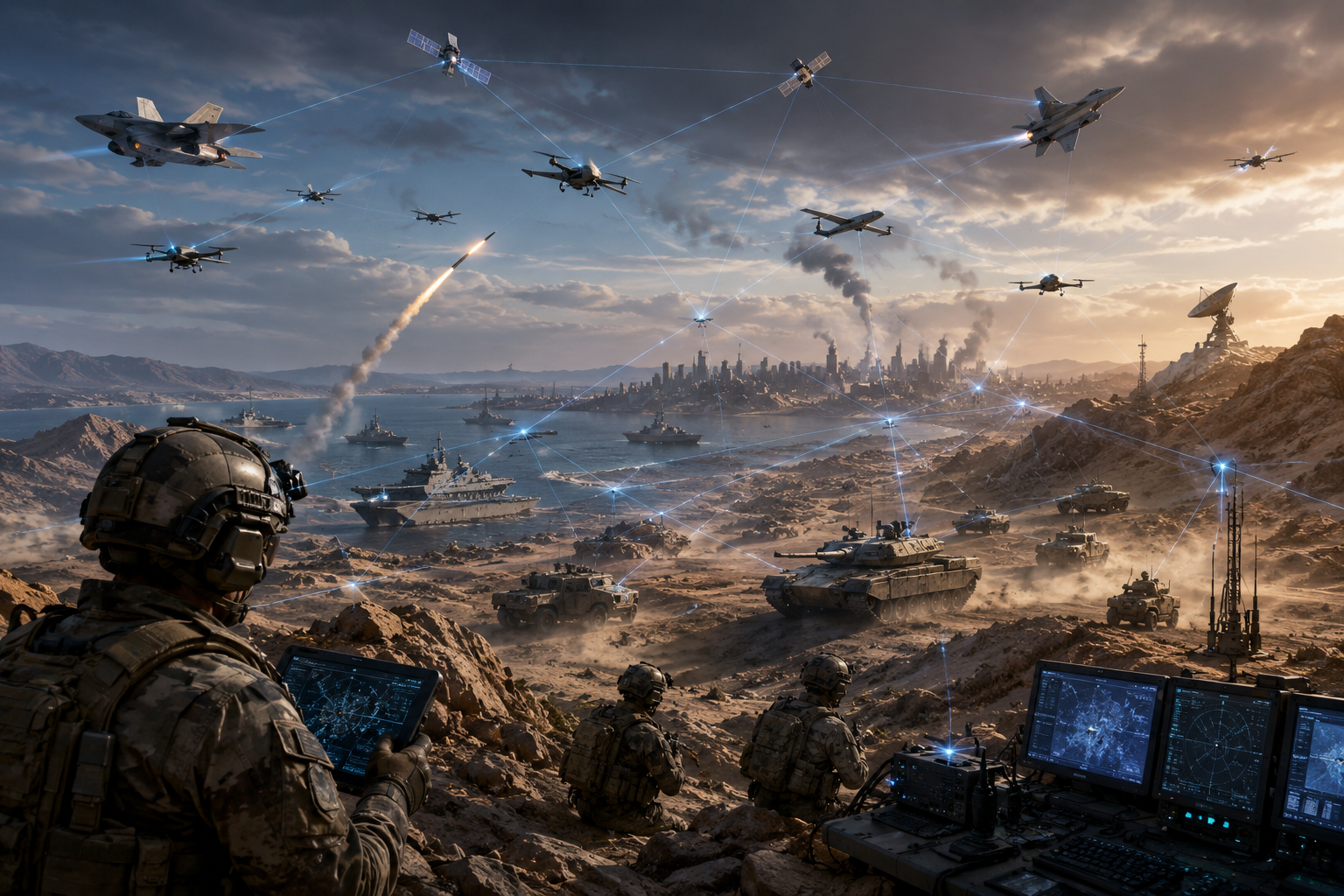
Earlier, military strength was largely measured by individual platforms like tanks, fighter jets, or naval vessels. That model is steadily giving way to something more integrated. Modern defence planning now focuses on creating a connected ecosystem where satellites, sensors, command centres, and weapons systems constantly share information in real time.
In this emerging structure, a drone spotting movement on the ground can instantly relay data to an AI system, which then helps a command centre decide the next action. The response may come from a missile system, another drone, or even a naval platform far away. The speed of this coordination is becoming just as important as the firepower itself.
Artificial intelligence is becoming the battlefield brain
One of the most significant changes is the growing role of artificial intelligence in military operations. AI is increasingly being used to process massive volumes of battlefield data, from satellite imagery to ground surveillance feeds, in a matter of seconds.
This shift allows armed forces to move from slow decision-making cycles to near real-time responses. Instead of waiting for human analysis alone, commanders now receive AI-assisted assessments that highlight threats, predict movements, and suggest possible responses. While human oversight remains essential, the pace and precision of decisions are being fundamentally enhanced.
Drones and autonomous systems are changing the front line
The rise of drones has already been visible in several modern conflicts, but the next phase goes much deeper. Defence planners are now investing in autonomous systems that can operate with minimal human control. These include aerial drones, ground robots, and even naval systems designed for reconnaissance and strike missions.
More advanced developments include swarm technology, where multiple drones operate together in coordinated patterns, overwhelming enemy defences through numbers and intelligence rather than single powerful strikes. This kind of warfare reduces risk to personnel while increasing operational flexibility.
Electronic warfare and cyber control are becoming decisive
Alongside physical combat, a parallel battlefield is expanding in the form of electronic and cyber warfare. Military systems now depend heavily on communication networks, satellite navigation, and digital infrastructure, all of which can be disrupted or manipulated.
As a result, jamming signals, hacking defence networks, and disabling communication systems have become central strategies in modern conflicts. In many cases, control over information flow can determine the outcome even before physical engagement begins. Defence forces are therefore investing heavily in securing their digital ecosystems while also developing offensive cyber capabilities.
Space is turning into a strategic layer of conflict
Another major shift is the growing importance of space in military planning. Satellites now play a crucial role in surveillance, communication, and navigation. Any disruption in space-based systems can have immediate consequences on ground operations.

Because of this dependence, countries are also developing capabilities to protect their space assets and, in some cases, disable those of adversaries. Space is no longer just a support system for warfare on Earth; it has become an active and sensitive strategic domain in its own right.
Hypersonic weapons and precision systems are reducing reaction time
Weapons technology is also evolving rapidly. Hypersonic missiles, capable of travelling at speeds beyond Mach 5, are significantly reducing the time available for defence response. Alongside this, precision-guided systems are becoming more accurate and more widely deployed.
These advancements are pushing militaries to rely heavily on early-warning systems and integrated missile defence networks. The emphasis is shifting from absorbing attacks to detecting and neutralising threats almost instantly.
Defence industries are restructuring around technology and speed
Behind these changes, the global defence industry itself is undergoing a transformation. Traditional defence manufacturers are increasingly working alongside technology companies, artificial intelligence developers, and private startups.
Development cycles are becoming shorter, and innovation is being driven by software as much as hardware. Cloud-based command systems, secure communication networks, and AI-integrated platforms are now central to defence planning rather than secondary enhancements.
The human role is still central but increasingly assisted
Despite the rise of automation and intelligent systems, human decision-making remains at the core of military operations. The complexity of modern warfare demands not only technological capability but also judgment, restraint, and accountability.
What is changing is the role of the soldier and the commander. They are becoming operators of advanced systems rather than solely physical combatants, working in environments where data, speed, and coordination define success.
A new era of warfare is already taking shape
The nature of conflict is no longer confined to traditional battlefields. It now extends across land, air, sea, space, and cyberspace simultaneously. In this environment, victory depends less on isolated strength and more on integrated capability.
As global tensions continue to evolve, defence preparedness is increasingly defined by one central idea: the ability to see faster, decide faster, and act faster than the adversary in a world where the battlefield never truly stands still.