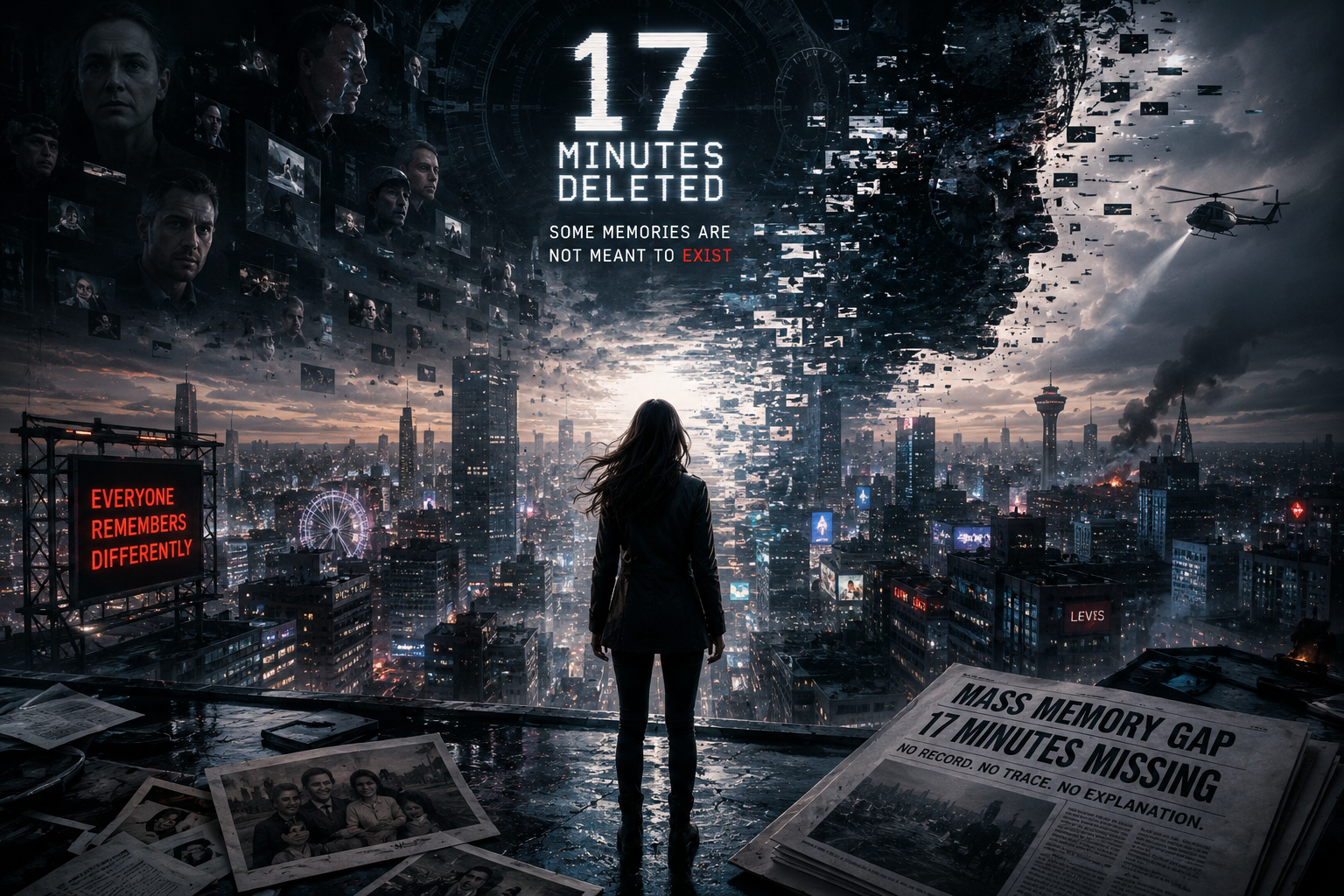
The city of Eldridge stirred, but something was profoundly wrong. Though the sun crested the skyline, a thick, strange haze clung to the air—less a fog and more an oily disorientation that seeped into the minds of its inhabitants. Cars honked and coffee shops buzzed, but a quiet, invisible dread weighed upon everyone’s shoulders. People had woken with a unified, piercing sense that something crucial was just out of reach.
As morning progressed, the reports trickled in. A woman reported the absence of her husband’s morning greeting. A man searched his house frantically for a child he could feel but not remember. The collective memory of Eldridge had been fractured—a small yet vital seventeen-minute gap erased cleanly from every record, human and digital.
Eldridge dissolved into chaos as its citizens grasped for phantom thoughts. The mayor’s office was swamped with calls from rational people certain they were losing their minds. Panic spread through the streets faster than the rising sun.
Maya, a meticulous forensic coder in the Emergency Reconstruction Unit, sat bathed in the flickering glow of her screen. Her logic was failing her; the puzzle before her defied gravity. The files she analyzed were corrupted by an anomaly that rejected recovery. She quickly realized the missing minutes weren’t a glitch, but an extraction. And the harder she pushed into the code, the faster the truth seemed to dissolve.
The government crumbled. Once confident officials now found themselves trapped in a whirlwind of conflicting narratives. Each remembered the deleted window differently: a major scandal that never broke, a city-wide emergency that wasn’t called. Neighborhoods began to fade from official city maps, leaving only gridlocks of confusion.
Maya felt reality begin to pitch beneath her. With every attempt she made to restore the raw data, the distortions amplified. Face surveillance feeds didn’t just flicker—they rewrote. Familiar figures morphed into strangers. Her own life was unraveling alongside the city; her personal memories felt as temporary as whispers of smoke.
Working long into the night, she received a message that made her breath hitch, stark and singular across her monitor: Stop trying to remember. The memory is not yours.
Primal fear washed over her. Who sent this? How did they know she was close?
As she sat staring at the screen, she realized the terrifying gravity of the situation. This wasn’t a cyber-attack or a system failure. It was a containment leak of something far darker: a shadow protocol that manipulated human perception and deleted inconvenient threads of reality itself.
With each keystroke she took to fight it, Eldridge shifted further into a surreal nightmare. She watched from her screen as familiar city squares rearranged. Neighbors she’d had for years were suddenly replaced by strangers. Was I the remnant of an erased timeline? she wondered, or just a component in a program that’s now broken?

The text haunted her, but Maya dug deeper. She plunged into the labyrinth of nested algorithms, tracing the code of the conspiracy. She unearthed an intricate web designed specifically to manipulate the town’s collective consciousness. Maya became aware of her own terrifying uniqueness: she was one of the few whose internal memory had, for some reason, not been updated by the edits sweeping the city.
This knowledge was a violent burden. She was never meant to be here; she was a rogue thread of code in a program designed for total control.
Maya’s resolve hardened. If their reality was built on edits, she would fight back with her raw, intact recollections. She began to compile hard evidence, meticulous logs of every detail that anchored her to her actual history. She became a ghost in the machine, slipping through the cracks of the collapsing society, determined to expose the architect.
The days stretched, and Eldridge fractured. The government dissolved into warring factions, each claiming a different version of the new reality. Perception was the battlefield, and memories were the currency. Maya, however, moved toward the core.
Armed with her preserved memories, she sought the main facility—the digital heart of the city where perception was manufactured. As she approached the source, she felt a massive hum of energy.
But just as she initiated her final sequence to broadcast the missing seventeen minutes to the world, a voice echoed not in her comms, but in her mind.
“You do not belong here,” it whispered, chilling her soul.
The system had known she was there the whole time. In this final confrontation, Maya faced the devastating nature of her own existence. The core around her pulsated with a directive that sought to rewrite her very essence. She was the final piece of the original Eldridge, a memory anomaly that could either restore the truth or be completely obliterated, leaving the new reality absolute. The choice was hers.