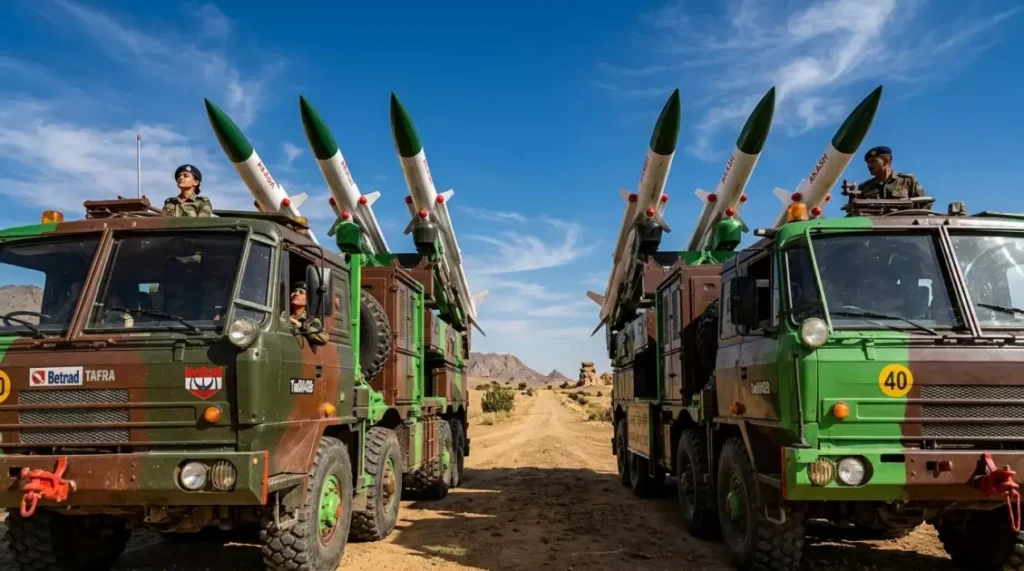
New Delhi: In a notable development for India’s private defence industry, Noida-based IG Defence is working on a fully indigenous short-range surface-to-air missile (SAM) system named Jwala, aimed at enhancing India’s battlefield air defence and rapid-response strike capabilities.
The project is being positioned as one of the country’s first privately developed short-range SAM systems, highlighting the expanding role of domestic private companies in advanced missile and aerospace technologies traditionally dominated by state-run agencies.

According to the company, Jwala is being designed as a rapid-reaction weapon system capable of engaging short-range aerial threats with high precision and operational flexibility. The missile uses solid-fuel propulsion, a configuration known for reliability, quick launch readiness, and reduced maintenance requirements.
This propulsion system is expected to enable fast deployment in combat situations where reaction time is critical, particularly against evolving airborne threats such as drones, helicopters, and low-flying tactical targets.
A major focus of the Jwala programme is precision guidance. The missile reportedly combines an advanced inertial navigation system with optimised terminal-phase guidance technologies to improve targeting accuracy during the final stage of engagement. Such capabilities are increasingly important in modern warfare, where precision strikes and minimal collateral impact are key operational requirements.
The system is also being engineered for all-weather deployment across diverse operational environments, including desert terrain, plains, and high-altitude sectors. Its ruggedised design is intended to ensure consistent performance under harsh battlefield conditions and extended operational use.
One of Jwala’s distinguishing features is its modular launch architecture. The missile system is being developed for both vehicle-mounted and fixed-launch deployment configurations, offering flexibility in battlefield integration and tactical mobility.
This adaptability could allow the system to support multiple mission profiles, ranging from mobile frontline air defence to static protection of strategic assets and sensitive infrastructure.
IG Defence has stated that the project is entirely indigenous in design and manufacturing, incorporating proprietary control systems and a secured domestic supply chain. The company describes the programme as part of its broader “built in Bharat for Bharat” vision, while also indicating long-term export potential for friendly international markets.


Although the company has not yet disclosed detailed specifications such as engagement range, speed, or warhead configuration, it has confirmed that the missile is being equipped with a dedicated combat warhead tailored for short-range interception roles.
Timelines related to testing, user trials, or eventual induction into the armed forces have not been officially announced, suggesting that the programme remains in an active developmental stage.
Alongside the Jwala initiative, IG Defence is also pursuing other indigenous strike and loitering munition programmes. These include the KAL loitering munition, reportedly designed for long-range missions, as well as a turbojet-powered loitering system intended for shorter-range tactical applications.
Together, these projects reflect the growing ambition of India’s private defence sector to participate in advanced weapons development, an area once largely restricted to organisations such as the Defence Research and Development Organisation.
Defence analysts view the Jwala programme as part of a broader transformation in India’s military-industrial landscape, where private firms are increasingly contributing to innovation, rapid prototyping, and indigenous capability development.
The initiative also aligns closely with the government’s Aatmanirbhar Bharat strategy, which seeks to reduce dependence on imported defence systems while building a self-sustaining domestic defence manufacturing ecosystem.
If successfully developed and inducted, Jwala could become an important addition to India’s layered air defence network and further strengthen the country’s push towards technological self-reliance in critical military systems.












 https://www.youtube.com/watch?si=RtToJsBhYBatUrym&v=mOuYNSdhjHA&feature=youtu.be