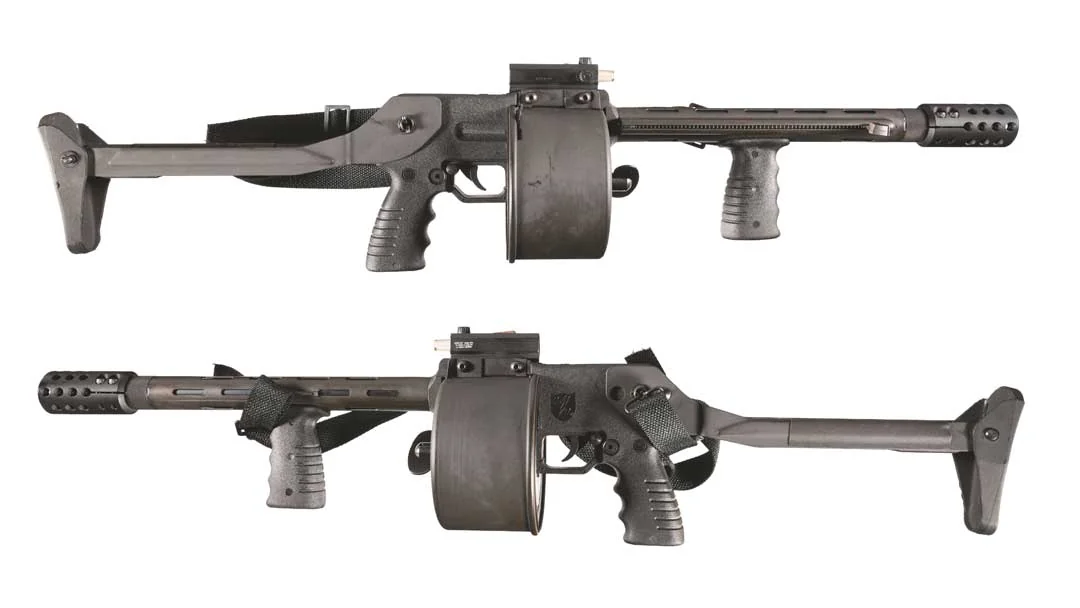
Bengaluru: In a significant boost to India’s indigenous defence manufacturing capabilities, Bengaluru-based SSS Defence has delivered the first batch of its locally developed T-12 semi-automatic shotguns to the Indian Army.
The induction marks another step forward in the country’s push for self-reliance in military technology under the Atmanirbhar Bharat initiative, while also reflecting the Army’s increasing focus on counter-drone warfare and specialised tactical operations.

The 12-gauge T-12 shotgun has reportedly been inducted into operational units, including formations under the Northern Command. Designed and manufactured in India, the weapon has already undergone field evaluations for counter-unmanned aerial system (CUAS) operations, where it demonstrated effectiveness against low-flying drones.
According to the manufacturer, the T-12 is equipped with a 20-inch nitride-coated barrel that enhances durability and corrosion resistance in demanding operational environments. The shotgun is compatible with both five-round and ten-round detachable magazines and includes a full-length Picatinny rail for mounting optics and accessories, allowing adaptability across a range of combat scenarios.
Weighing approximately 3.8 kilograms, the system is intended to provide a balance between mobility and firepower. Its ergonomic design includes ambidextrous controls and an adjustable buttstock with cheek support, making it suitable for a wide variety of operators and mission requirements.
One of the notable aspects of the T-12 programme is its emphasis on commonality with other SSS Defence weapon platforms. Several internal design elements and components are aligned with the company’s assault rifles and sniper systems, helping simplify logistics, maintenance, and operator training for security forces.
The upper and lower receivers are manufactured using high-strength 7075-T6 aluminium alloy, a material widely used in aerospace and defence applications for its strength-to-weight ratio. This construction helps keep the weapon lightweight without compromising structural integrity.
The Indian Army’s interest in the T-12 has been driven in part by the growing threat posed by small drones and first-person-view (FPV) unmanned systems in modern conflicts. Lessons emerging from the Russia–Ukraine war have demonstrated how shotguns can serve as an effective and low-cost solution against low-altitude drones, particularly quadcopters.

During trials, the T-12 reportedly succeeded in neutralising a drone target at a range of around 90 metres. The spread pattern generated by shotgun ammunition increases the probability of damaging drone propellers or onboard systems, making such weapons useful in close-range anti-drone defence.
Globally, several armed forces have begun adapting semi-automatic shotguns for similar roles. Systems such as the Benelli M4 Drone Guardian and Turkish-origin tactical shotguns have seen increasing attention in counter-drone applications, particularly in conflict zones where low-cost aerial threats have become widespread.
The T-12 was also showcased at the Northtech Symposium 2026 in Prayagraj, where defence experts and military officials highlighted its versatility in both conventional and emerging combat environments.
Apart from counter-drone operations, the shotgun is expected to support roles such as close-quarters battle, perimeter defence, breaching operations, and convoy protection. SSS Defence is also reportedly working on future variants, including suppressed configurations designed for specialised missions.
The successful delivery of the first production batch reinforces the growing role of India’s private defence industry in supplying advanced military equipment. It also reflects the Indian Army’s increasing willingness to adopt domestically developed systems tailored to evolving battlefield needs.
With drone warfare reshaping tactical doctrines worldwide, the induction of the T-12 shotgun signals India’s effort to equip its forces with flexible and indigenous solutions capable of addressing both conventional and next-generation threats.