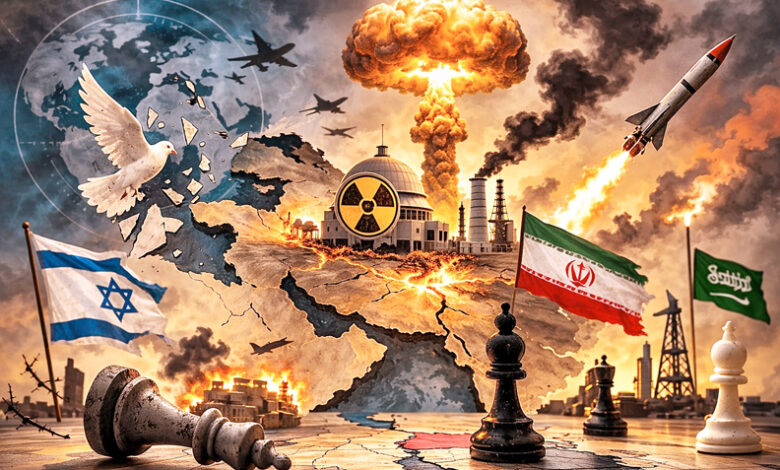
Delhi: The question of whether military intervention intended to halt nuclear proliferation might actually worsen it is gaining renewed relevance in today’s West Asian context. Nuclear weapons remain one of the most pressing challenges in modern international politics. Since the end of World War II, global efforts have focused on limiting the spread of nuclear arms, creating international treaties, monitoring mechanisms, and diplomatic frameworks. Yet, the debate persists: if a nation’s nuclear ambitions pose a regional or global threat, is pre-emptive military action justified? Critics argue such interventions can backfire, prompting other countries to pursue nuclear capabilities more aggressively.
The concept of a pre-emptive strike relies on neutralizing a threat before it fully materializes. If a state is developing nuclear capabilities, some powers may consider military action the safest way to prevent future conflict. In theory, this approach could avert larger wars. In practice, however, history shows that these strikes often fail to achieve long-term security and may even exacerbate tensions.

West Asia, with its complex mix of geopolitical rivalries, sectarian tensions, energy security concerns, and external interventions, exemplifies this dilemma. Military strikes on suspected nuclear facilities might initially damage infrastructure, but they also increase insecurity and mistrust. A nation under threat may view nuclear weapons as the ultimate safeguard, accelerating its program in secrecy and speed.
Regional security dynamics further complicate the issue. Neighboring states observing such strikes may feel compelled to strengthen their own nuclear capabilities, triggering an arms race. Pre-emptive attacks, therefore, risk unintentionally intensifying nuclear proliferation across the region.
Legal and global governance concerns also arise. Pre-emptive strikes act on potential rather than immediate threats, raising questions under international law. If powerful nations repeatedly justify interventions on such grounds, global stability is undermined, encouraging others to adopt similar approaches.

Moreover, modern nuclear programs are dispersed across multiple sites and technical networks, making it nearly impossible to eliminate a program with a single strike. Attacks can push nations to safeguard and conceal their nuclear efforts, complicating international monitoring and verification.
While some argue that pre-emptive action may be necessary if a country is on the verge of acquiring nuclear weapons and poses an imminent threat, it should remain a last resort. Sustainable solutions require diplomacy, international cooperation, and multilateral frameworks. Confidence-building measures, transparency, inspections, and economic or political incentives can help deter nuclear ambitions without resorting to military action.
Ultimately, pre-emptive war is a risky and controversial approach. In West Asia, interventions often complicate rather than resolve the challenge, increasing insecurity, mistrust, and the drive for nuclear development. A long-term, multifaceted strategy emphasizing diplomacy, collaboration, and robust global institutions offers a more effective path to controlling nuclear proliferation. The international community must recognize that lasting peace and security depend on dialogue, trust, and a fair global framework, not solely on military power.