New Delhi: Over the past decade, land warfare has undergone a profound transformation driven by technological innovation, geopolitical shifts, and evolving military doctrines. Traditional images of large armored divisions clashing across battlefields are increasingly being replaced by highly networked forces, autonomous systems, precision weapons, and hybrid warfare tactics. The conflicts of the 2010s and 2020s—from Russo-Ukrainian War to battles against extremist groups in the Middle East—have revealed how rapidly the character of ground combat is changing.
From Mass Armies to Network-Centric Warfare
For most of the 20th century, land warfare relied heavily on mass mobilization, large infantry formations, and heavy mechanized forces. However, modern conflicts have shifted toward network-centric warfare, where information dominance and connectivity play a decisive role.
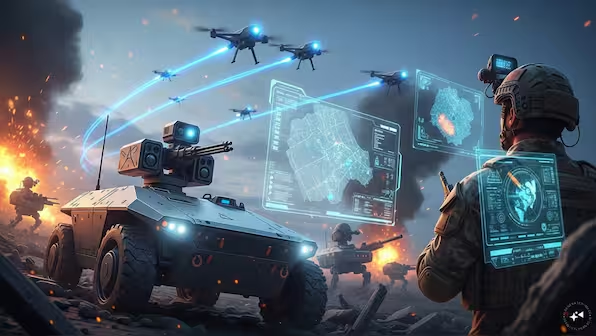
Today’s battlefield is increasingly defined by interconnected systems. Soldiers, armored vehicles, drones, satellites, and command centers are linked through digital networks that allow real-time data sharing. This connectivity enables commanders to make faster decisions and coordinate operations across vast areas.
The emphasis has moved from simply deploying large numbers of troops to integrating intelligence, surveillance, and reconnaissance capabilities. Digital communication networks allow commanders to visualize the battlefield in real time, dramatically improving situational awareness.
The Rise of Drones and Unmanned Systems
One of the most visible changes in land warfare over the last decade has been the widespread use of drones. Unmanned aerial vehicles (UAVs) are now essential tools for reconnaissance, surveillance, and targeted strikes.
Conflicts such as the Nagorno-Karabakh War (2020) demonstrated the devastating effectiveness of drones against traditional armored formations. Armed drones and loitering munitions were able to detect and destroy tanks, artillery systems, and air defenses with precision.
Similarly, in the ongoing Russo-Ukrainian War, both sides have extensively deployed small commercial drones for battlefield intelligence, artillery targeting, and even direct attacks using improvised explosives. The proliferation of low-cost drones has democratized airpower, allowing even smaller forces to achieve significant battlefield impact.
In addition to aerial drones, unmanned ground vehicles (UGVs) are beginning to appear on the battlefield. These robotic systems can perform tasks such as reconnaissance, logistics support, and mine clearance, reducing risks to human soldiers.
Precision Weapons and Smart Munitions
Another major shift in land warfare has been the growing reliance on precision-guided weapons. Modern artillery and missile systems are now capable of striking targets with extraordinary accuracy.
Systems like the HIMARS have demonstrated how precision strikes can disrupt supply lines, command posts, and ammunition depots far behind enemy lines. This capability allows militaries to weaken opponents without engaging in prolonged frontline battles.
Precision weapons have also increased the importance of intelligence and targeting data. Satellites, drones, and electronic surveillance systems now play a critical role in identifying targets and guiding strikes.
Urban Warfare and Complex Battlefields
Over the past decade, many conflicts have shifted from open terrain to densely populated urban environments. Cities have become the primary battlegrounds in wars across the Middle East, Eastern Europe, and parts of Africa.
Urban warfare presents unique challenges for military forces. Buildings provide cover for defenders, while narrow streets limit the mobility of armored vehicles. Civilian populations further complicate operations, raising humanitarian concerns and restricting the use of heavy firepower.
Fighting in cities often requires specialized tactics, including small-unit maneuver, building-to-building combat, and the integration of surveillance drones to detect enemy positions.
Hybrid Warfare and Non-Traditional Tactics
Modern land warfare increasingly blends conventional military operations with irregular tactics, cyber operations, and information warfare. This approach—often referred to as hybrid warfare—combines military force with political, economic, and technological tools.
The Annexation of Crimea in 2014 highlighted how hybrid tactics could be used to achieve strategic objectives without full-scale conventional warfare. Unmarked troops, local militias, cyberattacks, and propaganda campaigns were deployed simultaneously to destabilize the region.

In many modern conflicts, information operations have become as important as battlefield victories. Control of narratives, social media influence, and psychological warfare can shape public perception and political outcomes.
Artificial Intelligence and Battlefield Automation
Artificial intelligence is increasingly being integrated into military systems. AI-powered algorithms can analyze vast amounts of battlefield data, identify patterns, and support decision-making.
AI is also being used in autonomous systems, predictive logistics, and threat detection. For example, advanced software can process drone imagery to automatically detect enemy vehicles or troop movements.
While fully autonomous weapons remain controversial, the trend toward increased automation in land warfare is likely to continue as technology advances.
The Importance of Electronic and Cyber Warfare
Another defining feature of modern land warfare is the growing role of electronic warfare. Modern armies rely heavily on communication networks, GPS signals, and digital systems, making them vulnerable to electronic interference.
Electronic warfare systems can jam communications, disrupt navigation systems, and interfere with drone operations. In conflicts like the Russo-Ukrainian War, electronic warfare has become a critical tool for degrading enemy capabilities.
Cyber operations also play an important role in modern conflicts. Attacks on command networks, infrastructure, and military databases can weaken an adversary’s ability to coordinate operations.
Logistics, Mobility, and Rapid Deployment
The past decade has also highlighted the importance of flexible and resilient logistics systems. Modern warfare requires rapid movement of troops, equipment, and supplies across large distances.
Highly mobile forces capable of rapid deployment have become increasingly important. Light infantry units, airborne troops, and special operations forces often play key roles in modern land campaigns.
Supply chains must also be protected from precision strikes and cyberattacks, as disruptions to logistics can quickly undermine military operations.
The Human Factor Remains Crucial
Despite all technological advancements, human soldiers remain at the center of land warfare. Leadership, training, morale, and adaptability continue to determine battlefield outcomes.
Modern soldiers must now operate in highly complex environments where technology, information, and traditional combat skills intersect. Training increasingly focuses on integrating digital tools with conventional tactics.
The last decade has fundamentally reshaped the nature of land warfare. Advances in drones, precision weapons, artificial intelligence, and digital networks have transformed how armies fight and how battlefields are managed.
At the same time, the human dimension—leadership, strategy, and resilience—remains as important as ever. The future of land warfare will likely be defined by the ability of militaries to combine technological innovation with effective doctrine and disciplined forces.
As conflicts continue to evolve, the armies that adapt most effectively to these changing dynamics will shape the battlefields of the decades to come.