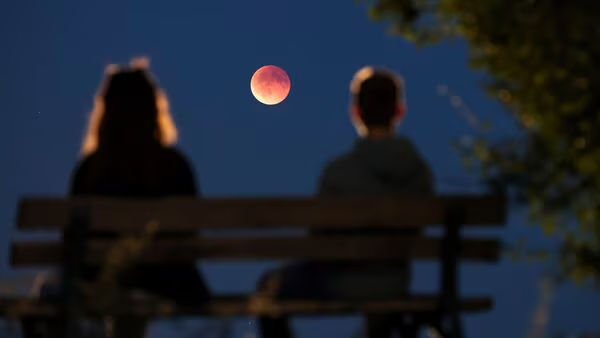
‘Blood Moon’ spectacle to be observed through telescopes; first total lunar eclipse of 2026 to be partially visible in Lucknow
Lucknow: A spectacular celestial event will grace the evening sky on March 3, 2026, as the first total lunar eclipse of the year unfolds. Weather permitting, the final phase of the eclipse will be visible across several parts of India, including North India and Lucknow. During its total phase, the Moon may appear reddish — a phenomenon popularly known as the “Blood Moon.”
The Indira Gandhi Planetarium will host a special public sky-watching programme at its परिसर, offering free telescope-assisted observation of the lunar eclipse. The event is being organised in collaboration with the Uttar Pradesh Amateur Astronomers Club and will continue from the evening until 7:00 PM.
In most parts of India, the Moon will rise while the eclipse is already in progress. In Lucknow, sunset will occur at 6:08 PM, and the Moon will appear low on the eastern horizon. By then, the total phase of the eclipse will have concluded, but the partial phase will still be underway. During this time, the Moon may appear slightly dim or tinged with red. The maximum possible viewing window from Lucknow is estimated to be around 39 minutes.
Lunar Eclipse Timings for Lucknow:
-
Sunset: 6:08 PM
-
Penumbral Eclipse Begins: 2:14 PM
-
Partial Eclipse Begins: 3:20 PM
-
Total Eclipse Begins: 4:34 PM
-
Duration of Totality: 59 minutes

-
Total Eclipse Ends: 5:33 PM
-
Partial Eclipse Ends: 6:47 PM
-
Penumbral Eclipse Ends: 7:53 PM
-
Estimated Visible Duration in Lucknow: Approximately 39 minutes
A lunar eclipse occurs when the Earth comes between the Sun and the Moon, casting its shadow on the lunar surface. This phenomenon can only happen on a full moon night. As Earth’s shadow gradually covers the Moon, it dims and may turn coppery red during totality. This reddish hue occurs because Earth’s atmosphere scatters shorter blue wavelengths of sunlight while allowing longer red wavelengths to pass through and bend toward the Moon — a process known as Rayleigh Scattering. The same effect makes sunsets appear red.
The Moon’s orbit is tilted about 5 degrees relative to Earth’s orbit around the Sun, which is why eclipses do not occur every full moon. Only when the Sun, Earth, and Moon align precisely does a lunar eclipse take place.
Astronomers note that lunar eclipses serve as a natural laboratory for understanding atmospheric light scattering and have historically played a vital role in astronomical calculations and timekeeping.
The March 3 lunar eclipse promises to be a memorable experience for astronomy enthusiasts and citizens alike, offering a rare opportunity to witness a captivating “Blood Moon” through scientific observation.