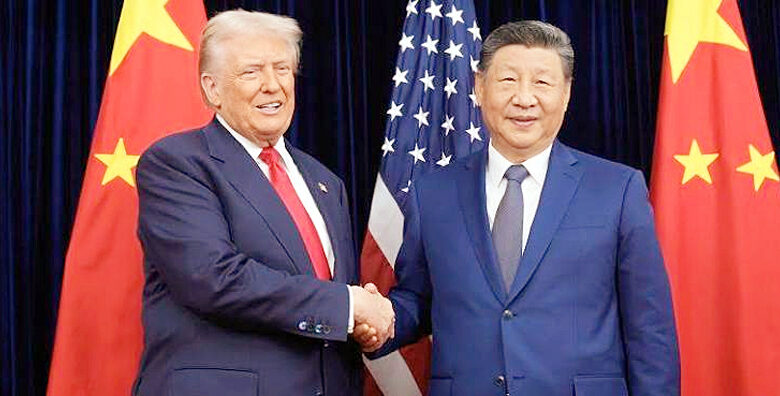
Washington/Beijing: Relations between the United States and China continue to reflect a complex mix of strategic rivalry and diplomatic engagement, as the world’s two largest economies seek to manage their differences while protecting their economic and security interests.
The two countries remain at odds over trade, technology, Taiwan, rare-earth minerals, artificial intelligence and their broader global influence. However, their deep economic interdependence continues to provide incentives for dialogue, with tensions between Washington and Beijing carrying implications for international markets, investment, supply chains and global growth.

The engagement does not necessarily signal a lasting improvement in bilateral relations. Instead, it highlights the efforts of both powers to prevent competition from escalating into a wider confrontation while exploring areas where their interests overlap.
Technology has emerged as a central battleground in the relationship. Semiconductors, artificial intelligence, telecommunications, electric vehicles, advanced manufacturing and critical minerals are increasingly linked to national security as well as economic development. Washington remains concerned about China’s technological and industrial expansion, while Beijing views US technology restrictions as obstacles to its development ambitions.
Taiwan remains one of the most sensitive issues in bilateral relations, alongside disagreements over the South China Sea and regional security. These differences underline the limits of diplomatic engagement and make any assumption of a lasting strategic rapprochement premature.
The emerging relationship can be characterised as one of managed competition. Both countries seek to protect their strategic advantages and reduce vulnerabilities while retaining channels of communication. They continue to recognise the economic costs that could arise from a renewed escalation in tariffs and trade restrictions.

For the global economy, sustained dialogue could help reduce uncertainty and support more stable trade and investment conditions. Conversely, renewed tariff disputes could disrupt supply chains, increase costs and place additional pressure on developing economies.
India has a particular stake in these developments. It is strengthening strategic and economic ties with the United States while maintaining significant trade relations with neighbouring China. A reduction in US-China tensions could support global economic stability, while continued competition could create opportunities for India to attract manufacturing, investment and supply-chain diversification.
Capitalising on these opportunities, however, will require India to improve its manufacturing capacity, technological capabilities and export competitiveness. Maintaining strategic autonomy while engaging with both major powers will remain an important consideration for New Delhi.
The durability of US-China engagement remains uncertain. Differences over trade, technology and security are substantial, and individual meetings or temporary understandings may not translate into lasting changes. Nevertheless, continued communication reflects the recognition that the two countries cannot easily separate their economies or ignore their respective roles in global affairs.
The trajectory of US-China relations will remain a major factor shaping international politics and economic stability. Their engagement is therefore best understood not as an end to rivalry, but as an effort to manage competition in an increasingly interconnected world.