Group Captain Shubhanshu Shukla Launches ‘The Second Orbit’, Shares Experiences of His Journey from Lucknow to Space
Lucknow: Stories of ambition, perseverance and space exploration took centre stage at the Gomti Book Festival on Tuesday, as Group Captain Shubhanshu Shukla interacted with students and shared experiences from his remarkable journey from Lucknow to space.
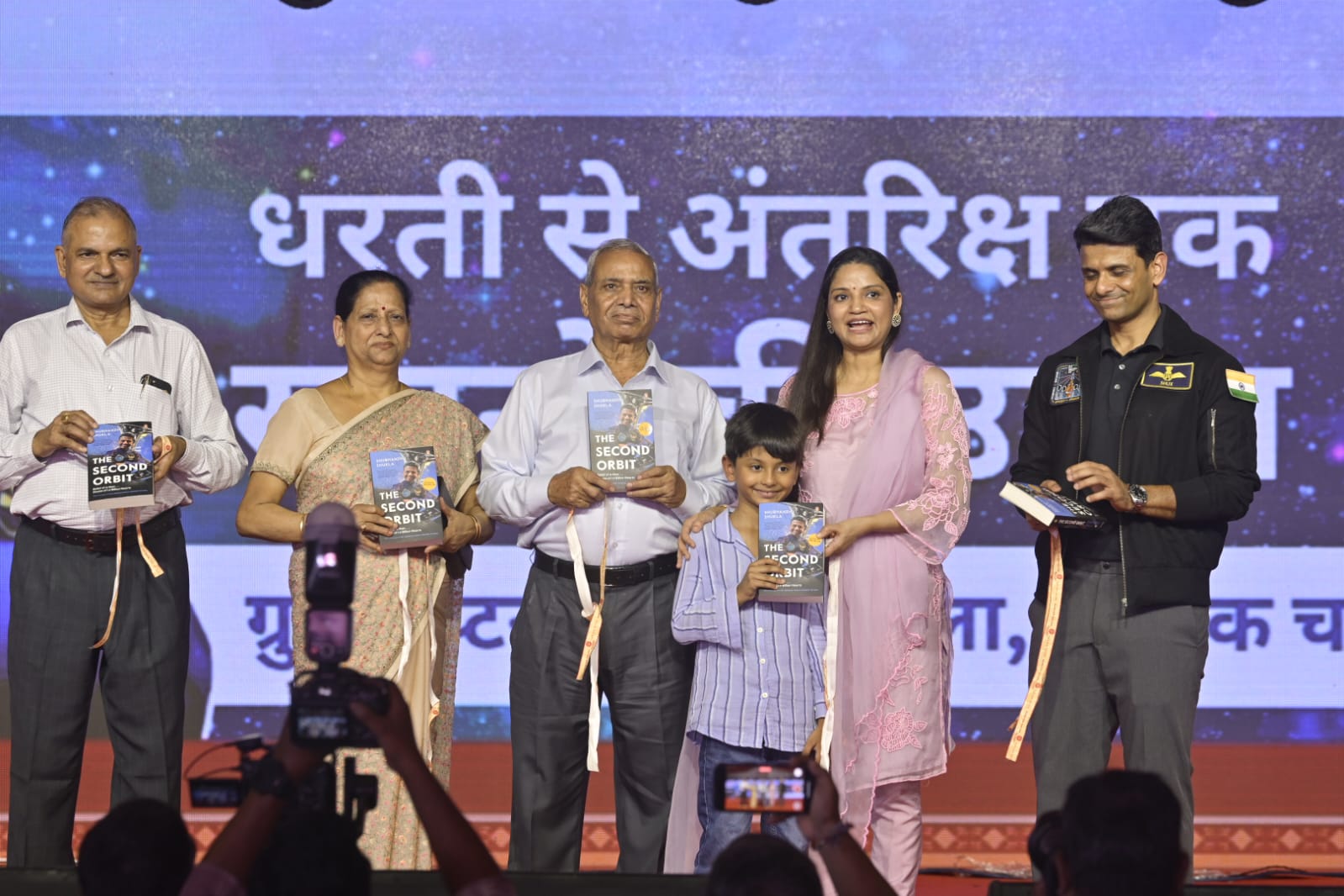
The special dialogue session, titled “Dreams Taking Flight from Earth to Space”, was organised by the National Book Trust, India. During the event, Shukla jointly launched his English book The Second Orbit with his family members. India’s first astronaut, Rakesh Sharma, congratulated Shukla through a video message and praised both the book and his space journey.

A New Perspective from Space
Speaking to students after the book launch, Shukla recalled his childhood, education, service in the Indian Air Force, training and eventual journey into space. He said that viewing Earth from space transforms a person’s thinking and perspective.
“From space, no country, city or regional boundary is visible. What you see is one beautiful and united Earth,” he explained. He told students that humanity’s divisions appear small when viewed from orbit, reminding everyone that they are residents of the same planet.
Recalling the early moments of his spaceflight, Shukla said he experienced both excitement and apprehension. He compared the feeling to entering an examination hall, where even a well-prepared student may briefly feel that their mind has gone blank. He said he managed the moment, remained mentally strong and proceeded with the mission.
Lessons from Life in Microgravity
Shukla explained how living in space brings significant changes to the human body and everyday activities. In microgravity, the body may temporarily increase in length, while movement, sitting and standing become very different from life on Earth.
He described how water released in space forms small floating spheres rather than falling downwards. Such conditions are important for scientific research, and he spoke about experiments conducted during his mission to study the effects of microgravity on the human body and surrounding environment.
He also explained that prolonged stays in space can weaken muscles because the body no longer works against gravity as it does on Earth. Astronauts therefore need regular exercise. Spacecraft maintain controlled conditions for air, temperature and the overall environment.
Returning to Earth also presents challenges, as the body needs time to readjust to gravity. Walking, sitting and even lying down may initially feel uncomfortable, he said, describing his return as another significant personal experience.
Encouraging the Next Generation
Shukla told students that India is steadily advancing its space programme, with preparations for the Gaganyaan mission and ambitions for future human exploration of the Moon. He said the dream belongs not only to scientists and astronauts but to the entire nation.
Encouraging young people in Lucknow, he said that a student from the city could also become an astronaut. Hard work, discipline, dedication and mental strength, he added, are essential to achieving such goals.

Referring to Rakesh Sharma’s famous message, “Saare Jahan Se Achha”, Shukla said the new generation has the responsibility of presenting India to the world from a fresh perspective through space exploration. He described the beauty of Earth, city lights and the Himalayas as reminders of a shared world beyond human-made boundaries.
He also connected the aspirations of young people with India’s vision of becoming a developed nation by 2047, urging students to understand their responsibilities and contribute honestly in their respective fields.
From Lucknow to the Stars
Sharing his personal story, Shukla recalled that Lucknow during his school days was very different from the city today. Facilities were limited and power cuts were common. In that environment, dreaming of travelling to space was not easy.
He said he had never imagined that he would one day travel into space, but big dreams and sustained hard work helped turn what seemed impossible into reality.
Addressing students, he said that astronauts are ordinary human beings without magical powers. The difference lies in their vision, dreams and determination to achieve them.
2019: A Turning Point
Shukla described 2019 as a decisive year in his life. While in Bengaluru, he received the message informing him of his selection. He recalled standing beside his car for some time, absorbing the significance of the news, before sharing it with his wife and children.
He highlighted the contribution of his wife, Kamna, during his years of service in the Indian Air Force and said that the support and trust of his family had been a source of strength during challenging periods.
He also reminded students that success is rarely achieved alone. Families, friends, teachers and colleagues play an important role in helping individuals reach their goals, and their contribution deserves recognition.
Concluding the interaction, Shukla urged students not to fear big dreams. “Do not be afraid to dream big. Sometimes, the dream that seems impossible becomes the greatest achievement of your life,” he said.
His message at the Gomti Book Festival left students with an inspiring lesson on ambition, resilience and the power of sustained effort in shaping India’s future.