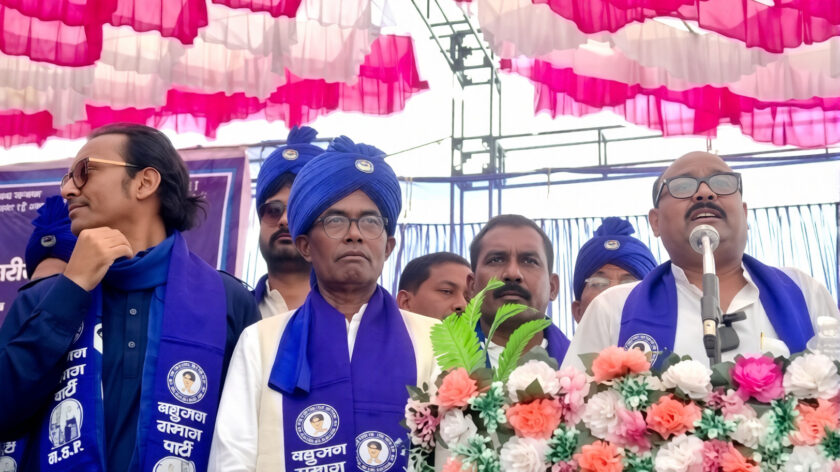
Lucknow: With the 2027 Uttar Pradesh Assembly elections still some distance away, political parties have already begun preparing for the battle. The BJP, Samajwadi Party and Bahujan Samaj Party are working to strengthen their respective social and political equations. In this evolving landscape, BSP chief Mayawati’s recent political statements and increased activity have attracted renewed attention.
Mayawati’s indication that the BSP intends to contest the next Assembly elections independently raises an important question: is the decision primarily aimed at preserving the party’s independent political identity, or does it form part of a larger electoral strategy? More importantly, can the BSP rebuild its traditional support base strongly enough to influence the outcome of the 2027 election and potentially place Mayawati in the role of a kingmaker?

The answers will depend on much more than political statements. The BSP’s prospects will be shaped by Uttar Pradesh’s complex caste equations, the party’s organisational strength, voter priorities and the ability of its leadership to convert political messaging into support on the ground.
The BSP was once one of the most powerful political forces in Uttar Pradesh. Built around a strong Dalit support base, the party expanded its social coalition over the years and successfully experimented with a broader strategy that brought different communities together. Its Dalit-Brahmin social engineering played a particularly significant role in Mayawati forming a government with a full majority.
However, the party’s electoral influence has declined over the past decade. Its performance in the 2022 Assembly elections and the 2024 Lok Sabha elections fell considerably short of its earlier levels. The 2027 Assembly election, therefore, could be a crucial test of whether Mayawati can restore the BSP’s relevance in Uttar Pradesh politics.
The decision to contest independently needs to be viewed in this context. Mayawati has expressed reservations about alliance politics on several occasions, while the BSP leadership has also faced the challenge of ensuring that its core voters do not shift towards alliance partners. Contesting on its own would allow the party to campaign under its own symbol, candidates and political agenda.
At the same time, the strategy carries considerable risks. In a state as electorally competitive as Uttar Pradesh, even a small change in vote share can alter the outcome in dozens of constituencies. If the BSP succeeds in retaining a substantial portion of its traditional Dalit support, it could turn several contests between the BJP and SP into three-cornered battles.
This is where Mayawati’s potential role becomes significant. Even if the BSP does not emerge as the principal contender for power, a strong performance in a sufficient number of constituencies could affect the government-formation arithmetic. In a closely fought election, the party’s support or opposition could become politically significant. Such a scenario could once again bring Mayawati into the role of a kingmaker.
But before that can happen, the BSP must first rebuild its support base.
One of the party’s biggest challenges is reconnecting with Dalit voters. The community can no longer be viewed as a completely uniform electoral bloc. The aspirations of younger voters have evolved, with employment, education, healthcare, social dignity, security, access to government schemes and economic opportunities becoming increasingly important.
A revival based solely on traditional slogans and identity politics may therefore prove difficult. The BSP will need to present a credible political and development agenda for contemporary Uttar Pradesh and explain what voters can expect from the party if it returns to power.
The party is also likely to look beyond its traditional support base. Expanding its influence among OBC groups, non-Jatav Dalits, Muslims and sections of the upper castes could significantly increase its electoral relevance. The challenge, however, will be to build a social coalition suited to present-day political realities rather than simply reproduce earlier formulas.
The political environment has changed considerably since the BSP’s strongest electoral years. The BJP has developed a formidable social and organisational base, while the Samajwadi Party continues to focus on its support among OBC and Muslim voters. Smaller caste-based parties could also influence electoral contests in specific regions.
Organisation will be another decisive factor. Elections are not won through speeches alone. A functioning booth-level network, active workers and sustained contact with voters are essential to converting political support into votes. In recent elections, questions about the BSP’s grassroots organisational effectiveness have been among the challenges confronting the party.

Mayawati will therefore need to transform political activity into a sustained election campaign. Reviving worker morale, strengthening the organisational structure and establishing a clear campaign narrative will be critical.
The future leadership question could also have implications for the party’s long-term prospects. Developments surrounding Akash Anand have highlighted the importance of clarity over the next generation of leadership within the BSP. While Mayawati remains the party’s central political figure, a durable organisational structure and a clearly defined leadership succession would be important for sustaining the party beyond individual electoral cycles.
Perhaps the biggest requirement for the BSP is to move beyond a largely reactive political approach and offer a positive policy agenda. Unemployment, inflation, farmers’ concerns, education, healthcare, women’s safety, employment opportunities for young people, the problems faced by small businesses and law and order are issues on which the party will need clear and credible positions.
Uttar Pradesh voters cannot be viewed solely through the prism of caste equations. Social identity remains important, but development, economic opportunity and individual aspirations are becoming increasingly influential, particularly among younger voters. They are likely to demand a clearer picture of the future from political parties.
If Mayawati succeeds in consolidating the BSP’s traditional Dalit support while expanding its appeal among OBCs and other communities, the party’s electoral influence could rise sharply. Such an outcome would make it difficult for both the BJP and SP to ignore the BSP.
Conversely, if the party fails to retain a significant portion of its traditional support and cannot rebuild its grassroots organisation, contesting independently could limit rather than enhance its political influence.
This makes the 2027 election more complicated than a straightforward BJP-versus-SP contest. The BSP’s performance could influence the result in several constituencies and, depending on the overall verdict, potentially affect the larger political arithmetic.
Mayawati’s renewed activity should therefore not be dismissed. She faces the difficult task of rebuilding lost political ground, but the BSP still possesses an established political identity, a history of electoral success and a distinctive social base.
The decision to contest independently can be seen as an attempt to protect that identity, while efforts to broaden the party’s social appeal and rebuild its organisation could be aimed at restoring its electoral relevance.
The central question now is whether Mayawati can convert political messaging into organisational strength and renewed public support. Uttar Pradesh has repeatedly produced elections in which parties considered to be on the defensive have delivered unexpected results.
If the BSP manages to reactivate its support base and build a broader social coalition, the 2027 Assembly election could become an opportunity for a significant political comeback. Mayawati may not necessarily emerge as the principal contender for power, but a strong BSP performance could once again make her an important factor in the state’s government-formation arithmetic.
Ultimately, the voters of Uttar Pradesh will decide the outcome. But if the BSP succeeds in rebuilding even part of its earlier influence, no major political formation is likely to find it easy to overlook Mayawati in the 2027 electoral equation.