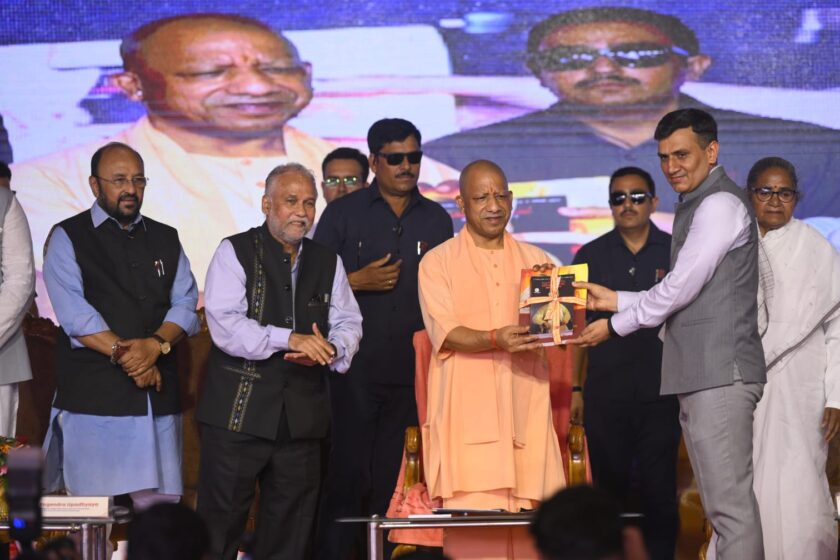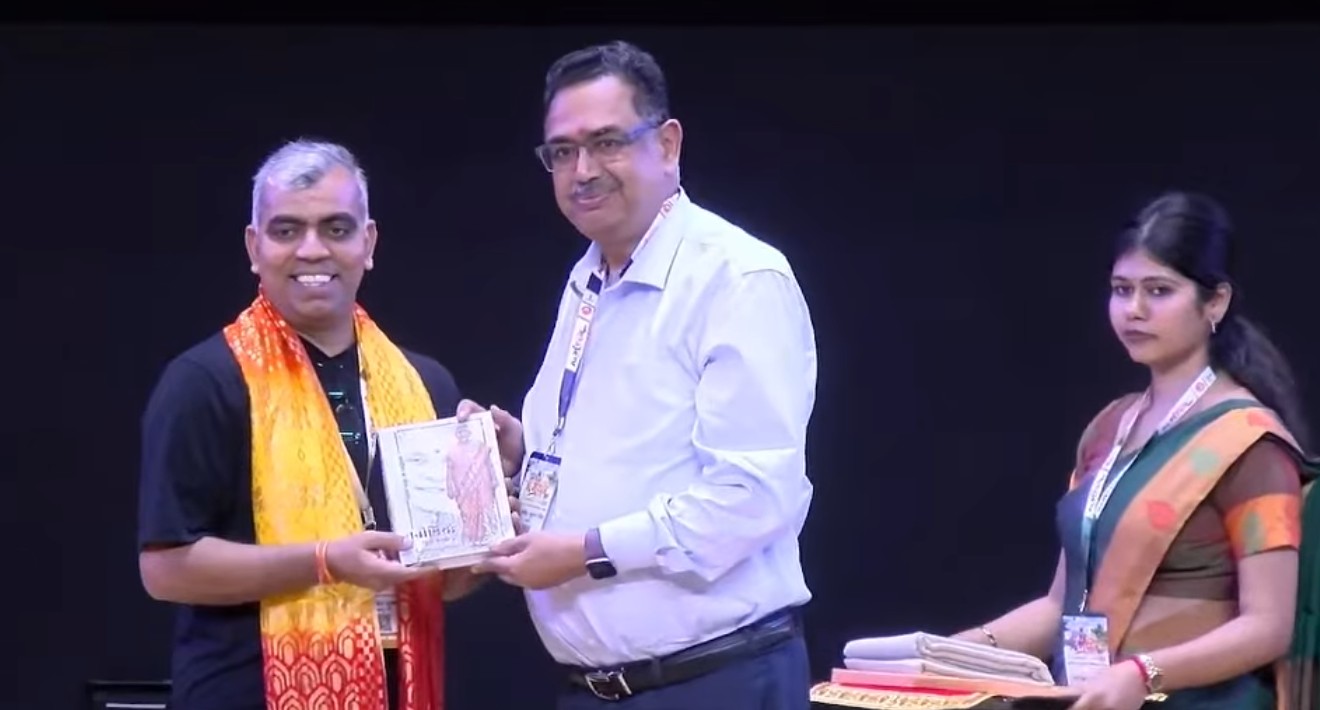
Lucknow: The second day of the two-day AI Manthan 2.0, held under the chairpersonship of Governor and Chancellor of state universities Anandiben Patel, focused on the growing role of artificial intelligence in education, higher education and research, with experts discussing physical AI, robotics, smart education and AI computing.
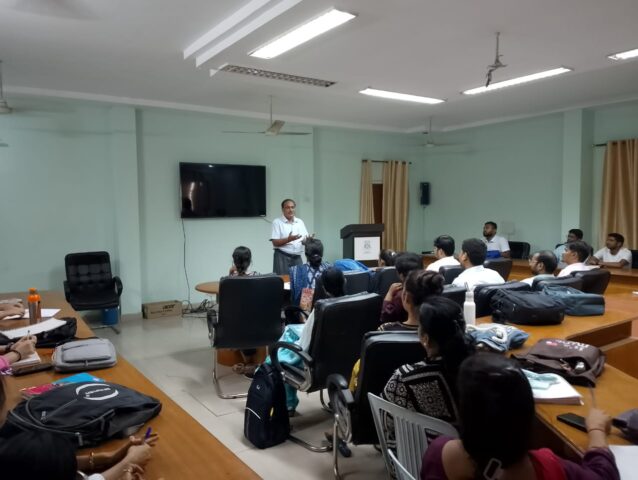
During the AI for Education session, Dr Amit Shukla of the Indian Institute of Technology, Mandi, delivered a presentation titled “From Research Papers to Robots in the Field: Building Judici’s Physical AI Ecosystem.” He said artificial intelligence was no longer confined to the digital world and was increasingly entering the physical environment.

Dr Shukla outlined key challenges in developing physical AI, including modelling the physical world, developing models for robots and understanding interactions between robots and their surroundings. Citing robotic systems developed for identifying and inspecting underground pipelines and power lines, he said such technologies could help reduce repeated excavation in cities while enabling better detection of damage and anomalies in underground infrastructure.
He also discussed applications involving quadruped robots, drones, aerial operations, bimanual robotic systems and long-distance remote operations. According to him, researchers are increasingly working on multi-robot systems in which aerial and ground-based robots can coordinate with one another. Research is also underway to train humanoid robots through AI to walk and perform complex physical tasks.
Referring to concepts similar to a “GPT for robotics”, Dr Shukla said the long-term objective was to develop AI models capable of operating across different types of robots and environments.
He also drew attention to the social implications of AI, noting that while the Industrial Revolution transformed physical labour, artificial intelligence was beginning to reshape cognitive and knowledge-based work. He said this would require society to rethink the role of human creativity, purpose, reasoning and meaningful work. He urged students and researchers to move beyond being consumers of AI and participate actively in its development and innovation.
Saurabh Rajpal of Google India spoke on “Modernizing Higher Education for Impact, Scale, Employability.” He said AI should be viewed as a tool to augment the capabilities and productivity of teachers and students rather than replace them.
Presenting Gemini as an AI-based educational assistant, Rajpal explained that teachers could use such tools to prepare lesson plans, curricula, quizzes, assignments, assessment material and evaluation criteria. Students could use AI for guided learning, examination preparation, deeper understanding of subjects and developing research ideas. Education administrators could also use AI for summarising lengthy documents and preparing emails and proposals.
Rajpal emphasised the importance of effective prompting and the P-A-R-T-S framework for obtaining better AI-generated results. He also highlighted the potential of customised AI assistants through Gems and the use of Gemini Notebook to organise learning and research based on specified sources, documents and study material.
He cited applications involving Google Classroom and Google Workspace, including summarising and responding to emails, preparing presentations and quizzes, and condensing documents. He said AI could make teaching material more interactive, personalised and learner-centric.
Rajpal stressed that AI literacy and technological skills would be increasingly important in the education system of the future. He urged teachers to view AI not merely as a technological tool but as a collaborative resource that could enhance education quality, research capabilities and employability.

Dr Ayush Maheshwari of NVIDIA India addressed the gathering on “Accelerating Research, Innovation and Talent at Scale.” He said the rapid expansion of AI would require computing power, energy, infrastructure, data and skilled human resources to realise its full potential.
Explaining the distinction between central processing units and graphics processing units, Dr Maheshwari highlighted the parallel computing capabilities of GPUs, which make them particularly effective for AI, machine learning and large-scale matrix operations.
He described the evolution of AI from systems focused on understanding and generation towards agentic AI. Unlike systems that merely provide answers, agentic AI can use different tools, reason through problems, evaluate outcomes and improve its approach before arriving at a solution.
Dr Maheshwari also discussed the importance of pre-training, post-training and test-time scaling in the development of foundation models. He said cutting-edge AI systems require substantial GPU and computing resources, but emphasised that computing power alone cannot guarantee success. Domain expertise remains equally important.
Highlighting the role of universities, he said higher education institutions should not restrict themselves to using AI applications. Students and faculty should also develop foundational knowledge of model training, fine-tuning, computing and AI infrastructure.
He cited areas such as agriculture, phenotyping and data collection as examples where universities could use open models and available computing resources to develop AI solutions tailored to local and sector-specific challenges. He added that AI computing was no longer limited to large data centres and that relatively energy-efficient desktop-based AI systems could also support research and experimentation in universities.
The experts collectively observed that the future of AI would extend well beyond technology companies. From physical AI and robotics to education, research and computing infrastructure, artificial intelligence is expected to reshape working methods across sectors.
They encouraged students and researchers to see AI not merely as a tool or consumer technology but as an area in which they could become creators, researchers and innovators. Alongside technical knowledge, they stressed the importance of creativity, domain expertise, critical thinking and responsible AI use.
The second day of AI Manthan 2.0 thus moved beyond the current applications of artificial intelligence to examine emerging areas including physical AI, robotics, AI-enabled education, research computing and the evolving relationship between humans and technology. The discussions offered higher education institutions a roadmap for adapting teaching, research, innovation and talent development to the demands of the AI era.




 ---------------------------------------------------------------------------------------------------