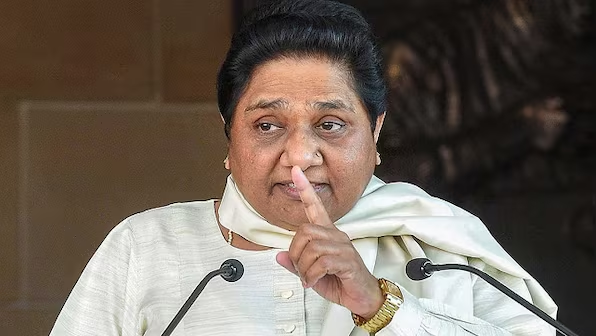
Lucknow | With the 2027 Uttar Pradesh Assembly elections approaching, Bahujan Samaj Party (BSP) chief Mayawati is once again attempting to revive the party’s successful 2007 “Sarvajan” (all communities) political formula by bringing together Dalits, Brahmins, Muslims and other social groups under a broader electoral coalition.
Political observers note that the BSP’s renewed outreach reflects a determined effort to regain lost ground after a series of disappointing electoral performances. Through the revival of “Bhaichara Committees” and a renewed emphasis on social engineering, the party is seeking to reconnect with communities that once played a crucial role in its rise to power.
Revisiting the 2007 Success Model
The BSP’s strategy draws inspiration from its historic victory in the 2007 Assembly elections when the party won 206 out of 403 seats and secured a clear majority. At the time, the combination of Dalit support, significant Brahmin backing and sections of Muslim voters helped transform the BSP into the state’s dominant political force.
The social engineering model was spearheaded by senior BSP leader Satish Chandra Mishra, who successfully cultivated support among Brahmins while maintaining the party’s traditional Dalit base. The campaign’s famous slogan, “Brahmin Shankh Bajayega, Haathi Badhta Jayega,” symbolized the alliance between upper-caste and Dalit voters.
However, political analysts point out that Uttar Pradesh’s political landscape has changed dramatically over the past two decades.
Electoral Challenges Facing BSP
The BSP’s electoral fortunes have steadily declined since its peak years. In the 2022 Uttar Pradesh Assembly elections, the party’s vote share fell to approximately 12.9 percent, and it managed to win only one seat. This marked a significant decline from its 22 percent vote share and 19-seat tally in 2017.
The party’s performance in parliamentary elections has also reflected its struggles. After failing to win a seat in the 2014 Lok Sabha elections, the BSP secured 10 seats in 2019 through an alliance with the Samajwadi Party. However, contesting independently in the 2024 Lok Sabha elections, the party once again failed to win representation.
Today, the BSP has minimal presence in major legislative bodies, intensifying concerns about its long-term political relevance.
Renewed Brahmin Outreach
Recent months have witnessed a series of Brahmin leaders joining the BSP, signaling the party’s efforts to broaden its social base. Several former BJP leaders and community representatives have publicly aligned themselves with Mayawati, fueling speculation that sections of the Brahmin electorate may be reassessing their political options.
Supporters of the BSP argue that some Brahmins feel underrepresented in key positions within the current political system and may be open to alternative platforms. The party hopes to capitalize on such sentiments through conferences, community outreach programs and targeted political messaging.
Nevertheless, analysts caution that attracting Brahmin voters remains a formidable challenge. Since 2014, the Bharatiya Janata Party (BJP) has maintained a strong hold over a substantial portion of the Brahmin electorate. Various post-election surveys have consistently indicated significant Brahmin support for the BJP across multiple elections.
The Dalit Vote Factor
Equally important for the BSP is the question of retaining and expanding its traditional Dalit support base. Historically, the party’s core strength came from the Jatav community and other Dalit groups who viewed the BSP as their primary political representative.

In recent years, however, political competition for Dalit votes has intensified. The BJP has made significant inroads among several non-Jatav Dalit communities through welfare programs and grassroots outreach. Benefits from schemes related to housing, cooking gas connections, sanitation and food security have helped the ruling party expand its support among marginalized sections.
As a result, the BSP now faces the dual challenge of rebuilding its traditional Dalit base while simultaneously attracting new social groups.
Competition from Emerging Political Narratives
The BSP’s revival strategy is unfolding in an increasingly competitive environment. The BJP remains the dominant political force in Uttar Pradesh, while the Samajwadi Party under Akhilesh Yadav has sought to expand beyond its traditional support base through its PDA (Backward, Dalit and Minority) outreach campaign.
Political observers note that the Samajwadi Party’s efforts have shown some success in attracting voters from communities that were once considered strong BSP supporters. This means that Mayawati’s challenge is not limited to competing with the BJP but also involves preventing further erosion of support to rival opposition parties.
Leadership and Organizational Questions
Another challenge confronting the BSP is organizational strength. The party was once known for its disciplined grassroots network and active cadre structure. Over the years, however, many prominent leaders have either joined rival parties or withdrawn from active politics.
Several districts now lack influential local leadership capable of mobilizing voters effectively. Analysts believe that rebuilding organizational capacity may be just as important as crafting new social alliances.
Questions have also been raised about whether the BSP possesses a contemporary Brahmin leadership figure capable of replicating the influence once wielded by Satish Chandra Mishra during the party’s most successful years.
Can the Sarvajan Formula Deliver Again?
The central question facing political observers is whether the social coalition that powered the BSP to victory in 2007 can be recreated in 2027.
Supporters argue that political dissatisfaction, shifting caste equations and the desire for a viable third alternative could create opportunities for the BSP. Critics, however, contend that today’s political environment is fundamentally different, with voters increasingly influenced by factors such as governance, welfare delivery, leadership perception and electoral viability.
Many analysts also suggest that strategic alliances could play a critical role in the BSP’s future prospects, given its current legislative strength and electoral position.
As Uttar Pradesh moves closer to the 2027 Assembly elections, Mayawati’s attempt to revive the Sarvajan model will be closely watched. Whether the strategy can restore the BSP to its former prominence remains one of the most intriguing questions in the state’s evolving political landscape