Lucknow / New Delhi: If you’ve flown anywhere in India over the past couple of years, you’ve probably noticed it yourself — the airports are busier, the flight options have multiplied, and it feels like a new terminal or regional route is opening up every few months. That’s not just a feeling. India is genuinely in the middle of one of the fastest aviation growth stories anywhere in the world right now, fueled by a mix of rising passenger demand, rapidly expanding airport infrastructure, aggressive fleet expansion by domestic carriers, and a government that’s been pushing hard on regional connectivity. And with airlines placing record-breaking aircraft orders and new airports popping up across the country, there’s a knock-on effect that doesn’t always make headlines: a serious, growing demand for skilled aviation professionals.
That demand is exactly why aviation education has quietly become one of the more attractive career paths for young people in India today — not just for those dreaming of the cockpit, but for anyone interested in aircraft maintenance, airport management, cabin crew roles, air traffic control, or aviation safety.

It’s Not Just About Flying Anymore
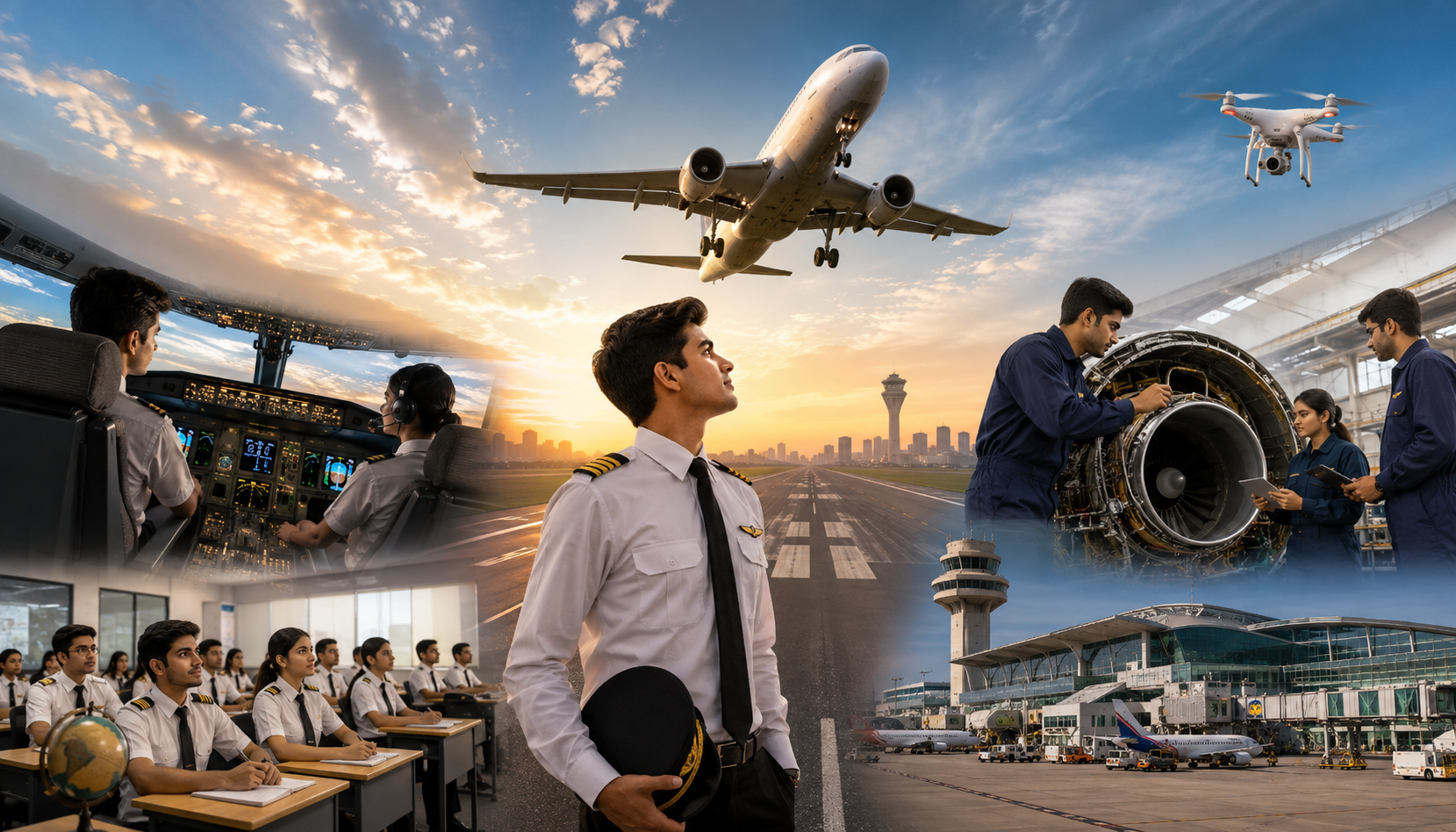
One of the more interesting shifts in this space is how broad the aviation industry has become. It’s no longer just pilots and planes — it now touches engineering, logistics, airport operations, aviation law, drone technology, air cargo, hospitality, customer service, and even aerospace research. Because of that, India’s leading aviation institutes have been redesigning their programmes to reflect this reality — blending classroom learning with simulator time, hands-on internships, and international exposure, rather than sticking to old-school, narrowly-focused training.
A Market That’s Only Getting Bigger
Over the next decade, India is expected to become one of the largest aviation markets in the world. That growth in domestic air travel — paired with expanding international routes — has pushed airlines to go on serious hiring sprees, bringing in thousands of pilots, engineers, technicians, and operational staff. On top of that, heavy investment is flowing into airport development, maintenance facilities, cargo terminals, and aviation technology, which is opening up even more employment avenues.
A lot of this momentum also traces back to government policy — the UDAN (Ude Desh Ka Aam Nagrik) scheme, aimed at improving regional air connectivity, has made flying more accessible in smaller cities, and in doing so, has created fresh demand for aviation professionals across the board, not just in the metros.
Where Students Are Training
A handful of institutions have built strong reputations in this space, each known for something slightly different.
Indira Gandhi Rashtriya Uran Akademi (IGRUA), Amethi remains one of the country’s most respected pilot training academies — a government-established institute equipped with modern aircraft and advanced simulators, and one that’s produced a steady stream of commercial pilots now flying for major domestic and international carriers.
Rajiv Gandhi National Aviation University (RGNAU) in Uttar Pradesh holds the distinction of being India’s first dedicated aviation university, offering specialized programmes in aviation management, airport operations, air transport economics, safety, logistics, and policy — with close ties to regulatory bodies and industry players to prepare graduates for leadership roles down the line.
Bombay Flying Club, one of the oldest flying institutions in the country, has been training pilots for decades now. Its long legacy, experienced instructors, and hands-on flying programmes continue to draw aspiring commercial pilots.
National Flying Training Institute (NFTI), Gondia has built its reputation on a modern fleet and structured Commercial Pilot Licence (CPL) programmes, training students using international operating procedures and up-to-date aviation technology.
Indira Gandhi Institute of Aeronautics rounds things out with programmes covering aircraft maintenance engineering, aviation management, cabin crew training, and airport operations — all built with an eye firmly on employability.
More Career Paths Than Most People Realize
Ask most people what an “aviation career” looks like, and they’ll say pilot. Fair enough — commercial piloting remains the most sought-after path, though it does demand rigorous flying hours, simulator training, and formal regulatory certification. With Indian airlines continuing to expand their fleets aggressively, demand for qualified pilots isn’t likely to slow down anytime soon.

But that’s really just one piece of it. Aircraft Maintenance Engineers (AMEs), for instance, are the ones responsible for keeping aircraft airworthy — inspecting, repairing, and maintaining them — and as India’s maintenance, repair, and overhaul (MRO) industry keeps growing, so does the need for licensed engineers in that space. Then there’s Airport Management, where graduates end up overseeing everything from terminal operations and passenger services to logistics, security coordination, and emergency response.
Beyond that, the industry has room for cabin crew, flight dispatchers, aviation safety officers, meteorologists, security professionals, airline operations executives, cargo specialists, drone operators, aviation consultants, and aerospace researchers. It’s a genuinely wide field.
Technology Is Reshaping How Aviation Is Taught
Modern aviation training doesn’t look like it did even a decade ago. Today’s programmes are increasingly built around artificial intelligence, predictive maintenance, big data analytics, digital air traffic management, unmanned aerial systems, cybersecurity, and sustainable aviation fuels. Simulation-based learning, in particular, has become central to how pilots and operational staff are trained — letting students practice emergency procedures and complex flight scenarios in a safe, virtual setting before ever facing them for real.
Drone technology has also carved out its own space in this world. A number of aviation institutes now offer dedicated courses in drone operations, mapping, surveillance, agricultural use, disaster management, and industrial inspection — a sign of just how much this sector has diversified.
It’s Not All Technical — Soft Skills Matter Too
Interestingly, employers in this space aren’t just looking for technical competence. Strong communication skills, leadership, problem-solving, teamwork, and the ability to make sound decisions under pressure all matter a great deal — which is why most aviation schools now build soft skills, customer service training, safety culture, and regulatory compliance directly into their curricula, alongside internships with airlines, airport authorities, and maintenance organizations that help graduates build real-world experience before they even finish their programmes.
What Happens After Graduation
Many well-regarded aviation institutes maintain strong partnerships with airlines, airport operators, ground handling agencies, and MRO companies, which naturally helps graduates find their footing. Career paths after training can lead to commercial airlines, business aviation, helicopter services, cargo operations, airport authorities, defence-support organizations, or even international aviation companies. And compensation tends to scale well over time too — pilot salaries typically rise with flying hours and aircraft type ratings, while those in management, engineering, or airport operations also see solid, long-term career progression.
Worth Knowing Before You Enroll
That said, aviation education isn’t something to jump into lightly. Pilot training in particular can involve a significant financial investment, so it’s worth doing real due diligence — checking that an institution has the right regulatory approvals, experienced instructors, modern aircraft and simulators, and a transparent track record on placements before committing. Medical fitness is another non-negotiable for aspiring pilots, while the more technical tracks demand a genuine aptitude for mathematics, physics, engineering, and analytical thinking.
Where This Is All Heading
Looking ahead, India’s aviation ecosystem shows no signs of slowing down. New airports, growing airline fleets, expanding cargo movement, digital transformation, green aviation initiatives, and a push toward indigenous aerospace manufacturing are all expected to generate thousands of skilled jobs every year. In response, institutions are rolling out increasingly specialized programmes — in aviation analytics, sustainability, airport digitalization, aerospace innovation, and unmanned aircraft systems — while international collaborations continue to strengthen the overall quality of training on offer.
For students drawn to technology, travel, engineering, or management, aviation genuinely offers one of the most dynamic, globally connected career paths available today. The key, as with any major decision, is choosing a school with solid practical training, experienced faculty, proper regulatory compliance, and real industry connections — because that foundation is ultimately what turns a passion for flight into a lasting career.
As India’s skies keep getting busier, its aviation schools are quietly doing some of the heaviest lifting — building the workforce that will keep this growth story flying. From the cockpit to airport command centers, maintenance hangars to cargo hubs, the opportunities today are broader than they’ve ever been, making aviation one of the more promising fields for the years ahead.