Islamabad: Pakistan finds itself, once again, at the center of global concern — not because of a single dramatic event, but because of the sheer accumulation of crises pressing down on it simultaneously. Political fragmentation, unrest in Pakistan-administered Kashmir, military dominance over civilian governance, a fragile economic recovery, and tension along two volatile borders have combined to paint a picture of a state under serious strain. But does that amount to a “complete collapse” of government, as some commentary now suggests? The evidence points to something more layered — a country navigating overlapping emergencies rather than one careening toward outright disintegration.
A Political Crisis Without an End Date

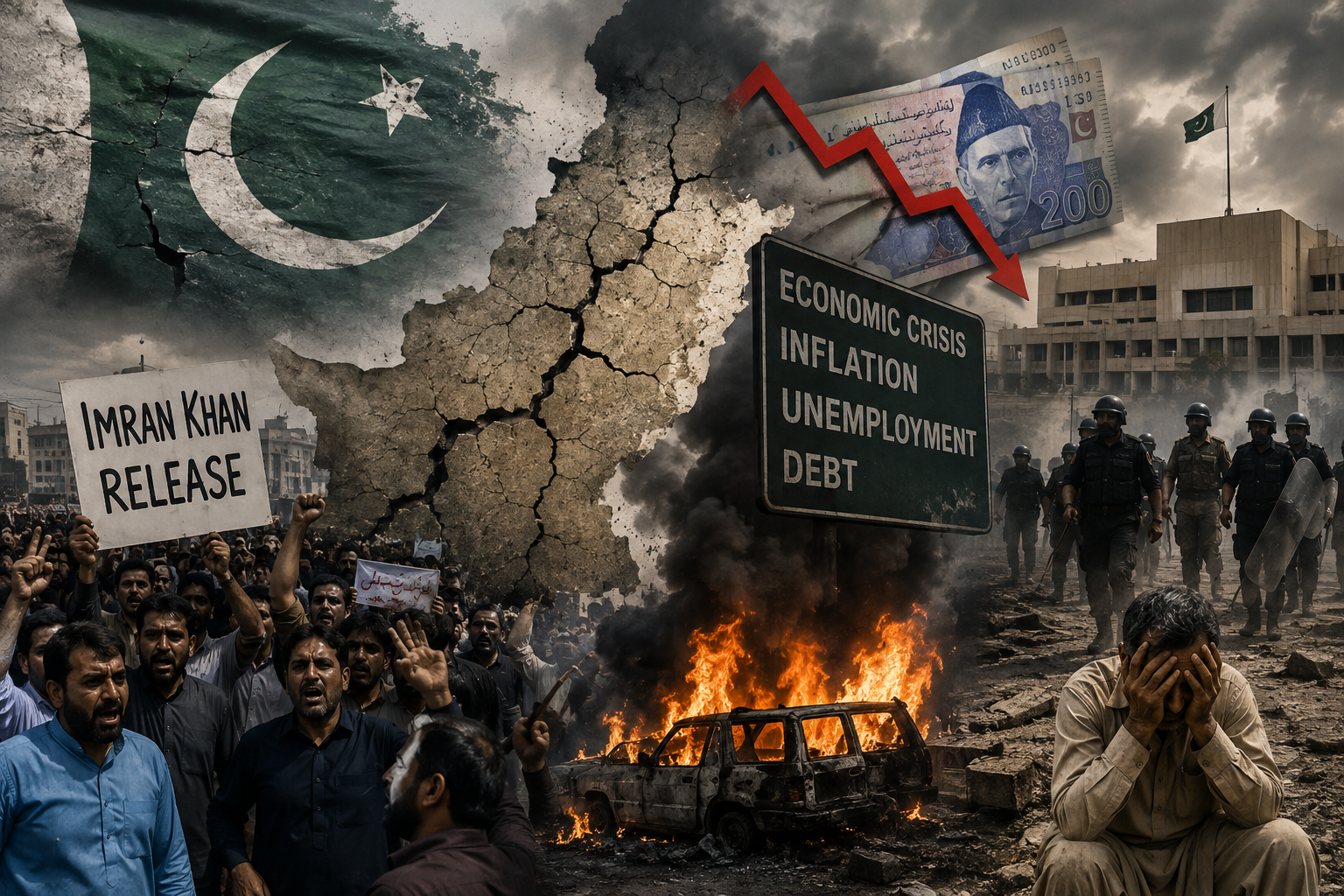
Pakistan’s current political turmoil traces back to April 2022, when Prime Minister Imran Khan was removed from office through a no-confidence motion — a moment that set off a chain of events that, remarkably, is still ongoing more than four years later. What followed was a cascade of destabilizing episodes: an assassination attempt on Khan in November 2022, his arrest in May and again in August 2023, his continued imprisonment since then, and allegations of vote-rigging surrounding the 2024 general election. In the aftermath of Khan’s removal, his supporters staged nationwide protests, he launched a public campaign demanding early elections, and his party briefly regained control of Punjab, Pakistan’s largest province, through by-elections in August 2022. Mass arrests of his party’s leaders and workers followed riots connected to his May 2023 arrest, prompting many senior figures to break away and form splinter parties.
This isn’t a crisis confined to national politics alone. In October 2025, Khyber Pakhtunkhwa — one of Pakistan’s provinces — was plunged into its own constitutional standoff after the disputed resignation of its chief minister, a contradictory approval of that resignation by the provincial governor, and a contested process to install his successor amid opposition claims of illegality. Episodes like this underscore a deeper structural problem that outside analysts have flagged repeatedly: the military’s outsized role in Pakistani politics, paired with a restrictive political environment, continues to erode the country’s democratic institutions. This is arguably the throughline connecting nearly every political flare-up in Pakistan over the past several years — governments rise and fall, provincial administrations get contested, but the underlying power structure, dominated by the military establishment, has remained remarkably durable throughout.
Kashmir: The Sharpest Edge of the Crisis
If there’s one flashpoint that most closely resembles a genuine breakdown of order, it’s in Azad Jammu and Kashmir (AJK), the Pakistan-administered portion of the disputed Kashmir region. What began as a routine legislative assembly election has spiraled into what regional observers describe as a state of profound political and humanitarian limbo, marked by violent unrest, severe infrastructural paralysis, and deep political alienation. Voting has been delayed in key areas — elections in the regional capital Muzaffarabad and in twelve refugee-reserved seats were postponed, while voting in the Poonch division has also been disrupted — a sign of just how badly the process has unraveled.
On the ground, the situation has turned violent. Protests led by the Jammu Kashmir Joint Awami Action Committee (JAAC) have escalated into deadly clashes with security forces, disrupting elections, transport, and daily life across several districts — described by observers as one of the most serious episodes of political unrest the region has witnessed in recent years. Security forces have reportedly clashed with protesters attempting to march on administrative centers, and police have alleged that some demonstrators used automatic weapons during the confrontations. What makes AJK’s crisis particularly combustible is its unusual constitutional position: the territory enjoys a degree of autonomy but lacks full state sovereignty, since ultimate decision-making authority rests with Islamabad — meaning local institutions absorb public anger over grievances they don’t actually have the power to fix. That mismatch between local accountability and central control is precisely the kind of governance failure that fuels prolonged unrest rather than resolving it.
The Economy: Stabilizing, but Still Fragile

Where the “collapse” narrative runs into trouble is the economy — a sector where the picture, while far from rosy, has actually been improving rather than deteriorating. Pakistan went through a genuine balance-of-payments emergency in 2023, driven by a mix of factors: heavy debt repayments, surging global fuel and commodity prices, domestic political instability, and the catastrophic 2022 floods, which caused an estimated $30 billion in damage, compounded further by the lingering economic fallout of the pandemic. Facing soaring inflation and the real prospect of default, the government turned to the IMF, securing a $3 billion loan in July 2023 followed by a larger $7 billion bailout package in September 2024.
That intervention appears to have bought Pakistan real breathing room. By the end of 2024, inflation had dropped to 4.1%, and the country recorded its first fiscal surplus in more than two decades. Foreign investment also picked up meaningfully — Pakistan received $1.962 billion in foreign direct investment in 2024, more than three times the $600 million it attracted in 2023. Even so, the recovery remains narrow and reliant on external support: Pakistan’s GDP per capita, adjusted for purchasing power, stood at just $6,720 in 2024, only a modest improvement, and the country’s finances remain tightly bound to IMF conditions and continued bailout support rather than any organic, self-sustaining growth.
Pressure on Two Borders
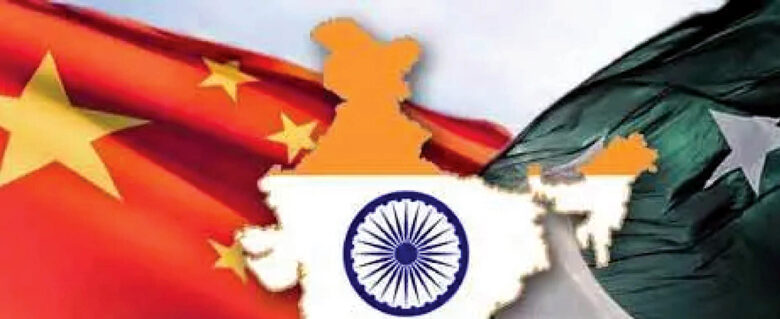
Compounding the domestic picture, Pakistan is also contending with friction on both its eastern and western flanks. To the east, longstanding tension with India persists, with India accusing Pakistan of harbouring militants and even sponsoring attacks on Indian soil, and no resolution in sight over the two countries’ dispute over Kashmir, which continues to claim lives on both sides. To the west, relations with Afghanistan have deteriorated sharply, with a fresh outbreak of hostilities between Islamabad and Kabul following a series of lethal jihadist attacks in western Pakistan, which the Pakistani government blames on militants it says are being sheltered by the Afghan Taliban. Analysts tracking the region have suggested that outside powers may need to help both capitals de-escalate before the situation worsens further. Regionally, there are also signs Pakistan is trying to hedge against this instability diplomatically — it’s part of an informal consultative arrangement with Saudi Arabia, Egypt, and Türkiye aimed at giving these countries a greater say in shaping the Gulf region’s future, a framework whose first real test is likely to be navigating the fallout from the broader US-Israel-Iran conflict playing out nearby.
So, Is Pakistan Collapsing?
The honest answer is: not in the sense of a state ceasing to function. Government institutions, however weakened, are still operating; the economy, while fragile, has stabilized rather than spiraled; and the military establishment — for better or worse — continues to provide a kind of institutional backbone that has kept the state apparatus intact through repeated political shocks. What Pakistan is experiencing instead is a slow-burning, multi-front crisis: a political system that hasn’t found stable footing since 2022, a violent and unresolved crisis in AJK that risks further alienating an already marginalized population, an economy that remains one shock away from renewed trouble, and security pressure building on two separate borders at once.
That combination is serious enough to warrant real concern — for regional stability, for Pakistan’s roughly 240 million citizens, and for neighboring countries watching closely. But “collapse” implies an endpoint, a state that has stopped functioning. What’s unfolding in Pakistan looks more like chronic instability — a country lurching from crisis to crisis without either fully breaking down or fully resolving the underlying tensions driving it. Whether that pattern eventually gives way to either genuine stabilization or a sharper unraveling will likely depend on how the AJK crisis is handled in the coming months, and on whether the fragile economic gains of the past two years can hold against the next external shock.