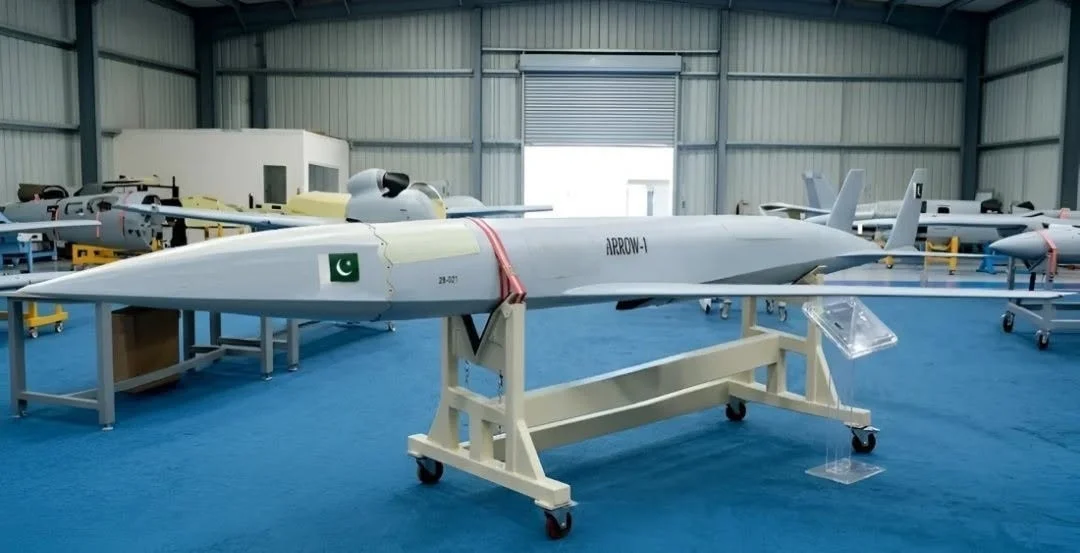
Islamabad: Pakistan has reportedly unveiled a new jet-powered strike drone, designated Arrow-1, featuring a low-observable design aimed at reducing its radar signature. The development could add a new dimension to the evolving military and security environment in South Asia.
The drone is reportedly being developed under Pakistan’s National Aerospace Science and Technology Park (NASTP). Its angular airframe and stealth-oriented configuration suggest that designers are focusing on improving its ability to penetrate modern air defence systems.
Defence observers have drawn comparisons between its external design and advanced Western cruise missiles, including the American AGM-158 JASSM. There are also suggestions of possible design similarities with Pakistan’s Ra’ad series of air-launched cruise missiles. However, no official technical confirmation has established a direct connection between the two programmes.
If the reported design approach is developed further, Pakistan could potentially adapt existing navigation, flight-control and aerodynamic technologies for a ground-launched, subsonic stand-off weapon.
The Arrow-1 is reportedly being considered for multiple operational roles. These could include one-way attack missions, electronic warfare decoy operations and deployment as part of coordinated drone swarms.
Recent footage reportedly showing the drone’s assembly inside a factory has also attracted attention. It suggests that the project may have progressed beyond the initial design stage. However, the footage alone does not establish whether the platform has completed testing or entered operational service.
Military analysts caution that the actual effectiveness of the Arrow-1 will depend on several factors, including production capacity, supply-chain reliability, guidance accuracy, operational testing and its eventual integration into Pakistan’s armed forces.
Implications for India’s Defence Preparedness


The reported development is significant for India because of Pakistan’s growing interest in unmanned aerial systems and comparatively low-cost strike platforms.
When considered alongside other Pakistani drone programmes, including the Lightning series of loitering munitions and the Yiha-III drones mentioned in defence discussions, the Arrow-1 points towards an apparent interest in expanding drone-based strike capabilities.
One possible operational concept is saturation warfare, in which large numbers of relatively inexpensive drones are launched together to overwhelm an adversary’s air defence network and exhaust its available interceptors.
For India, such developments underline the need to continue strengthening its multi-layered air defence capabilities, including radar surveillance, electronic warfare systems and counter-drone technologies.
However, the Arrow-1’s actual military significance remains uncertain. Its ability to evade radar, carry out precision strikes and operate reliably in contested airspace will need to be established through testing and verified technical information.
Pakistan’s reported move towards stealth-oriented strike drones is worth monitoring, but its impact on the regional military balance will ultimately depend on whether the system can be produced in significant numbers and successfully deployed by its armed forces.












 https://www.youtube.com/watch?si=RtToJsBhYBatUrym&v=mOuYNSdhjHA&feature=youtu.be