Emphasises industry-academia collaboration and translation of research into affordable healthcare solutions towards Viksit Bharat 2047
Lucknow: Dr Jitendra Singh, Minister of State (Independent Charge), Ministry of Science and Technology and Vice President, CSIR, visited CSIR–Central Drug Research Institute (CSIR-CDRI), Lucknow and inaugurated its state-of-the-art Biosafety Level-3(BSL-3/ABSL-3) facility and Dr B. Mukerji Lecture Theatre. Addressing around 500 scientists, researchers, students, staff, industry representatives and media personnel, he emphasised the need to accelerate indigenous drug discovery, strengthen industry-academia partnerships and translate scientific innovations into affordable healthcare solutions.
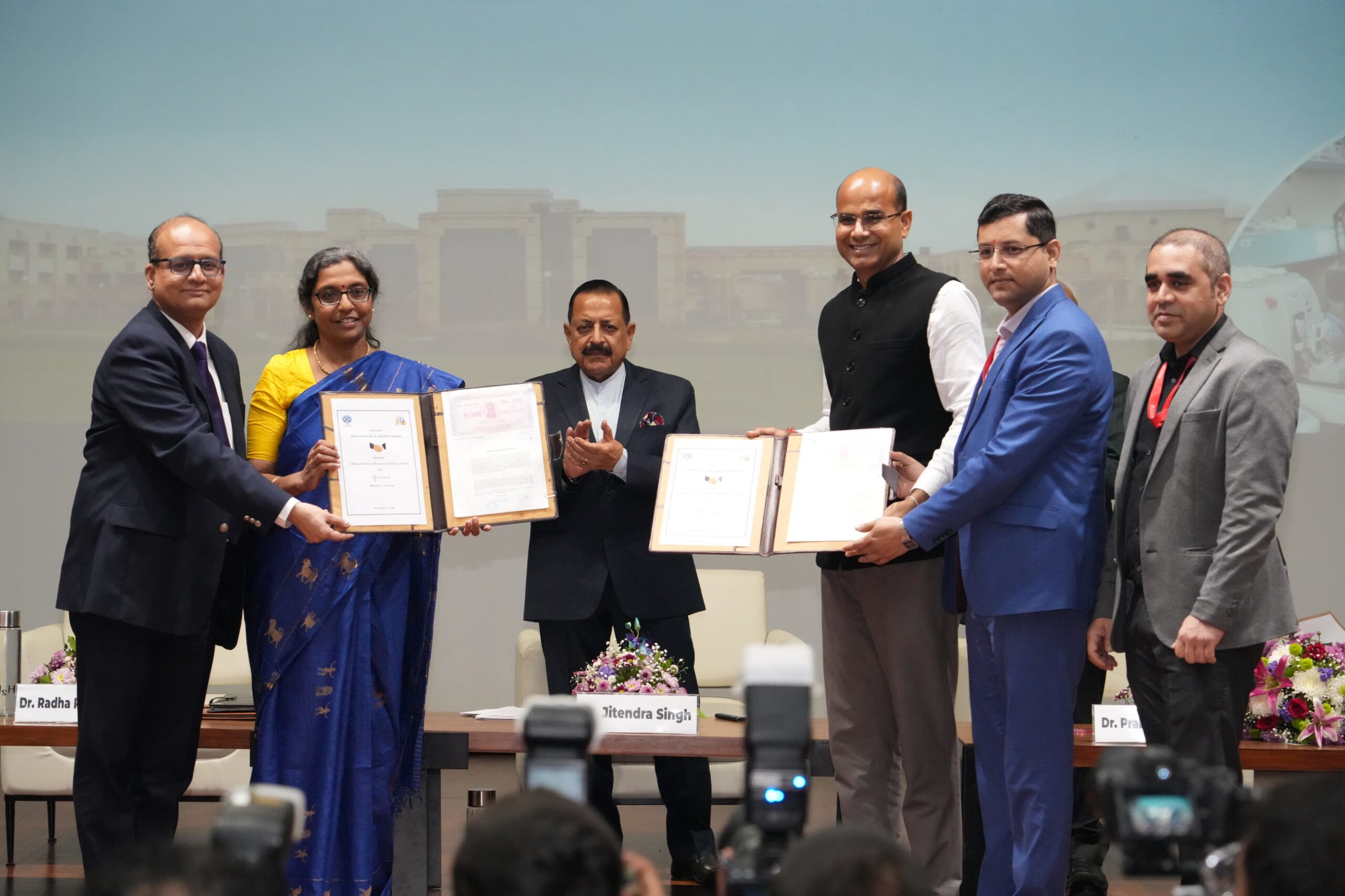
On this occasion, Dr Singh congratulated CSIR-CDRI on signing collaborative agreements with ICMR–National Institute of Research in Tribal Health, Jabalpur; Uttar Pradesh University of Medical Sciences, Saifai; and Medanta Hospital, Lucknow. He expressed confidence that these partnerships would promote collaborative research, facilitate clinical translation and address important healthcare challenges.
Highlighting India’s growing strength in science and technology under the leadership of Prime Minister Narendra Modi, Dr Singh said that research institutions must focus on innovations that deliver tangible societal benefits. He appreciated CSIR-CDRI’s significant contributions to drug discovery and biomedical research, including 13 drugs that have reached the market, more than 80 process technologies and six diagnostic technologies licensed, over 12,000 research publications, and more than 1,000 patents filed in India and internationally.
Appreciating CSIR-CDRI’s contribution to human resource development, he noted that the Institute has trained more than 2,000 PhD scholars and over 10,000 trainees, significantly strengthening India’s scientific talent pool.The newly inauguratedstate-of-the-art Dr B. Mukerji Lecture Theatre would definitely be helpful to train the human resource.
The newly inaugurated BSL-3/ABSL-3 facility will strengthen the Institute’s research capabilities in high-containment biological research, particularly involving Mycobacterium tuberculosis and non-tuberculous mycobacteria (NTM), thereby contributing to national preparedness against challenging infectious diseases.
Referring to CSIR-CDRI’s landmark discovery, Centchroman (Ormeloxifene), Dr Singh highlighted its successful inclusion in the National Family Planning Programme in 2016. More than 350 lakh strips have been distributed free of cost to women across the country during the last five years through ASHA workers, with over five lakh current users. He described it as an outstanding example of indigenous research translating into a significant public health intervention.
Dr Singh also appreciated the Institute’s promising drug development pipeline, particularly the standardised Picrorhizakurroa extract for metabolic dysfunction-associated steatotic liver disease (MASLD), which has completed Phase III clinical trials. He highlighted L-Ormeloxifene for contraception and S007-1500 for accelerated fracture healing, along with promising research leads for malaria, cancer, neuropathic pain and age-related macular degeneration. He also encouraged further development of phytopharmaceuticals by integrating traditional knowledge with modern scientific validation.
Emphasising India’s position as the world’s third-largest pharmaceutical producer by volume, Dr Singh said that the country must move beyond its established strength in generic medicine manufacturing and emerge as a global discoverer and developer of innovative therapeutics. He observed that the vision of Viksit Bharat 2047 requires national research institutions to play a pivotal role in developing indigenous technologies and innovative medicines.
He called for stronger research-industry partnerships, effective technology-transfer mechanisms and early industry participation in drug development. Appreciating CSIR-CDRI’s collaborations with Zydus, Cipla, Dr. Reddy’s Laboratories, Himalaya, Themis Medicare and several startups, he encouraged the Institute to further strengthen its engagement with pharmaceutical companies and healthcare institutions.
Dr Singh also highlighted the transformative potential of artificial intelligence, computational biology and interdisciplinary research in accelerating drug discovery. He urged scientists to pursue ambitious research, explore novel scientific challenges and ensure that discoveries address actual clinical needs, emphasising that the ultimate beneficiary of scientific research must be the patient.
The Institute also highlighted its major technology-transfer achievements, including Reunion, a Dalbergiasissoo-based formulation for fracture healing and post-menopausal osteoporosis; Joint Fresh for osteoarthritis; Umifenovir for COVID-19; GreenR, an indigenous nucleic acid staining dye; and technologies for corneal drug delivery, arboviral detection, fluorescence quenchers and phytopharmaceuticals for liver disorders, benign prostatic hyperplasia and PCOS. Recent collaborations with Himalaya Wellness Company and other pharmaceutical partners further reflect the Institute’s commitment to translating indigenous research into healthcare products.
CSIR-CDRI has also strengthened its preclinical and translational research infrastructure through its NGCMA-certified GLP facilities, Common Research and Technology Development Hub (CRTDH), NABL-accredited clinical laboratory, Drug Testing Laboratory and Centre for Bioinformatics and Computational Biology. Its AI-driven drug discovery initiatives and pharmacovigilance capabilities are further enhancing the national research ecosystem.
During the COVID-19 pandemic, the Institute contributed significantly to Uttar Pradesh’s public health response by testing more than three lakh COVID-19 samples and sequencing over 1,000 samples to support the surveillance of emerging variants.
Highlighting the Institute’s commitment to inclusive and sustainable development, CSIR-CDRI’s recognition as a GATI achiever by the Department of Science and Technology and its recognition by ICMR for research excellence and CII for promoting women in STEM were also noted. The Institute has additionally undertaken campus-wide solarisation, with rooftop solar installations reducing dependence on grid electricity by approximately one-third.
Concluding his address, Dr Singh expressed confidence that CSIR-CDRI would continue to strengthen India’s indigenous drug discovery capabilities and contribute significantly to the national vision of Viksit Bharat. He encouraged scientists to translate their dreams into scientific discoveries and innovative medicines that improve and save lives.







 https://www.youtube.com/watch?si=RtToJsBhYBatUrym&v=mOuYNSdhjHA&feature=youtu.be