By Arvind Singh Bisht
The Sun rises and the Sun sets. Day gives way to night, and night eventually yields to day. This eternal rhythm constitutes one of the most fundamental cycles of the universe. The Sun is the source of light and energy, and light, in its most elemental form, is the very essence of life. Darkness, its apparent opposite, is not necessarily the absence of existence; it is perhaps another expression of the cosmic order, waiting for light to return.

Beyond such philosophical interpretations, one undeniable truth remains: the Sun is the giver and sustainer of life on Earth. Our understanding of this celestial force, from ancient civilisations to modern scientific discoveries, represents an extraordinary journey of human curiosity, intellectual inquiry and scientific advancement. Yet, long before science began explaining the mysteries of the solar system, human civilisation had recognised the Sun’s indispensable place in the continuity of life. One of the most profound cultural expressions of this realisation is the festival of Chhath.
A Ritual That Celebrates the Cosmic Balance
Originally rooted in Bihar and the adjoining Bhojpuri-speaking regions of eastern Uttar Pradesh, particularly Purvanchal, Chhath has gradually transcended its geographical boundaries. Today, it is celebrated with remarkable devotion across different parts of India and even in countries abroad. What was once perceived primarily as a regional tradition has acquired a much wider cultural acceptance. The credit undoubtedly belongs to its devotees, cultural proponents and countless ordinary people who have carried its traditions beyond their native places.
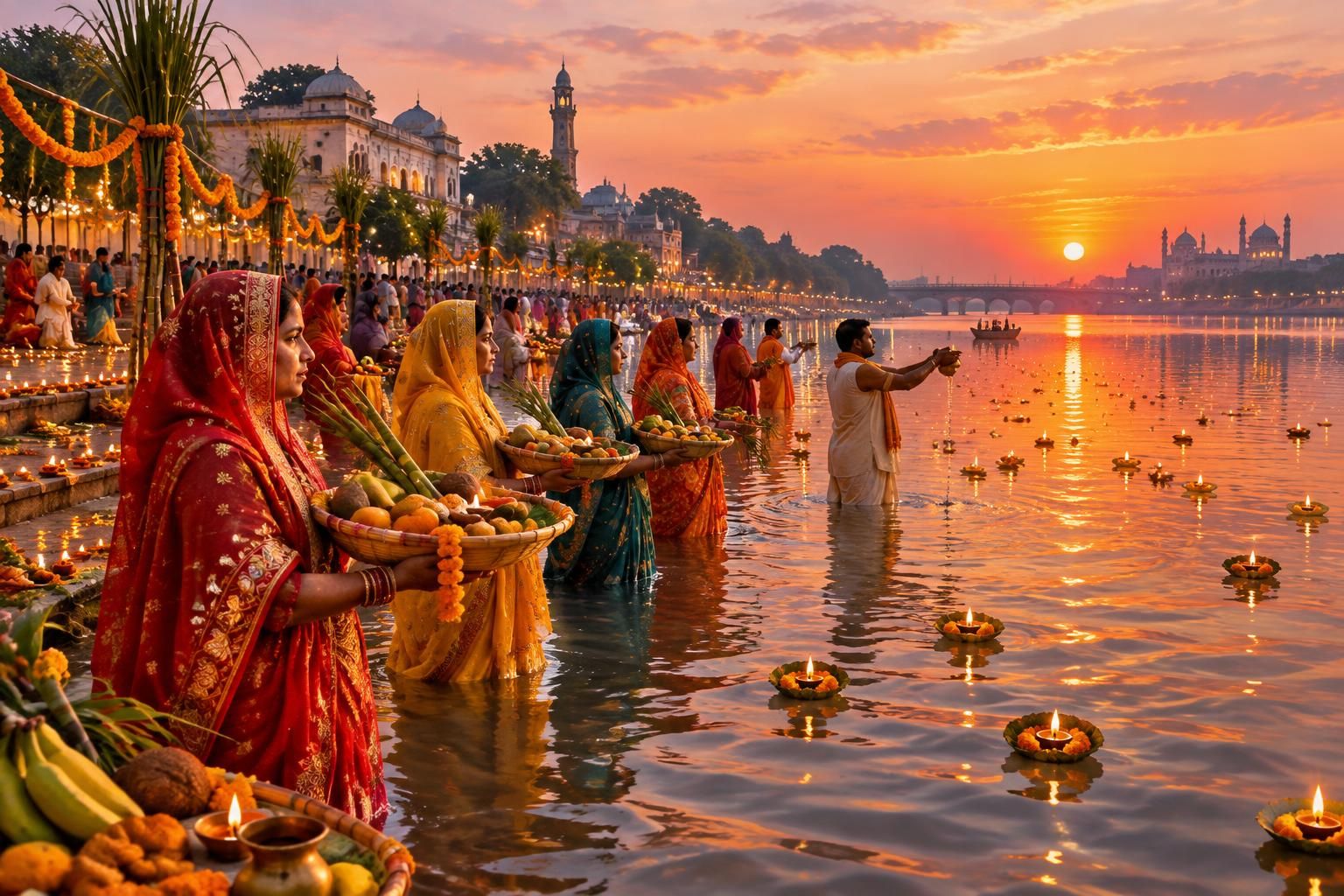
The essence of Chhath lies in its extraordinary simplicity and spiritual intensity. The festival involves rigorous fasting, traditionally observed by women, often without food or water for approximately 36 hours, sometimes longer depending on the observance. The central deity is the Sun, worshipped through offerings known as Arghya.
The ritual begins with offerings to the setting Sun and culminates the following morning with prayers to the rising Sun. Devotees gather at riverbanks, ponds and other water bodies, standing in water as they offer their prayers. The Ganga holds a special place in this tradition, although the ritual is performed with equal devotion at other rivers and water bodies.
There is something profoundly symbolic about this ritual. The Sun, which gives energy to the entire living world, receives an offering of water from human beings. One may interpret this as an expression of gratitude towards the elements of nature, but there is also a deeper philosophical thought embedded in it.
The Sun gives us light, warmth and energy; water sustains life on Earth. Neither can be separated from the other in the larger scheme of existence. By offering water to the Sun, human beings symbolically acknowledge this interdependence of nature and express their gratitude to the cosmic forces that sustain life.
It is also an expression of humility: despite all our scientific achievements, humanity remains dependent on the natural elements that make existence possible.
The Unspoken Debt of Men Towards Women
Chhath is also a festival of family welfare. Traditionally, women undertake this arduous observance praying for the health, happiness and longevity of their husbands, sons and the well-being of their families. Their devotion, discipline and physical endurance make the festival an extraordinary expression of maternal and familial affection.
But there is another dimension that deserves greater attention.
If women willingly undergo such hardship for the well-being of their families, do men not acquire a corresponding moral responsibility towards them? Their sacrifices should not merely be received as an expression of religious devotion; they should be acknowledged as a reminder of the dignity, respect and equality that women deserve.
In a society where women have historically faced discrimination, harassment, subjugation and various forms of patriarchal domination, Chhath offers an opportunity for introspection. The prayers of women for the well-being of men should inspire men to become more sensitive, respectful and protective of women’s dignity and rights.
Perhaps this is one of the most meaningful social messages that can be drawn from the festival: a woman’s devotion should never be taken for granted; it should be reciprocated with respect, affection and equality.
The true fulfilment of such a festival would lie not merely in the completion of its rituals, but in the transformation of human relationships that its spirit ought to inspire.
A Festival That Brings People Home
Another remarkable feature of Chhath is the extraordinary emotional attachment it generates among people living away from their native places. As the festival approaches, thousands upon thousands of people begin their journey home, particularly towards Bihar and eastern Uttar Pradesh. Railway stations become crowded, trains overflow, and people often undertake difficult journeys, sometimes without the comfort of a confirmed seat, simply to be with their families during these few days.
It is difficult to find another festival that inspires such an intense collective longing to return home.
The great significance of Chhath also lies in the importance it attaches to one’s roots and to the simple yet profound happiness of living amidst one’s family, friends and loved ones. In the relentless pursuit of livelihood, professional success, social standing and material achievements, people often drift away from their native places and the relationships that once gave their lives meaning. Chhath provides an occasion to reconnect with those roots. Perhaps this is why people are so eager to return home, overcoming distance, discomfort and even the uncertainties of travel.
Human relationships are not merely a source of emotional comfort; they give meaning to our achievements, provide strength in moments of adversity and multiply our happiness when it is shared. To live among one’s own people, to converse with them and to share the little joys of everyday existence constitute the real wealth of life.
This truth finds a particularly poignant expression in an episode from the Mahabharata. After losing almost all his great warriors and close companions in the devastating war, Duryodhana is said to have realised the futility of his ambition for the kingdom. Bhishma Pitamah, his dearest friend Karna, and his revered teacher Dronacharya were no longer alive. These were the people whose presence would have made his victory meaningful and whose happiness he would have cherished upon becoming king. With them gone, the very kingdom he had fought so fiercely to possess had lost much of its significance.
What greater philosophy of life can there be? Power, wealth, prestige and achievements derive their true meaning from the people with whom we can share them. A victory achieved in solitude can sometimes feel like the greatest defeat when those we love, and those who would have rejoiced in our success, are no longer there.
Perhaps this is the deeper human significance of Chhath. People do not return home merely to participate in a religious ritual; they return to reconnect with the relationships that give their lives meaning. To sit among one’s own people, revisit childhood memories, meet old friends and share moments of happiness with family are pleasures that no material achievement can replace.
Ultimately, the greatest achievement in life is not how much one has accumulated, but how many loved ones remain beside us with whom we can share the joy of having lived.
This phenomenon evokes a personal memory from my schooldays. I remember how eagerly I used to wait for the Dussehra holidays, when I could return home from my school in a distant town. The anticipation of meeting my family, my loved ones and the familiar surroundings of home gave those holidays a joy that no amount of urban glamour or modern entertainment could ever replace.
The happiness was not in the journey itself, but in the thought of whom I was going to meet.

Perhaps that uncomplicated joy has become increasingly elusive in our changing lives. We have acquired greater material comforts, better means of communication and easier mobility, yet something of that innocent excitement of returning home seems to have diminished.
Chhath, however, continues to preserve that emotion. The sight of millions of people making their way home, overcoming distance, discomfort and even the uncertainty of travel, is a reminder that human beings ultimately remain attached to their roots and relationships. The longing to meet one’s own people is perhaps one of the most enduring sources of happiness.
My Encounter with Chhath in Lucknow
My own understanding of Chhath developed rather late in life. Having grown up in Uttarakhand, I was not particularly familiar with the intensity and cultural significance of this festival until I came to Lucknow.
An interesting encounter in 2005 brought me much closer to it.
That year, I had conceived the idea of organising a Bhagwat Katha at Laxman Mela Maidan in Lucknow. After obtaining the requisite permission from the Lucknow Nagar Nigam, completing the necessary formalities and depositing the prescribed fees, I arranged an elaborate facility spread over approximately 80,000 square feet. A huge tented pandal was erected, with adequate space also earmarked for parking.
The nine-day discourse was delivered by my revered Guruji, Acharya Mahamandaleshwar Swami Avdheshanand Giri Ji Maharaj, the Peethadhishwar of Juna Akhara and one of the most respected spiritual figures in the country.
It was during this period that Chhath Puja happened to coincide with our programme.
One day, I received a call from a gentleman named Prabhunath Rai. He informed me that the Bhojpuri community intended to organise Chhath Puja at the same venue and suggested that we should cooperate with them.
My immediate reaction was not particularly welcoming. Having gone through the formalities, made substantial arrangements and secured official permission for our religious programme, I initially perceived his proposal as an intrusion into an arrangement that had already been made.
But my reaction changed as I began to understand the significance of Chhath and the extraordinary devotion with which the Bhojpuri community observed it. I realised that the occasion was not merely another religious gathering seeking space; it was an important expression of the faith, identity and collective sentiment of a large community.
I decided to extend my full cooperation.
What began as an encounter arising out of a practical disagreement gradually became an association founded on mutual respect and appreciation.
Over the years, I have watched Prabhunath Rai closely. His sustained commitment to the Bhojpuri Samaj and the organisation of Chhath Puja has been particularly noteworthy. He has devoted himself to the cause with remarkable persistence, working tirelessly to bring people together, preserve their cultural traditions and ensure that the festival receives the recognition and organisational support it deserves.
What I find especially admirable is that his involvement goes far beyond the requirements of an annual religious event. It is a continuing commitment to his community and its cultural identity. Such work demands time, energy, patience and considerable personal effort, often without any tangible material reward.
His contribution deserves appreciation and recognition, not merely from the Bhojpuri community but from the wider society of Lucknow. Indeed, the cultural acceptance and growing visibility of Chhath in the city owe much to the dedicated efforts of people like him.
My first encounter with Prabhunath Rai also taught me something about the nature of social harmony. Sometimes, what initially appears to be an inconvenience or a conflict of interests can become an opportunity for understanding another community, its traditions and its emotions. All that is required is a willingness to look beyond one’s immediate concerns.
The Larger Meaning of Chhath
Chhath brings together several dimensions of human existence: nature, spirituality, sacrifice, family, community and cultural continuity. It is a celebration of the Sun, but its significance extends far beyond the worship of a celestial body.
It reminds us of our dependence on nature, our gratitude towards the elements that sustain life, the sacrifices made by women for their families and the enduring human need to remain connected with one’s roots.
Its beauty also lies in its simplicity. There is no elaborate display of material wealth or ostentation at the heart of its rituals. There is faith, water, sunlight, devotion and an overwhelming sense of collective participation.
Perhaps the greatest lesson of Chhath is that life is sustained not merely by the energy we receive from nature, but also by the affection, sacrifices and relationships that surround us.
The setting Sun is worshipped with the same reverence as the rising Sun. This, too, carries a beautiful philosophical message: life deserves respect in all its phases. The declining light is not denied its dignity merely because it is about to disappear, just as the rising light is welcomed for the promise it carries.
And when millions of people return home to celebrate this festival, they reaffirm something that modern civilisation often makes us forget: our achievements may take us far away, but our emotional roots continue to draw us back.
Chhath is ultimately a celebration of life, gratitude and belonging. It is a prayer to the Sun, an offering to nature, a tribute to the sacrifices of women and, above all, a reaffirmation of the bonds that make us human.












 https://www.youtube.com/watch?si=RtToJsBhYBatUrym&v=mOuYNSdhjHA&feature=youtu.be