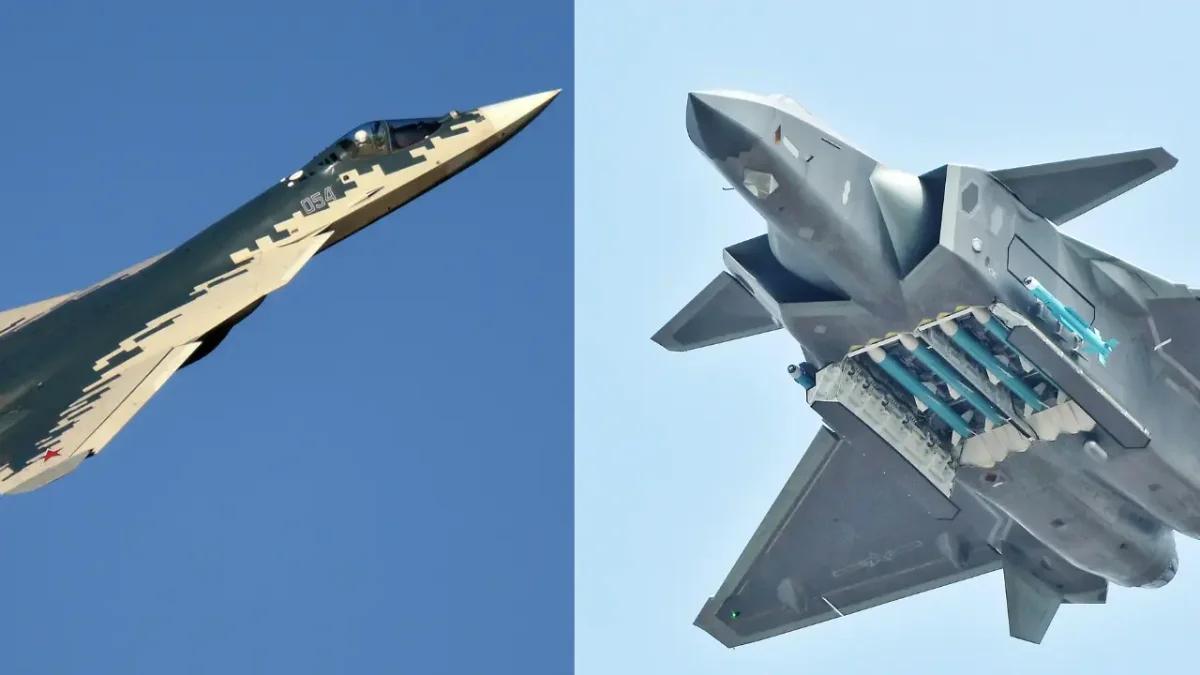
Moscow: The appearance of Russia’s fifth-generation Su-57 fighter at the Zhuhai Airshow in China has triggered fresh discussions among Chinese military analysts about the changing nature of aerial warfare. Comparisons with China’s Chengdu J-20 have brought into focus two different approaches to stealth technology, aircraft manoeuvrability and modern combat operations.
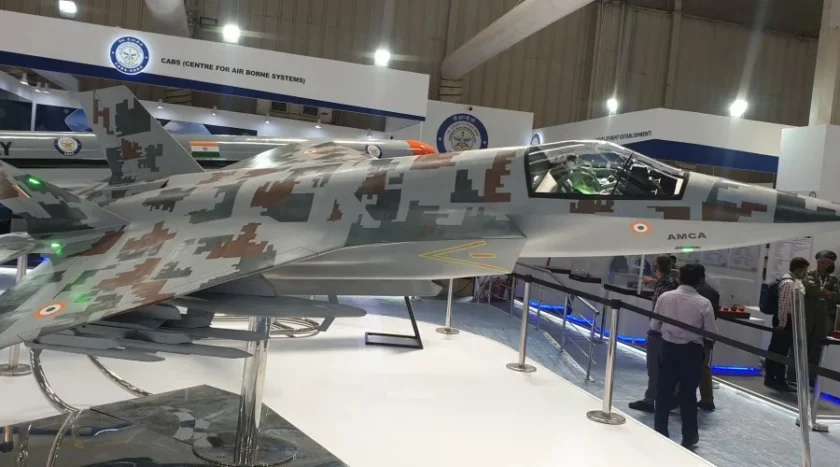
For India, the debate carries important implications as the Indian Air Force (IAF) works towards modernising its combat fleet and developing the indigenous Advanced Medium Combat Aircraft (AMCA).
The central issue emerging from the comparison is that future air superiority may depend as much on digital connectivity, intelligence sharing and electronic warfare capabilities as on the performance of an individual fighter aircraft.
Su-57 and J-20 Follow Different Design Philosophies
Chinese observers examining the Russian Su-57 have questioned aspects of its stealth design, pointing to visible fasteners, panel gaps and other surface details that they believe could affect its radar signature.
The Russian aircraft appears to place considerable emphasis on manoeuvrability alongside reduced radar visibility. Its design incorporates thrust-vectoring engines, allowing it to perform complex aerial manoeuvres, while its sensor suite includes systems intended to improve detection capabilities across different combat situations.
The J-20, developed by China’s Chengdu Aircraft Industry Group, follows a different approach. Its design places greater emphasis on reducing frontal radar visibility and engaging adversaries at long distances.
Chinese military commentators argue that extreme manoeuvrability, although useful in certain situations, may offer limited advantages in a battlefield increasingly shaped by long-range missiles, advanced sensors and electronic warfare.
This comparison does not establish that one aircraft is universally superior. Their actual effectiveness would depend on mission requirements, weapons, supporting systems, pilot training and operational conditions.
Network-Centric Warfare Changes the Equation
One of the most important aspects of the Chinese debate is the growing emphasis on network-centric warfare.
Under this approach, a fighter aircraft operates as part of a connected combat system rather than functioning independently. Information is exchanged between airborne early warning and control (AEW&C) aircraft, ground-based radar stations, electronic warfare platforms, unmanned aerial vehicles and space-based intelligence, surveillance and reconnaissance systems.
The J-20 is intended to operate within such an integrated network. Information gathered by external sensors can help its pilots identify and track potential targets while limiting the need to expose the aircraft through continuous use of its own radar.
This arrangement can improve situational awareness and allow fighters to engage targets using information received from other platforms.
The introduction of China’s twin-seat J-20S has added another dimension to this concept. The aircraft is associated with efforts to coordinate unmanned aerial systems, including the potential use of drone wingmen in future combat operations.
In an electronic warfare environment, the ability to collect, process and distribute information securely can become a major operational advantage. A fighter with advanced onboard technology may still face limitations if it cannot exchange information reliably with other military assets.
Lessons for the Indian Air Force
The Su-57 versus J-20 debate offers several lessons for India’s air power planning, particularly as the IAF prepares for future threats along its northern and eastern borders.


First, India needs a stronger and more integrated surveillance network to detect and track low-observable aircraft. This requires investment in additional AEW&C platforms, long-range ground-based radars and modern air defence systems.
A layered network would allow information collected by different sensors to be combined, improving the ability to monitor airspace and respond to potential threats.
Second, future fighter acquisitions and indigenous aircraft development must give greater attention to electronic warfare, secure communications and sensor fusion.
These capabilities allow pilots and commanders to build a clearer picture of the battlefield by combining information from multiple sources. They also help military units coordinate their actions during complex operations.
The same requirements will be relevant to India’s AMCA programme. Developing a fifth-generation fighter involves more than designing an aircraft with reduced radar visibility. Its sensors, weapons, communication systems and ability to operate alongside other platforms will determine much of its practical combat value.
AMCA and the Future of Indian Air Power
India’s indigenous Advanced Medium Combat Aircraft programme is intended to develop a fifth-generation stealth fighter for the IAF. Its long-term success will depend on the development and integration of several advanced technologies, including low-observable design, modern avionics, electronic warfare systems and networked combat capabilities.
India will also need to strengthen coordination between fighter aircraft, airborne surveillance platforms, ground-based air defence and unmanned systems.
The growing use of drones adds another layer to future air operations. Unmanned platforms could perform surveillance, electronic warfare and other missions alongside manned fighters, reducing the risks faced by pilots in heavily defended airspace.
For India, developing these capabilities as part of a common operational network will be as important as improving the performance of individual aircraft.
The Future May Belong to the Better-Connected Air Force
The comparison between the Su-57 and J-20 reflects a wider change in military aviation. Traditional measures such as speed, manoeuvrability and weapons capacity remain important, but they no longer provide a complete picture of a fighter’s combat effectiveness.
Stealth, long-range engagement, electronic warfare, real-time intelligence and secure data sharing are increasingly interconnected elements of air combat.
For the Indian Air Force, the lesson is clear: preparing for the next generation of aerial warfare will require an integrated system in which fighters, radars, surveillance aircraft and unmanned platforms work together.
The decisive advantage in a future conflict may depend less on which aircraft performs the sharpest manoeuvre and more on which side can detect, process and act on battlefield information faster and more reliably.








 https://www.youtube.com/watch?si=RtToJsBhYBatUrym&v=mOuYNSdhjHA&feature=youtu.be