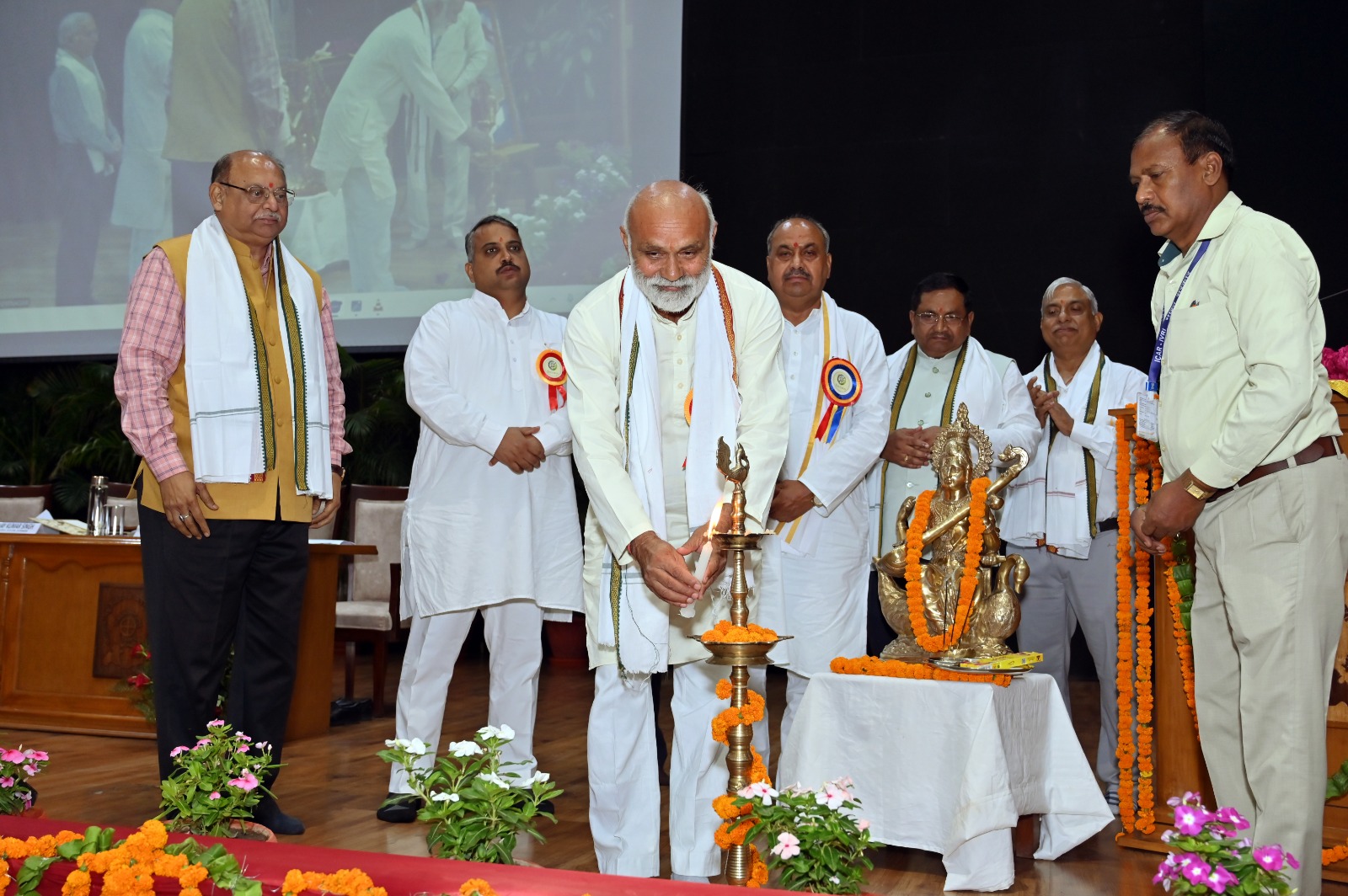
Bareilly: The Indian Council of Agricultural Research–Indian Veterinary Research Institute (ICAR-IVRI), Izatnagar, witnessed the grand inauguration of BASiC–2026: Bharatiya Animal Science Conclave and Science Expo, a national-level event jointly organized by IVRI and Vijnana Bharati (VIBHA), Braj Province. The conclave is centered on the theme, “From Tradition to Technology: The Path of Biosciences Towards Viksit Bharat@2047.”
More than 350 research scholars from across the country, along with scientists, academicians, industry representatives, livestock farmers, entrepreneurs and students, are participating in the multi-day event aimed at fostering dialogue between science, society and industry.
Addressing the inaugural session as the chief guest, Padma Shri awardee Kanwal Singh Chauhan emphasized that agriculture can become truly profitable only when farmers move beyond production and actively engage in value addition, processing and direct market linkages. Sharing his journey in farming, he highlighted the importance of integrating livestock-based agriculture with scientific innovations. He advocated the use of cow dung and cow urine-based organic inputs, including advanced bio-fertilizers and formulations such as Gau Kripa Amrit, to promote sustainable and environmentally friendly farming while reducing dependence on chemical fertilizers.
Delivering the keynote address, Dr. Sanjay Kumar Singh, Joint Director (Research), IVRI, described BASiC–2026 as a significant national platform that underscores the role of animal and biosciences in achieving the vision of a developed India by 2047. Marking World Milk Day, he congratulated stakeholders of the dairy sector and highlighted the crucial contribution of women, who account for nearly 78 percent of India’s dairy workforce.
Dr. Singh noted that the conference theme reflects India’s development journey by combining traditional knowledge systems with modern science and technology. He stressed that indigenous livestock management practices and traditional veterinary wisdom should be scientifically validated and integrated with contemporary technologies for the benefit of future generations.
He said the conclave has been designed to bring together the three pillars of science, society and industry, linking laboratories with farms and innovation with implementation. According to him, scientific achievements gain real significance only when they create tangible benefits for farmers, livestock owners and rural communities.
Highlighting emerging areas of research, Dr. Singh said the conference will focus on artificial intelligence, digital livestock management, precision farming, molecular diagnostics, translational biosciences, climate-smart animal husbandry, One Health, disease control and antimicrobial resistance.
He also highlighted IVRI’s achievements, including its NAAC A++ accreditation and strong global academic standing. The institute has played a pioneering role in developing nearly 50 animal vaccines, many of which are being used in national disease-control programmes against Foot-and-Mouth Disease (FMD), Brucellosis, PPR and Classical Swine Fever. IVRI has also contributed significantly to the eradication of diseases such as Rinderpest and African Horse Sickness.
The institute has developed notable livestock breeds, including the Vrindavani crossbred cattle, improved pig breeds and the recently registered Rohelkhandi cattle breed. IVRI continues to provide round-the-clock diagnostic services, biological quality control and advanced disease surveillance facilities, while its diagnostic kits and antigens are widely used across the country.

Speaking on the occasion, Rajesh Sengar, Vice Chairman of the Uttar Pradesh Cow Service Commission, stressed the importance of indigenous cattle in sustainable agriculture, energy security and environmental conservation. He said India must draw upon its traditional knowledge systems and scientific research capabilities to address global challenges such as climate change and resource scarcity.
Praveen Ramdas, National Joint Organising Secretary of Vijnana Bharati, emphasized the need to bridge India’s rich scientific heritage with modern research and innovation. He said achieving the vision of Viksit Bharat@2047 would require scientific advancement rooted in Indian values and cultural perspectives.
VIBHA Braj Province President Prof. Manoj Rawat highlighted the importance of integrating India’s traditional knowledge in agriculture, health and sustainable living with contemporary biosciences. He advocated a “traditional plus modern” approach rather than viewing the two as competing paradigms.
Dr. R.P. Singh, Director of PDFMD, Bhubaneswar, observed that BASiC–2026 provides a unique platform that combines scientific inquiry, national development and Indian philosophical thought. He noted that India is increasingly emerging as a self-reliant nation in animal health technologies and disease-control solutions.
Former Madhya Pradesh Public Service Commission Chairman Prof. S.P. Gautam, the keynote speaker, spoke about the scientific dimensions embedded in India’s ancient knowledge traditions. Referring to texts such as the Ramcharitmanas, Mahabharata and Bhagavad Gita, he said these works contain valuable insights on environmental sustainability, social harmony and balanced living that remain relevant in addressing contemporary global challenges.
Earlier, Organising Secretary Prof. Raghvendra Singh welcomed the dignitaries and presented an overview of the conclave. The programme was conducted by IVRI scientist Dr. Anshuk Sharma, while the vote of thanks was delivered by Dr. Pranav Dhar, Head of the Department of Standardization.
The inaugural session witnessed the participation of senior IVRI officials, department heads, scientists, research scholars, students, industry representatives, startup entrepreneurs and members of Vijnana Bharati, reflecting the growing importance of interdisciplinary collaboration in advancing India’s biosciences sector and supporting the national vision of Viksit Bharat@2047.
Report by Akhilesh Chandra Saxena, Bareilly.