The evening settled over Lucknow like an intricately woven shawl—heavy with fog, memory, and the lingering aroma of kebabs drifting from street-side stalls. The city did not fall silent so much as it softened, its sounds muffled beneath the humid embrace of twilight. The Gomti River flowed with restrained grace, carrying in its stillness the reflections of lanterns that flickered along the ghats like suspended fireflies.
In that hour between light and darkness, Lucknow seemed less like a city and more like a living archive. Its air held whispers of forgotten dynasties, of grandeur carefully preserved and secrets even more carefully buried. As the last embers of the sun slipped behind the ornate minarets of the Bara Imambara, a disturbance broke the fragile calm. Somewhere deep within the narrow, winding galiyan of the old city, a commotion erupted—sharp, urgent, and out of place.

A man had vanished.
There was no struggle, no witness, no trace left behind except the faint echo of hurried footsteps and a half-finished sentence that never reached its end. He was a historian of considerable repute, a man whose life had been devoted to decoding the layered past of Lucknow. His work on the Nawabs of Awadh had earned him respect in academic circles and quiet suspicion in others. He believed history was not dead—it was merely concealed beneath ornament and denial, waiting for someone persistent enough to uncover it.
His disappearance rippled through scholarly circles like a crack in glass. Whispers turned into theories, and theories into unease. Some spoke of political motives, others of academic rivalry. But among the older families of Lucknow, those who still clung to fading aristocratic pride, another explanation surfaced in hushed tones—curses, relics, and truths that were never meant to be disturbed.
It was into this uneasy silence that Amira Khan stepped forward.
Amira was an archaeologist by profession, but a seeker by nature. She carried within her an unrelenting curiosity that often drew her into places where history and myth overlapped. Lucknow was her longest fascination—a city where beauty and decay coexisted without contradiction, where every crumbling arch seemed to guard a sentence from the past.
She was not unfamiliar with loss or ambiguity. If anything, she found comfort in uncertainty, in the spaces where facts dissolved into interpretation. But this case felt different. It was not just about a missing man; it felt like something had been dislodged beneath the surface of the city itself.
As she stepped into the fog-laden evening, the air carried a strange weight, as though the city was watching her in silence. Her footsteps echoed softly as she moved through the bustling Chowk, where life continued with practiced indifference. Children laughed near sweet shops, vendors called out their wares, and cycle rickshaws threaded through the crowd like restless thoughts.
Yet beneath this ordinary rhythm lay something fractured.
The historian’s disappearance was not an isolated event—it felt like a thread pulled loose from a much larger tapestry, one that Amira could sense but not yet see in full.
Her first stop was the historian’s residence.
The haveli stood at the edge of fading grandeur, its once-majestic façade now dulled by time and neglect. Yet traces of its former elegance remained in the carved arches, the delicate latticework, and the faded murals that still clung stubbornly to the walls.
Inside, the air was heavy, almost reverent, as if the building itself had paused in grief.
Books lay scattered across the floor in chaotic constellations. Papers were strewn across tables, and ink bottles stood overturned, their contents dried into dark stains like frozen spills of thought. At the center of the disorder lay a half-finished manuscript, its pages filled with meticulous notes on the Nawabs of Awadh.
Amira picked it up carefully. The handwriting was steady but urgent, as though the writer had been racing against time rather than simply documenting history. There was passion in every line—but also something else. A sense of discovery so profound it bordered on fear.
As she turned the pages, a particular couplet caught her attention. It was written in the margin, almost as an afterthought:
“Where silence sleeps beneath stone and gold,
The truth is buried, yet never told.”
Beneath it, a reference to a relic.
A forgotten artifact, allegedly linked to the Nawabs, said to reveal truths that had been deliberately erased from recorded history. The mention of it sent a quiet shiver through her thoughts. If the historian had indeed found evidence of such a relic, then his disappearance might not be accidental.
It might be intentional.
Her investigation led her into a web of intersecting lives, each touched by ambition, resentment, or hidden knowledge.
There was Dr. Rahim, a respected academic whose envy of the missing historian was barely concealed behind scholarly courtesy. In lectures, his admiration for the past often soured into bitterness toward those who dared reinterpret it. His words carried intellect, but also a quiet, simmering resentment.
Then there was the Chaudhary family—once noble, now reduced to echoes of their former status. Their crumbling palace stood as a monument to lost privilege, its corridors filled with fading portraits and heavier silences. They spoke often of reclaiming their legacy, of restoring what they believed had been unjustly taken from them. But desperation, Amira knew, often disguised itself as justification.
And finally, there was Bilal.
A street performer who appeared unpredictably across the old city, weaving poetry into stories of Lucknow’s forgotten corners. He spoke with charm, but also with unsettling familiarity, as though he did not merely recount history—he remembered it.
Amira could not decide whether to trust him or question him. Sometimes both instincts coexisted uneasily within her.
As days passed, the mystery tightened around her like fog refusing to lift. She moved through the city as both observer and participant, gathering fragments—oral histories, architectural clues, hidden inscriptions, forgotten corridors. Lucknow responded to her presence not with answers, but with deeper questions.
Every alley seemed to conceal another layer of truth.
Every silence felt deliberate.
One night, as the fog thickened into a near-opaque veil, Amira found herself standing before the Bara Imambara. The monumental structure loomed above her like a memory carved in stone, its arches dissolving into mist.
She recalled the manuscript, the couplet, the reference to a hidden chamber.


Something beneath this very structure.
Driven by instinct more than certainty, she entered through a lesser-known passage, her lantern casting trembling light against ancient walls. The corridors twisted like thought itself, leading her deeper into the monument’s forgotten interior.
The air grew colder.
Heavier.
Finally, she found it—a weathered wooden door, nearly indistinguishable from the stone around it. Intricate carvings covered its surface, symbols that seemed both decorative and intentional, as though they were warnings disguised as art.
With a steady breath, she pushed it open.
The door groaned in protest.
Beyond it lay a narrow passage descending into darkness. She stepped forward cautiously, each movement swallowed by the silence. The walls here were older, their texture different, as though time itself had stopped trying to preserve them.
At the end of the passage, she entered a chamber.
Relics of the Nawabs were arranged carefully within—jewelled artifacts, fragile manuscripts, and objects whose purpose was no longer clear but whose presence felt deeply intentional.
And then she saw it.
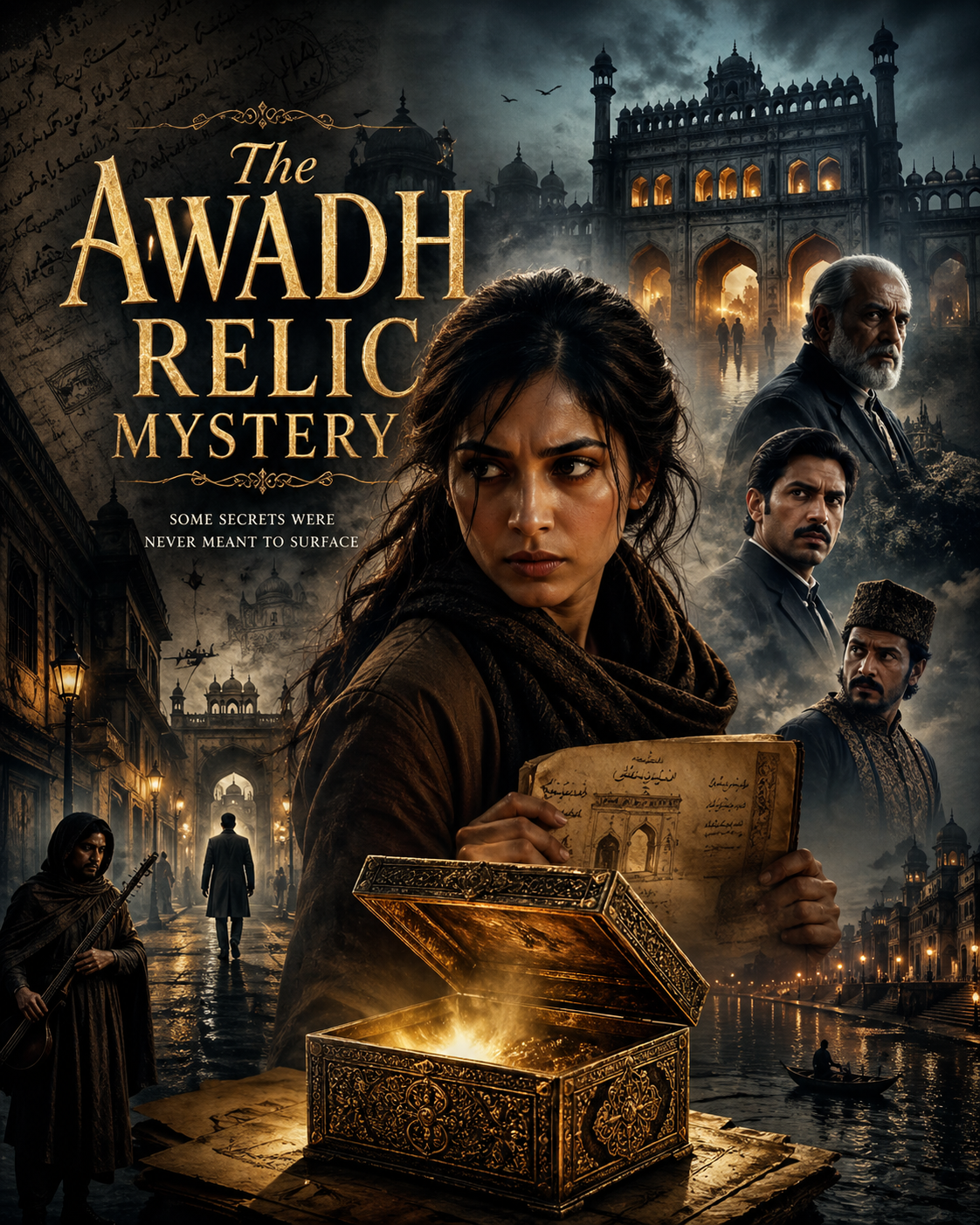
A small ornate box, its surface engraved with patterns that shimmered faintly in the lantern light. It seemed ordinary at first glance, yet carried an undeniable weight of significance.
As her hand moved toward it—
A sound broke the silence.
Footsteps.
From the shadows, Bilal emerged.
Not as a stranger this time, but as someone carrying the burden of knowledge he had long avoided sharing. He confessed that he had been following her—not to obstruct, but to ensure she reached what the historian never could complete.
The historian had discovered the chamber. He had uncovered the relic. And in doing so, he had touched a truth powerful enough to threaten reputations built over generations.
The Chaudhary family, Bilal revealed, was not merely guarding pride—they were guarding exposure.
Together, Amira and Bilal deciphered the markings on the box. It was not a treasure in the conventional sense, but a repository of records—hidden correspondences, erased transactions, and documented betrayals that reshaped Lucknow’s past in ways never recorded in official history.
The historian had not been searching for fame.
He had been searching for justice.
And for that, he had been silenced.
By the time dawn approached, the confrontation had already begun.
The accused stood within the shadowed halls of the Imambara, confronted not by accusation alone but by evidence—silent, undeniable, and preserved through time itself. The Chaudhary family attempted deflection, Dr. Rahim attempted rhetoric, but truth has a way of collapsing performance.
One by one, their narratives fractured.
Outside, the first light of dawn touched the domes of Lucknow, dissolving fog into fragile clarity. The city did not cheer, nor did it mourn. It simply continued—as it always had—absorbing its truths quietly, as if learning to breathe them in.
Amira stood in silence, the relic secured, the mystery no longer whole but no longer hidden.
She had not merely solved a disappearance.
She had uncovered a layer of the city’s soul.
And in doing so, she had become part of its endless, unfolding story—another voice within Lucknow’s living archive, where history never truly ends, it only waits to be heard again.












 https://www.youtube.com/watch?si=RtToJsBhYBatUrym&v=mOuYNSdhjHA&feature=youtu.be