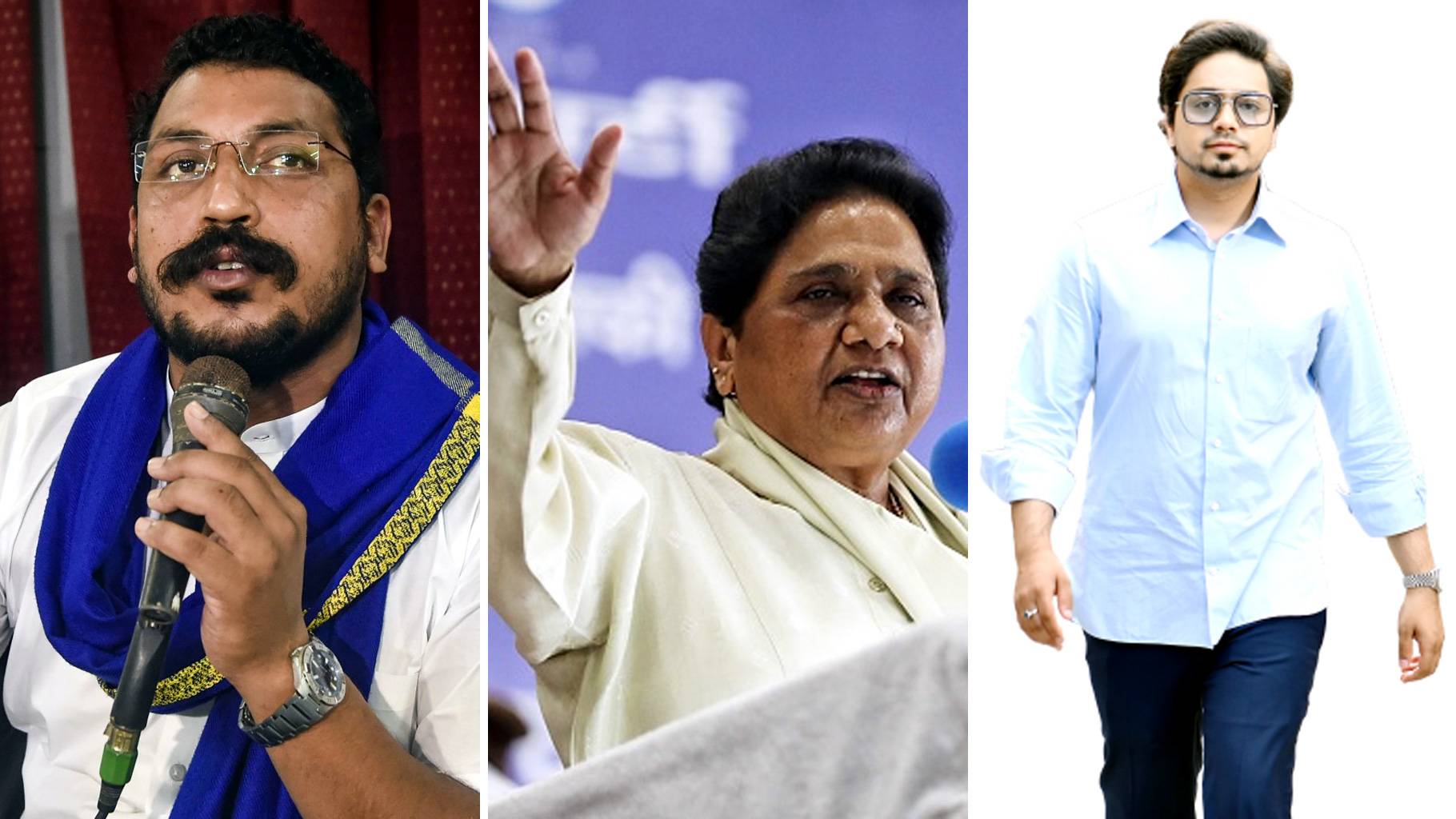
Lucknow: Bahujan Samaj Party (BSP) chief Mayawati’s decision to reappoint her nephew Akash Anand as the party’s national coordinator is more than an organisational reshuffle. Coming after repeated reversals over his political status, the move raises fundamental questions about succession, leadership control and the BSP’s ability to rebuild itself before the 2027 Uttar Pradesh Assembly elections.
The timing is significant. Once a dominant force in Uttar Pradesh politics, the BSP is now struggling to regain its electoral footing amid changing voter preferences and competition from emerging Dalit leaders. Anand’s return could be an attempt to address these challenges, but it also exposes the uncertainty surrounding the party’s leadership transition.

A Pattern of Expulsion and Reintegration
Anand’s political journey has been marked by abrupt changes. Named Mayawati’s successor in December 2023, he was removed from key responsibilities during the 2024 Lok Sabha election campaign, reinstated later that year and expelled again in 2025. Further developments in 2026 preceded his latest return to a key organisational position.
This pattern raises questions about the balance between leadership discipline and the need to empower a successor. In a party where Mayawati has traditionally exercised centralised authority, Anand’s political standing appears closely linked to her assessment of his conduct, independence and role within the organisation.
His latest reinstatement followed a series of developments, including his public expression of regret on social media on October 2 and the withdrawal of his father-in-law, Ashok Siddharth, from active politics. The sequence suggests that internal relationships and questions of influence have played a role in the leadership debate, although the precise considerations behind Mayawati’s decision remain a matter of political interpretation.
The Challenge from Chandrashekhar Azad
The BSP’s leadership dilemma cannot be separated from the changing dynamics of Dalit politics. Chandrashekhar Azad, founder of the Azad Samaj Party (Kanshi Ram) and MP from Nagina, has established himself as a prominent alternative voice, particularly among sections of younger Dalit voters.
The competition is not simply about personalities. It concerns how political parties respond to a generation increasingly focused on employment, education, reservation, alleged discrimination and representation. Younger voters may not share the same political loyalties that sustained the BSP during its strongest years.
For Mayawati, keeping Anand away from frontline politics for extended periods could have risked weakening the party’s appeal among younger supporters. His return offers an opportunity to revitalise the organisation, communicate more directly with young voters and give the party a recognisable second-generation leader.
However, visibility alone will not guarantee renewed support. Anand will need to demonstrate an ability to mobilise workers, build local leadership and translate political messaging into sustained grassroots engagement.
Centralised Leadership Versus Succession
The BSP was founded by Kanshi Ram as a movement seeking to convert the collective strength of historically marginalised communities into political power. Its rise demonstrated the electoral potential of social mobilisation and coalition-building.
Over time, however, the party’s highly centralised structure has raised questions about institutional continuity beyond Mayawati. Anand’s repeated removal and reinstatement have brought those questions into sharper focus.

A successor needs sufficient authority to build an independent political identity, yet the transition must also accommodate the existing leadership’s expectations. If the successor’s position remains uncertain, party workers and voters may find it difficult to assess the organisation’s long-term direction.
Mayawati has indicated that the latest changes are intended to provide greater stability and prevent repeated organisational disruptions. Whether this objective is achieved will depend on how clearly responsibilities are defined and how consistently the party implements its decisions.
The 2027 Electoral Test
The scale of the BSP’s challenge is evident from its electoral trajectory. In 2007, the party won a majority in the Uttar Pradesh Assembly under Mayawati, demonstrating the effectiveness of its social-engineering strategy. Its subsequent decline has raised questions about whether that coalition can be reconstructed under changed political circumstances.
The party now faces the task of consolidating its traditional support base while attracting younger voters and expanding its appeal across social groups. It must also rebuild organisational confidence after repeated leadership changes.
Anand could take responsibility for campaigning, youth outreach and organisational mobilisation, allowing Mayawati to retain control over major strategic decisions. But such a division of responsibilities would need to be clear enough to prevent further uncertainty.
The BSP’s future will depend less on the announcement of another appointment than on whether the party can establish a stable leadership framework, reconnect with its electorate and offer a credible political programme.
A Strategic Necessity or a Lasting Reset?
Mayawati’s decision can be interpreted as an attempt to balance organisational control with the practical need for generational renewal. It may also reflect the urgency of preparing for the 2027 elections without allowing internal uncertainty to overshadow campaign-building.
Yet the reappointment does not, by itself, resolve the BSP’s deeper problems. Anand must establish his credibility beyond his family connection, while the party must demonstrate that it can move from centralised decision-making towards a more consistent and effective organisational structure.
The decisive question is whether Anand’s return marks the beginning of a sustained revival or merely another adjustment in a cycle of leadership reversals. For the BSP, the stakes extend beyond the fortunes of one political leader: they concern the future of a party that once reshaped Uttar Pradesh politics through Dalit mobilisation and social coalition-building.
As the 2027 elections approach, the test for Mayawati and Anand will be whether the party can convert this latest leadership decision into organisational stability, renewed public confidence and measurable electoral recovery.