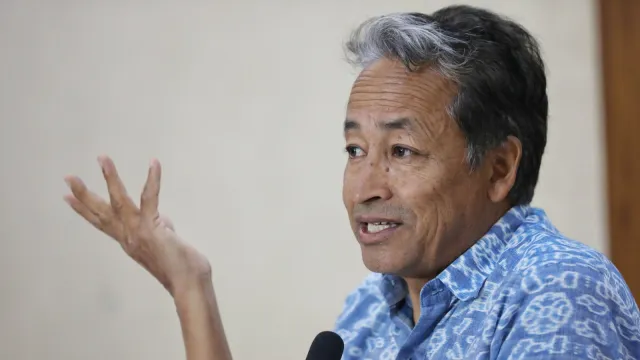
Educationist, innovator, and climate activist Sonam Wangchuk brought a pointed perspective on development, governance, and democratic accountability to IFP Season 16, joining Shoma Chaudhary for a conversation spanning everything from the purpose of education and the environmental costs of progress to Ladakh’s political future, allegations against him and the Cockroach Janata Party (CJP) protest.
Questioning the pursuit of material wealth as a measure of progress, Sonam highlighted the diminishing returns of consumption, saying, “This is what needs to be reminded to all these so-called development gurus, that your very Bible says that more and more of something doesn’t give you more and more of satisfaction.” He added, “Finally, I think wealth and progress are tools to achieve an end. The end is not wealth. The end is contentment, happiness, satisfaction. So if it doesn’t take you there, then you better reconsider.”
The conversation also turned to Ladakh’s future and the need for local communities to have a say in decisions affecting their land and livelihoods. Speaking about Ladakh’s governance and the need for local representation, he said, “And currently Ladakh, most unfortunately, after the 2019 bifurcation has become like a former colony with a viceroy, not from London, from New Delhi, who makes decisions about how people live and manage Ladakh and Ladakh’s nature.” He added, “People who live should have a right to decide how the place should be taken care of.”
On the proposed solar project in Ladakh, Wangchuk reiterated his support for solar energy but questioned its potential impact on local livelihoods and pashmina-grazing land. “They’ll destroy one thing to create another thing,” he said. He also described what he saw during his padayatra, saying, “Then I went into Himachal Pradesh, where entire valleys were to be evacuated to make dams, to produce power thousand times more than what the people there needed or what the people in Ladakh needed.”

Addressing political labels and his commitment to justice, he clarified, “I am with no one. I am with goodness and truth and justice, yeah. If a certain party is with truth and justice, fairness, I’m in support. If they falter, I am not.”
Wangchuk also addressed the CJP protest and his decision to end his fast, explaining that his concerns included the possibility of violence and the prospect of legal harassment for the young people involved. “So I was more moved by the violence prospects and the harassment. Therefore, I gave the condition when the ministers came and said, ‘You have to break the fast’; I said, ‘I’ll have conditions’,” he said. Recalling his time in hospital, he added, “All my phones and everything was taken away. In fact, that was the design. It was a hospital, not a jail, but a hospital turned into a jail so that there is no communication.” He also defended peaceful protest as a democratic mechanism, describing it as “a great mechanism, a feedback, a pressure valve for governments to perform better if they see that.”
From a 50-hour filmmaking challenge that began in 2011 to a multidisciplinary creative platform bringing creators from across the world together, IFP brings the 16th season with the same idea at its heart: make something, put it out into the world, and see where it takes you.













 https://www.youtube.com/watch?si=RtToJsBhYBatUrym&v=mOuYNSdhjHA&feature=youtu.be