Lucknow: Architecture involves the technique of building and also the design appeal, that is, it deals with the structural component as well as the decorative elements. Hindu temple architecture goes beyond meeting functional and serves a deeper purpose. The temple embodies a worldview of cosmic order and guides the devotee through a carefully structured journey into the sacred realm of devotion and divinity. The design of Hindu temple is rooted in ancient cosmological and philosophical understandings that view the temple as a microcosm of the universe itself. It is designed to guide human consciousness, to facilitate spiritual transformation. It serves as a bridge between the material and spiritual worlds, inviting visitors to embark on an inward journey of self-realization and union with the divine.
As the enters the precincts of a temple, he moves from outward multiplicity toward inward concentration, and the structure gently directs perception toward the divine centre. The forms, spaces, and symbols of the temple are meticulously ordered to evoke specific responses, to inspire reverence, and to awaken the senses and mind to deeper truths. Thus, in Hindu temple architecture, the temple emerges as a living sacred presence, where divinity is both revealed and made accessible.

The Design of the Cosmos – Temples are laid out to mimic the universe’s layout, with the central sanctum representing the point of creation, Brahman, the abstract divine source. Through the temple’s proportions, orientation, and symbolism, the devotee journeys through the cosmic layers, progressing towards unity with the divine centre. It teaches that the path toward the divine is a movement from dispersion toward centeredness. In this way, the temple is both a sacred microcosm and a path that guides human consciousness to align with universal consciousness. This orientation toward cosmic order reveals the Hindu belief in a deeply interconnected reality where divinity, nature, and humanity form an inseparable triad.
Temple as Ritual – In Hindu thought, any action can become ritual when performed with intention and awareness. The temple embodies this principle by serving as a physical expression of sacred ritual space.Temple architecture directs the devotee through prescribed movements and practices, such as circumambulation (pradakṣiṇā), aligning bodily movement with cosmic cycles. Rituals within the temple help devotees perceive ṛta, the cosmic order that governs creation. This alignment is understood not only as symbolic but as a way of making unseen universal rhythms experientially present.Through ritual participation, devotees harmonize their actions with divine order, transforming physical movement into a process of inward refinement and spiritual awakening.By engaging in temple rituals, devotees harmonize their actions with divine order, transforming physical movement into a process of inner transform
The VāstupuruṣaMaṇḍala, based on principles from the VāstuŚāstra, which governs spatial harmony,is central to Hindu temple architecture. It maps the temple space, integrating various deities and energies into a grid structure. It is a sacred diagram that links earthly space (vāstu) with the cosmic being (puruṣa). The maṇḍalaitself is a yantra, a sacred diagram that invokes specific energies. It establishes the temple as a place where terrestrial and cosmic forces are brought into alignment. The grid’s divisions represent deities associated with different cosmic functions, ensuring that each area within the temple resonates with divine consciousness. This layout acts as the template through which earthly and cosmic energies connect, drawing the devotee into an active alignment with universal forces.


The style of construction depends on the country or region as well as the time period. In many parts of the world, large buildings such as palace, forts or temples have similar construction features. In Tamil, the word for temple is ‘koyil’ – ‘ko’ ‘il’, which translates as ‘king’-‘abode’. This indicates that the building is large, befitting a king, and also that it is like a palace. The meaning can be understood as – ‘Residence of The Lord who is the king of our world’. Temple design is a very advanced subject in Agama and śilpaśāstras and have detailed measurements, ratio and proportions etc. for perfect construction.
India with its long history has a large variety in terms of architecture in different regions and time periods, and yet the basic designs of a temple complex share many common features. When we consider the Jain temples in Rajasthan and Shore temple in Mahabalipuram, we can see the variety in the landscape, materials and design of the structures.
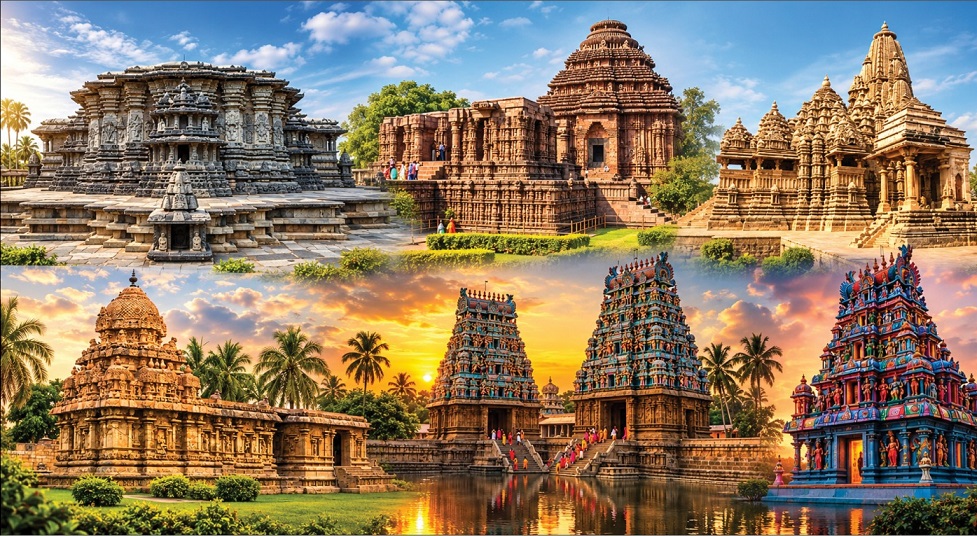
Styles of Temple Architecture: Nāgara, Drāviḍa&Vesara – Temple architecture is broadly classified into three types in India. Nāgara is mostly found in North India as in Khajuraho and Puri. Many temples in South India are of Dravidian style, and within that they show features of Pallava, Chola, Vijayanagar as well as Nayaka styles as they were renovated by many kings over time. Great examples are in TanjavurBrihadeeswaraand Madurai Meenakshi temples. Vesara style is mainly found in Hoysala architecture at Belur and Halebid. These are special designs with star-shaped base, found in Karnataka.












 https://www.youtube.com/watch?si=RtToJsBhYBatUrym&v=mOuYNSdhjHA&feature=youtu.be