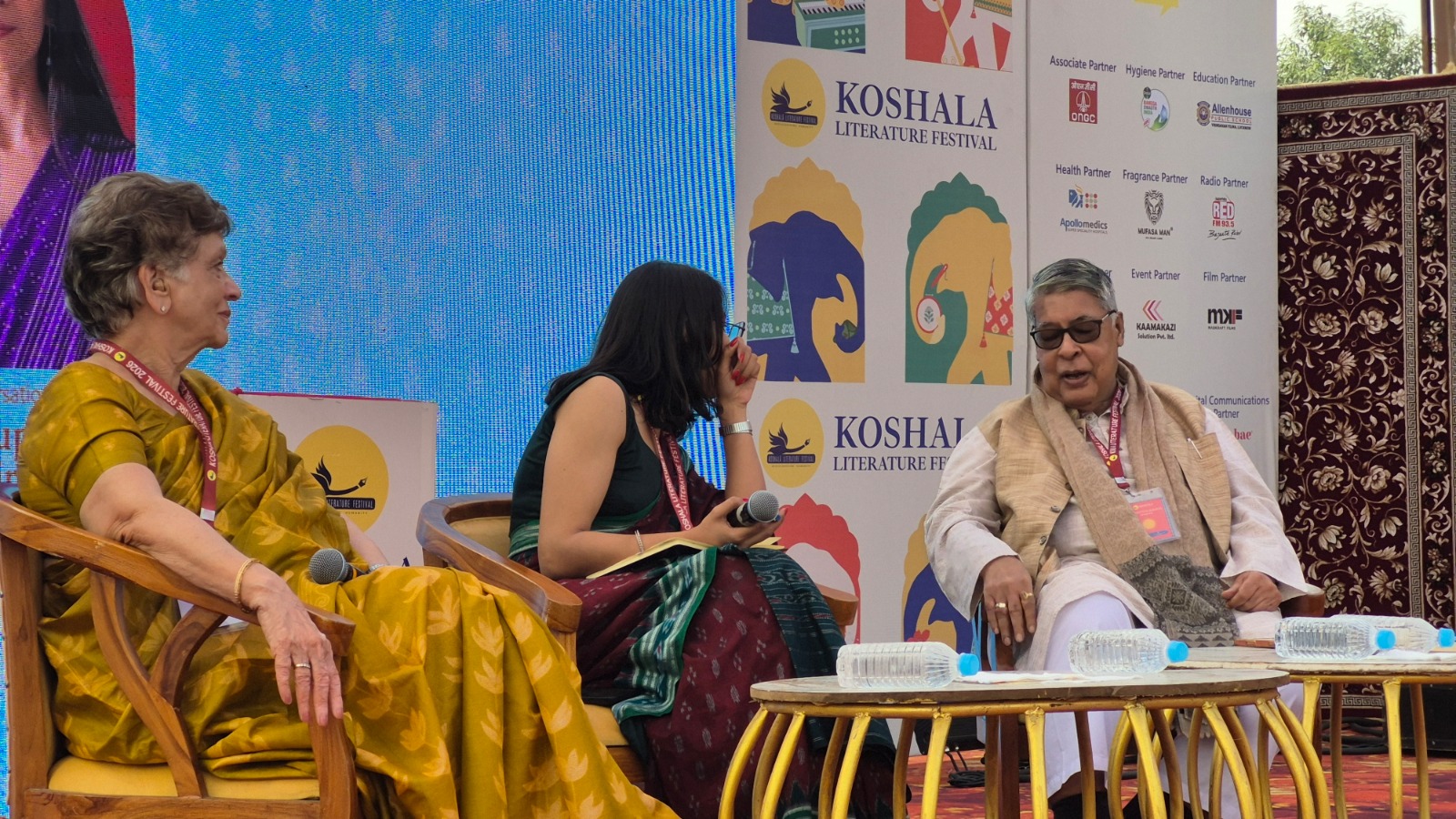
Purushottam Agrawal and Neera Chandhoke in conversation with Kanupriya Dhingra
Lucknow: What does freedom actually mean, and who gets to shape the idea of India? This conversation went well beyond political leaders to look at the poets, writers, filmmakers and thinkers who have shaped the country’s sense of itself.
For Neera Chandhoke, freedom starts with being able to think, question and argue without fear. It isn’t simply doing as you please. It includes the right to question the government and its institutions, and a democracy, she said, can’t be reduced to the arithmetic of majorities. It needs strong institutions and healthy norms to hold it up. Purushottam Agrawal added that freedom often arrives with fresh problems. Drawing on Rousseau and on India after 1947, he pointed out that people can win political freedom and still be stuck with poverty, joblessness, illness and inequality.
Cinema came up as a mirror of those early years. Agrawal talked about Guru Dutt’s Baazi and Raj Kapoor’s Awara, both from 1951, which followed ordinary people struggling against hard social and economic realities even in a newly independent country. He also spoke about Pyaasa, and the song in which the poet asks where those who claim to be proud of India are now. To him, it captures the disillusionment that followed the promise of freedom. Cinema and literature, he said, don’t just reflect society. They question it, expose its contradictions and nudge audiences to see things differently.
The two speakers also argued that political ideas don’t live only in academic papers. They surface in films, poems, novels and popular culture. Agrawal said literature deals with the messiness of human life, and used Godan as an example: its characters can’t be boxed into “good” or “evil” because they carry so many sides of human behaviour and circumstance. He also stressed creative freedom, noting that bodies like the National Film Development Corporation have backed films that look critically at government and society.
On how young readers should approach Jawaharlal Nehru, Agrawal called him a significant figure in India’s political and intellectual history, and his contribution to nation-building still relevant. His mistakes deserve honest scrutiny, he said, but criticism shouldn’t become a way to dodge present-day responsibility. For a broader picture, he recommended Who Is Bharat?, Ramachandra Guha’s India After Gandhi, and writing on Nehru’s relationship with Subhas Chandra Bose. He also underlined India’s diversity, and said unity in diversity remains key to understanding the country.
Turning to Gandhi, Swaraj and the freedom movement, Chandhoke asked how the idea of freedom changed during the struggle. Agrawal observed that the language of mainstream nationalist leaders was often heavily Sanskritised, which could leave parts of India’s varied society out. He spoke of minority concerns, caste inequality, and the movement’s limited engagement with caste and patriarchy. He also pointed to Urdu literature and the Progressive Writers’ Movement, which confronted poverty, oppression and gender inequality, showing how the idea of freedom kept widening through voices that were often pushed to the margins.
The last part of the evening was about dissent, civil liberties and room for criticism in India today. Agrawal traced the history of civil liberties within the national movement and voiced concern over the weakening of institutional safeguards, especially the judiciary’s role in protecting citizens’ rights. Dissent, he argued, is essential to democracy, and protest movements can invent new forms of political expression. Looking at student movements and protest culture, he noted that satire, humour, unconventional language and even profanity have sometimes become ways of challenging authority.
The speakers closed on a shared note: freedom is never finished. It’s an ongoing process. Cinema, literature, political thought and public dissent keep shaping how India understands itself. They urged people to protect freedom of expression, think critically, and remember that democracy depends not just on voting, but on citizens’ ability to question power, debate openly and challenge injustice.








 https://www.youtube.com/watch?si=RtToJsBhYBatUrym&v=mOuYNSdhjHA&feature=youtu.be