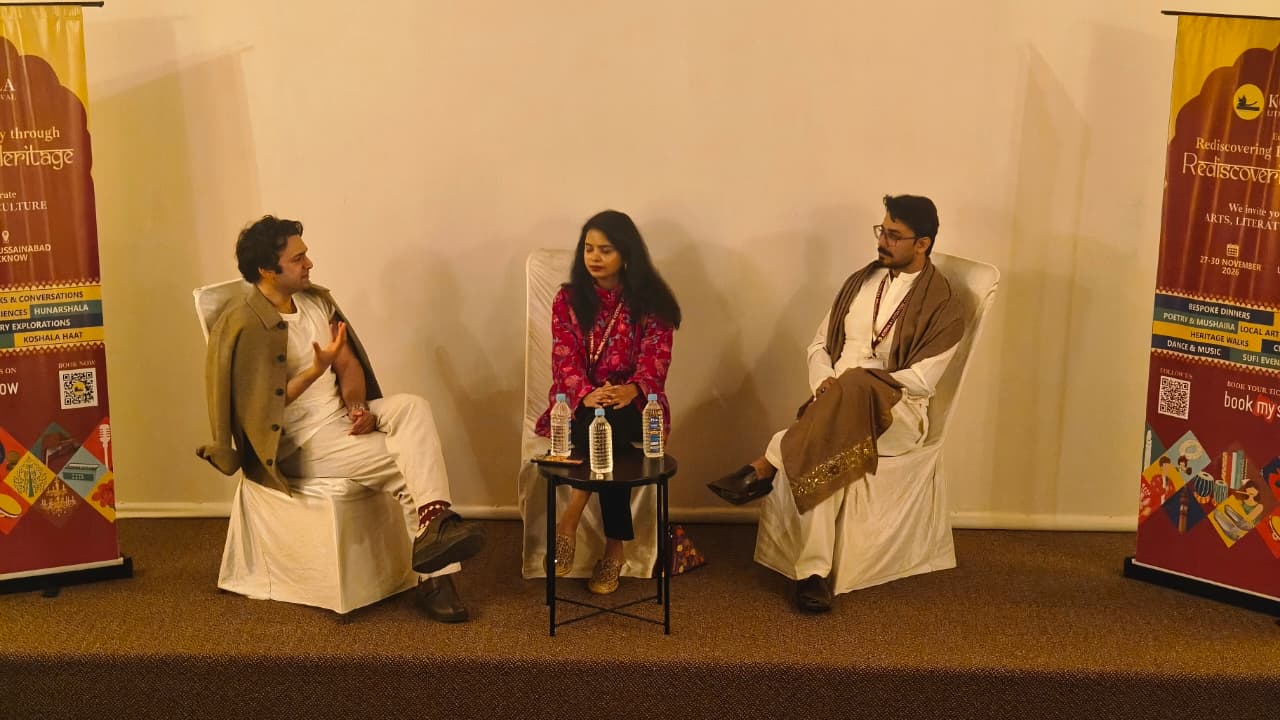
Lucknow: 2:40 pm to 3:20 pm, Inside LMHA Museum. In conversation: Taha Ahmad and Syed Mohd Zaid. Moderated by Taruka Srivastava.
Some sessions at a festival are talks. This one felt more like a conversation about where art actually comes from: the family stories, the city, and the habits that shape a creator long before anything gets made.
Rooted and global
Taha Ahmad lives in two worlds. He is deeply rooted in Lucknow but works globally, with credits that include Netflix and time on the sets of A Suitable Boy with Mira Nair. When Taruka pointed out that being both is not easy, he went back to his family home and to Anjuman-e-Arzu, the cultural organisation his family of lawyers ran. Faraz and Sajjad Zaheer sat in its mehfils and mushairas. Prithviraj Kapoor visited, and Begum Akhtar once performed at the house.
The real spark came later, when Taha found his grandfather’s 120 mm camera and a green file of family papers. Inside were nearly a thousand letters, among them some from Braj Narayan Chakbast, plus unpublished poems and old books. That file pulled him toward Urdu and Awadhi. Today he blends costumes, sets and stills from his Netflix work with Indian artefacts, and the India Art Fair will show this work next year. His way of staying global is to take South Asian stories to the West through a South Asian gaze.
Lucknow and its tehzeeb
Syed Mohd Zaid isn’t from Lucknow, yet the city has loved him so warmly that people often assume he is. He called Lucknow the heart of Ganga-Jamuni tehzeeb, even though neither river runs through it. The city, he said, is possessive about its culture and has never tampered with it. But he was honest about where things stand: the tehzeeb is fading, and “we have done it ourselves.”
His advice was simple. Ask your families about their traditions, and then actually follow them. He pointed to the logic inside everyday customs, like gudiya on Holi and sewaiyan on Eid, and said Lucknow’s food is research-based and seasonal. He also asked people to take responsibility for looking after the city’s monuments.
The AI question
The two disagreed here, and the disagreement was interesting. Taha recently visited the sets of King, where nearly 60 per cent of the work used AI, including Korean AI technology. He found it amazing. In his view AI isn’t going away, and it should enhance creativity rather than create dependence, since it saves time, labour and budget. In his own practice he uses it in immersive displays but makes the work by hand.
Zaid stays away from it. He relies on practical effects and called AI a necessary evil.
Facing resistance
Asked about the racism creators face in other countries or states, Taha said to find your own people, and to learn to see the thin line between critique and hatred. Zaid said you have to understand your niche to make art, and then go beyond it.
Staying hungry
Taha named three things that keep his creative hunger alive: passion, goals and desire. He added that success and failure are more nuanced than we tend to think.
Zaid’s advice was practical. Use references and quotes in your content. Everyone makes mistakes, and patience eventually moves you ahead. Rejection matters, and feedback should come from experts in your field. On social media, work matters more than numbers, the algorithm will find good work, and creators should focus on organic followers.
He shared a story to prove it. His reel on Mahatma Gandhi and “Raghupati Raghav Raja Ram,” posted on 1 October, got fewer views than his other reels. Even so, Chief Minister Yogi Adityanath appreciated it, and it won him a content creator award from the government.
Taruka ended by asking the audience to embrace rejection and build resilience. In the end, she said, it comes down to self-belief.










 https://www.youtube.com/watch?si=RtToJsBhYBatUrym&v=mOuYNSdhjHA&feature=youtu.be