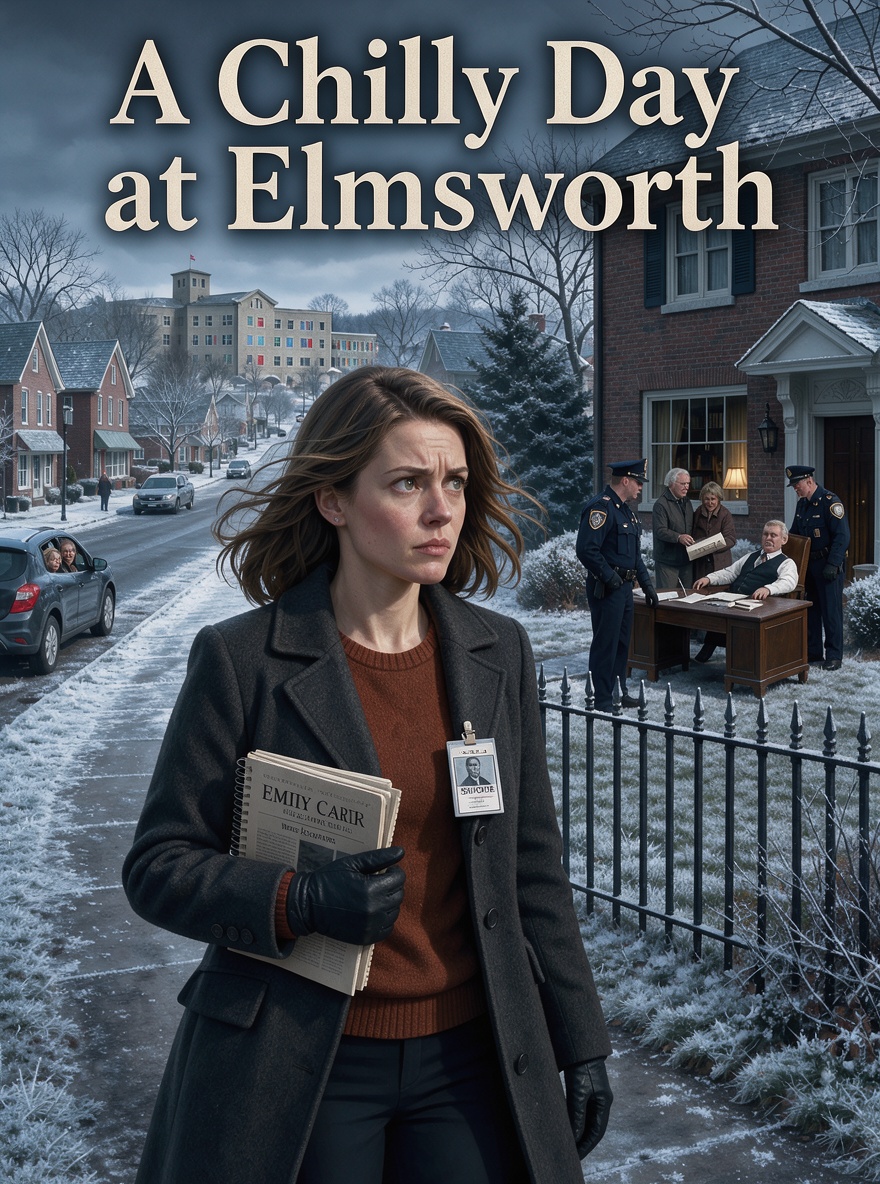
Elmsworth was the kind of town where people waved from their cars. So when Gregory Halstead was found dead in his study on a Tuesday morning, the news spread faster than the police could have stopped it.
He was sixty-one, a businessman, the man behind the new children’s wing at the hospital. The study door had been locked from the inside, and the housekeeper had to get her husband to take it off the hinges. There was no forced entry, no weapon, no prints but his own. The coroner wrote “suicide” on the preliminary report, and most of the town nodded along because the alternative was harder to think about.
Emily Carter didn’t nod. She was twenty-eight, three years into a job at the county paper, and she had a habit that her editor called stubbornness. Halstead had given a speech at the library fundraiser two weeks earlier, and she’d been in the room. He hadn’t looked like a man who was done.
She found the note on her second visit to the house, in a drawer of his things that the family had boxed up and not yet touched. Half a sheet, handwritten, dated the following Friday. Final meeting. Remember the promise. Don’t let her find out. The date made no sense for a dead man, and she read it a dozen times before deciding it hadn’t been a mistake. He had been planning something and he’d known it might not go his way.
Three people had reason to want him gone, and she wasn’t sure which of them frightened her most.
William Reyes had been Halstead’s partner for twenty years. The paper had run a small item in March about the company’s debts, and William had been seen at the bank more often than a healthy man would be. Clara, Halstead’s sister, had come home after a decade away, and she told anyone who asked that she’d come to make peace. Their father’s will had left her almost nothing, though, and she did not look like a woman who had forgiven it. Then there was Nora Quinn, who had been Halstead’s assistant for six years and who a neighbor had seen leaving his office the afternoon before he died. Nora was kind to Emily, helpful in a way that took a while to feel strange.
The weeks went by. Emily spent hours in the library basement with the microfilm reader, and in October she found a clipping from 1989. A warehouse owned by the Halstead family had burned to the ground one night in November. Nobody was hurt, the insurance paid out, and the article ran four paragraphs. It was the kind of story people forget, and she thought that was the reason she kept thinking about it.
Other details began to line up. A friend of Halstead’s told her he’d been taking calls in the garden, voice low, hand over the phone. His lawyer, after some persuading, admitted that a large life insurance policy had been taken out only two months earlier. The sole beneficiary was Clara.
Clara, when Emily brought it up, went very still. “I didn’t know,” she said. Emily wasn’t sure she believed her.
Then the pressure started. A car she didn’t recognize idled outside her apartment two nights in a row. A source she’d trusted gave her a name that turned out to belong to a man who’d died in 2004. Testimony she’d collected began to contradict itself. William swore Halstead had been about to cut him out of the company, and Clara insisted she’d been the one trying to make amends. Nora, whenever Emily tried to pin down a time to talk, had somewhere else to be.
In early November, following a tip about a possible witness, Emily ended up in the old Halstead house on Marrow Lane, empty since the seventies. It smelled of damp plaster and mice. In a bedroom upstairs, one wall panel sounded hollow when she knocked, and behind it was a flat tin box of letters. They were written in two different hands, mostly bitter, about money and a betrayal she couldn’t fully piece together. Whatever had gone wrong in that family had gone wrong decades ago, and nobody had ever finished arguing about it.
The threats came a week later, one taped to her windshield and one pushed under her door. Stop. Nothing else. She kept both and kept working.


Then a photograph turned up in the back of a file box. Halstead stood at the edge of a parking lot, talking to a man whose face the camera had caught only in profile. Emily looked at the shape of his shoulders and felt cold. She knew that posture. She couldn’t say from where, and that bothered her more than if she could.
It was the note that finally cracked it. She went back to it one night and stopped looking at the date and read the wording. Don’t let her find out. Halstead hadn’t been writing to anyone. He’d been writing for himself, a reminder of something he was afraid of, and the “promise” wasn’t a promise. It was a price. Someone had been squeezing him with the family’s old secrets, and he had been paying for a long time.
She went to Nora because she wanted to be wrong.
Nora was in her kitchen, and she didn’t seem surprised. She poured two cups of tea and sat down across from Emily like she’d been expecting this conversation for weeks. “I wondered how long it would take you,” she said.
She told it quietly. She had known the family’s history for years, because Halstead had trusted her with more than he should have. At some point she’d decided to use it. The money had been small at first, then not small. She’d kept steering Emily too, a nudge here and a name there, because she’d wanted to know how close the story was to the truth.
“I didn’t kill him,” Nora said. “I want you to understand that. He called me to his study that night and told me he was going to the police, that he was done. We argued. I told him he’d lose everything. He locked the door behind me when I left, and I heard the lock turn.” She looked at her hands. “I told myself he wouldn’t do it. I didn’t call anyone.”
The police found the pill bottle in the study drawer, the one the first officers had written off as routine. It turned out Halstead had taken everything in it. He had locked himself in so nobody would stop him, and what had pushed him there wasn’t a stranger with a knife but a person he’d trusted, standing on the other side of the door.
When the police arrived, Nora gave one more thing away, almost as an afterthought. Halstead hadn’t only been afraid of her. A few months before he died, he’d found something out about his own family’s money, about where it had really come from and who in Elmsworth had known and helped. Organized crime had been laundering through the Halstead company for thirty years, and a few people in town had been well paid to look the other way. Some of them were still in office.
Emily stood outside the station afterward as the light went amber over the hills. She thought about the study, about the lock that had turned from the inside, about the date on the note. The case was closed, and the town would call it a tragedy and move on.
But the photograph was still in her bag, and she still couldn’t place the man in it. Someone in Elmsworth had been controlling all of this for a very long time, and she wasn’t sure the person in handcuffs was the only one who knew where the doors were.











 https://www.youtube.com/watch?si=RtToJsBhYBatUrym&v=mOuYNSdhjHA&feature=youtu.be