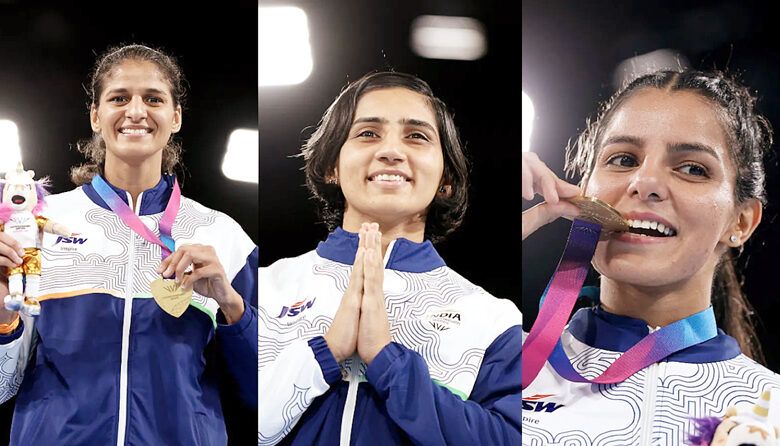
Glasgow: There are moments in sport that get etched into history in letters of gold, and Indian boxing wrote exactly one such chapter at the Commonwealth Games 2026 in Glasgow. When India’s boxers stepped into the ring, there was a different kind of confidence on their faces and an unmistakable glint of victory in their eyes — a glint that wasn’t the result of a single day’s effort, but of years of sweat, countless struggles, and a burning desire to prove themselves on the world stage. This time, the Indian contingent competed in ten boxing finals and won a medal in every single one — proof, if any were needed, that Indian boxing has arrived at an entirely new level. Seven gold and three silver medals is no small feat. It’s India’s best-ever boxing performance at the Commonwealth Games, and one that has made the nation proud.
This historic success can’t be measured by medal count alone. Behind it lies the story of talent emerging from India’s small towns, villages, and qasbas — young athletes who refused to let their dreams die despite countless hardships. Whenever boxing comes up, it’s natural for places like Bhiwani and Rohtak in Haryana to be mentioned, but this time, the list of medal winners is proof that this sporting passion has spread across the entire country. The Boxing Federation of India’s forward-looking policies, sustained government support, and the round-the-clock dedication of coaches have together built an ecosystem where athletes now step into the ring not just to participate, but to win. This performance is clear evidence that Indian boxers can now match the world’s best, both technically and physically.

Perhaps the most striking part of this extraordinary success has been the dominance of India’s women boxers. In the women’s category, India claimed gold in five separate weight divisions — a living example of women’s empowerment. Sakshi Chaudhary in the 51kg category, Preeti Pawar in 54kg, Jasmine Lamboria in 57kg, Priya Ghangas in 60kg, and Arundhati Chaudhary in 70kg displayed a level of aggression and technical skill that left sporting experts around the world stunned. These women proved that India’s daughters are second to none in any field. Their punches didn’t just land on their opponents — they landed on the rigid, old-fashioned mindsets that still try to confine girls within four walls. Their agility inside the ring, precise footwork, and sense of timing made them virtually unbeatable. This win is an inspiration for every young girl in India who is gathering the courage to dream big for herself.
The men held their own too, delivering a string of impressive performances. Sachin Siwach in the 60kg category and Ankush Panghal in 80kg won gold, sending a clear signal that the future of Indian men’s boxing is in very safe hands. The balance of composure and aggression both fighters showed inside the ring was a sight to behold — they gave their opponents no room, turning their bouts one-sided through sharp, well-planned strategy. Jadumani Singh in the 55kg category and Narender Berwal in the 90kg-plus division added silver medals to the tally, bringing further credit to the country. Those silvers are no less valuable than gold — both fighters beat several of the world’s top boxers on their way to the final, and their performances will serve as a strong foundation heading into upcoming events like the World Cup and the Olympics.
The experienced campaigners in the squad were just as vital to its strength. Olympic medallist Lovlina Borgohain won silver in the 75kg category, proving her consistency yet again. Sport has its ups and downs, and finals are sometimes lost by the finest of margins — but Lovlina’s return to the podium shows the old fire is still very much alive in her. Her mere presence would have taught the younger athletes a great deal. As a senior member of the team, she played a mentoring role for the whole squad, and her experience is bound to prove invaluable in India’s future competitions.

It’s also worth understanding the science and technical thinking behind this success. Boxing today isn’t just a test of strength anymore — it has become a complex mix of mental preparation, technique, sports science, and video analytics. A huge part of the credit for this success belongs to the coaches and support staff, who studied every opponent’s weaknesses closely and built strategies around them. Everything, from diet to mental well-being, was carefully looked after. The impact of the government’s significant recent investment in sports is now visible on the ground — the grassroots talent-development drive that was set in motion some years ago is now bearing fruit at scale. When an athlete gets access to world-class facilities, their confidence naturally grows, and that very confidence was on full display in the Glasgow boxing arena.
This golden run in boxing has also given a major boost to India’s overall medal tally at the Games, helping the country hold a strong position among the leading nations on the standings. There was a time when India’s medal hopes rested largely on a handful of sports like shooting or wrestling, but boxing has now firmly established itself as a major sport in its own right. This shift didn’t happen overnight — at the 2018 Gold Coast Commonwealth Games, India won seven medals in total, including three gold, which was the best performance at the time. Breaking that record with ten medals, seven of them gold, marks a massive leap forward — a sign that India’s sporting system has matured to a point where it keeps setting new records against its own past achievements.
The impact of this historic win won’t be limited to the medal table. Its biggest effect will be on the millions of young Indians who dream of building a career in sport. When an athlete stands on an international stage holding the national flag as the anthem plays, that moment brings the entire country together. Today, athletes like Sakshi, Preeti, Sachin, and Ankush have become new role models for the youth — a living symbol of hope for children training and sweating it out in akharas and rings across India’s villages and small towns. This win will add a new dimension to the country’s sporting culture and give parents the confidence that a golden future can indeed be built in sport too. It should also encourage sports federations and sponsors to invest further in boxing, which in turn should bring better facilities and results in the years ahead.
In the end, it’s no exaggeration to say that what India’s boxers achieved in Glasgow will be remembered for generations. Seven gold and three silver medals aren’t just pieces of metal — they represent a new identity for Indian boxing. They’re the echo of a new India that no longer considers itself second to anyone on the world stage. These athletes have proven, through sheer hard work, that any goal is achievable with honest effort in the right direction. Attention will now turn to the upcoming World Championships and the Olympics. Glasgow’s golden success has raised the hopes of an entire nation, and it’s safe to say India’s boxers are fully prepared for the challenges that lie ahead. This golden era of Indian boxing has only just begun — and in the years to come, it promises to shine India’s name even brighter on the world stage.