By Dhruv Wahi, Goa Institute of Management
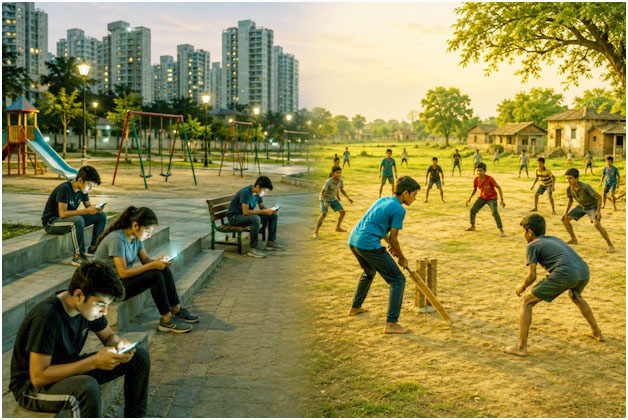
Lucknow: A walk in any park on a week day evening in Gomti Nagar or Indira Nagar reveals a startling trend. The swings remain unbent with children playing on them. The cricket fields host no players. In their place, the teens lounge in the balconies or inside, with their eyes glued to the smartphone screens. For the city youth, smartphone has replaced the playground.

Reality Check
This observation can be backed up by a study conducted by the Dr. Ram Manohar Lohia Institute of Medical Sciences, Lucknow. It reports that over 99% of over 650 children surveyed exceeded the recommended screen time limits for their respective ages. Further, over 60% parents believed that screen time was a safer alternative to letting their children play in the streets. The reasons cited include traffic, safety and the gradual disappearance of open grounds where kids can play.
The problem is not unique to Lucknow. India’s Economic Survey 2017 observes that the country has an extremely high prevalence of social media and gaming addiction among the 15-24 age group. The issue is especially acute in urban centres due to the lack of community-based recreational facilities. Further, a study on Gaming Disorder among Indian School Children concludes that Indian children who spent over three hours daily on games were more likely to report poor sleep, stress, anxiety and depression.
Contrast and Compare
The scenario in the villages surrounding Lucknow, such as Mall, Kakori, or Malihabad is drastically different. Even today, the evenings echo with the sounds of children playing cricket or kabaddi. The village kids continue to play cricket and kabaddi, and their creativity knows no bounds. They use their bikes and imagination to create thrilling adventures. Of course, the smartphone culture has begun to seep even into the villages. But the smartphone has not overtaken outdoor games.

The smartphone addiction in rural areas is caused due to high internet penetration and an absence of other entertainment venues. But the rural lifestyle still permits community bonding and children playing outdoors and building social skills.
Disorder in Disguise
The disorder associated with smartphone addiction on the children is not just physical inactivity. The mental health fallout has also been severe. The study on Gaming Disorder among Indian School Students concludes that gaming addiction leads to deterioration of social behaviours and relationships.
Outdoor games and sports provide the much-needed socialisation platform for a child. It introduces him/her to teamwork, leadership, good sportsmanship and handling victory and defeat. This environment, sadly, is absent when a child plays a game on his/her smartphone. Today, psychologists see a rising number of young adults who have trouble developing relationships, since their social interactions as children were limited to the screen and virtual interactions.
Conclusion
The smartphone culture has overtaken the city playgrounds, with deleterious effects on the body and mind of the child. However, the villages have resisted the complete takeover by technology, substituting it with outdoor activities. This insight can prove to be beneficial to the urban centres. As Lucknow progresses as a smart city, planners need to ensure that parks and playgrounds are not sacrificed at the altar of progress. The smartphone addiction afflicting children needs to be countered by encouraging physical activity and community interaction. After all, sometimes, the best technology is no technology at all.