New Delhi | As India marks Hindi Journalism Day, media professionals, scholars and readers across the country are reflecting on the remarkable journey of Hindi journalism—a journey that has played a pivotal role in shaping public consciousness, strengthening democracy and contributing to nation-building for nearly two centuries.
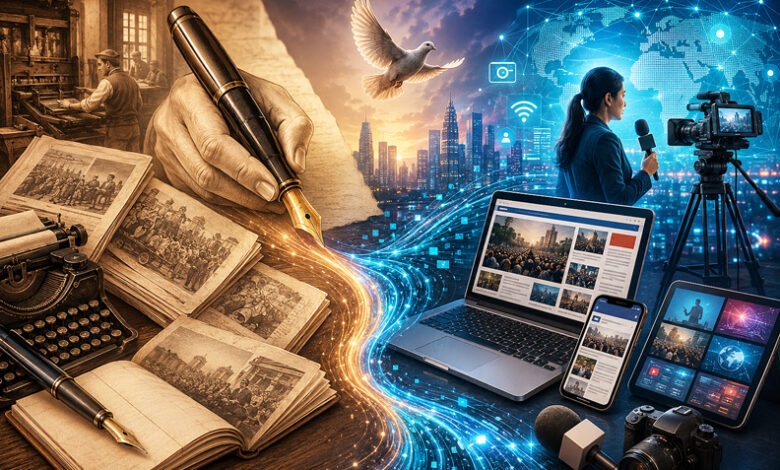
Often described as the voice of India’s social and cultural identity, Hindi journalism has evolved from handwritten editorials and printed newspapers to digital platforms, podcasts, mobile journalism and artificial intelligence-driven newsrooms. Yet its core mission—informing citizens and holding power accountable—remains unchanged.
The Birth of Hindi Journalism
The foundation of Hindi journalism was laid on May 30, 1826, when Pandit Jugal Kishore Shukla launched Udant Martand, the first Hindi newspaper, from Kolkata. The publication emerged during British colonial rule, a period marked by limited resources, financial constraints and significant communication challenges.
Despite these obstacles, the newspaper represented a bold effort to provide information in Hindi and connect with a wider Indian audience. Though Udant Martand struggled financially and had a short lifespan, it ignited a movement that would grow into one of the most influential forces in Indian public life.
Journalism as a Tool of National Awakening
The early decades of Hindi journalism were characterized by commitment, sacrifice and public service. Publications such as Banaras Akhbar, Hindi Pradeep, Kavi Vachan Sudha, Bharat Mitra, Saraswati and Pratap became important platforms for social reform, education and political awareness.
Far from being a commercial enterprise, journalism during this period was viewed as a mission dedicated to public welfare and national awakening. Newspapers served as vehicles for spreading ideas of self-respect, education and freedom among ordinary citizens.
A Powerful Voice During the Freedom Movement
Hindi journalism played a critical role in India’s struggle for independence. Prominent figures such as Bal Gangadhar Tilak, Ganesh Shankar Vidyarthi, Baburao Vishnu Paradkar, Makhanlal Chaturvedi and Mahatma Gandhi used journalism as a tool to challenge colonial rule and inspire public participation in the freedom movement.
Pratap, edited by Ganesh Shankar Vidyarthi, became a symbol of resistance against injustice and oppression. Baburao Vishnu Paradkar elevated Hindi journalism through intellectual rigor and editorial integrity, while Mahatma Gandhi consistently emphasized truth, ethics and public service as the foundation of responsible journalism.
Many journalists of the era faced imprisonment, censorship and legal persecution. Yet their commitment to truth and national interest remained unwavering.
Journalism in Independent India
Following independence, Hindi journalism entered a new phase, focusing on nation-building and development. Newspapers increasingly highlighted issues affecting farmers, workers, rural communities and marginalized sections of society.
The expansion of radio broadcasting, followed by television and satellite news channels, significantly broadened the reach of Hindi media. As literacy levels improved and newspaper circulation expanded, Hindi emerged as one of India’s most influential media languages.
Throughout this period, Hindi journalism maintained a close connection with ordinary citizens, often amplifying voices that were overlooked by political and administrative institutions.
The Digital Revolution
The twenty-first century has transformed journalism more rapidly than any previous era. News is no longer confined to printed pages or television broadcasts. Digital platforms, social media networks, podcasts, video streaming services and mobile applications have fundamentally changed how information is produced and consumed.
Today, millions of Indians access news through smartphones, while independent journalists and creators from smaller towns and rural areas have found new opportunities through digital media.

The rise of artificial intelligence, data journalism and multimedia storytelling is further reshaping newsrooms. Information now travels across the world in seconds, making journalism more immediate and accessible than ever before.
Challenges in the Modern Era
Despite technological progress, journalism faces serious challenges. Media experts frequently cite concerns over misinformation, fake news, sensationalism, declining public trust and increasing commercial pressures.
The race to publish breaking news often creates tension between speed and accuracy. Social media platforms have democratized communication, but they have also accelerated the spread of unverified information and misleading narratives.
Many observers argue that journalism’s greatest challenge today is maintaining credibility in an environment where information is abundant but verification is often lacking.
Concerns have also been raised about the influence of market forces, corporate interests and ideological polarization on editorial independence.
Preserving Journalism’s Core Values
Media scholars emphasize that journalism’s fundamental purpose extends beyond delivering information. A healthy press serves as a watchdog of democracy, encourages informed public debate and promotes accountability.
In this context, the enduring principles of truth, impartiality, public interest and social responsibility remain as relevant today as they were during the freedom struggle.
Experts believe that while technology will continue to transform news production, journalism’s true strength will always lie in human judgment, ethical reporting and a commitment to serving society.
A Promising Future for Hindi Media
The future of Hindi journalism appears promising as India’s digital ecosystem continues to expand. With Hindi among the fastest-growing languages on digital platforms, regional and language-based journalism is expected to play an increasingly important role in shaping public discourse.
Artificial intelligence and emerging technologies may change how stories are produced and distributed, but the essence of journalism—understanding human experiences and speaking truth to power—cannot be replaced by machines.
As the country commemorates Hindi Journalism Day, tributes are being paid to generations of editors, reporters, photographers, camerapersons and media workers who have dedicated their careers to informing society and strengthening democratic values.
Nearly two centuries after the launch of Udant Martand, Hindi journalism continues to stand as a powerful expression of India’s cultural identity, public consciousness and democratic spirit—a testament to the enduring power of the written word in shaping history.