Lucknow: Lucknow witnessed a powerful coming together of educators, policymakers, social leaders, and learning experts as the two-day Leadership Circle Conference concluded with a strong collective commitment to ensure that every child in India becomes foundationally literate and numerate.
Organised by DEVI Sansthan, the conference brought together more than 2,000 educationists, school leaders, academicians, policymakers, and social sector representatives from 18 states and Union Territories, creating a vibrant national platform focused on improving foundational learning outcomes across the country.

The event highlighted the growing urgency around foundational literacy and numeracy (FLN), which experts increasingly regard as the most critical building block for quality education and lifelong learning. Through discussions, demonstrations, workshops, and policy dialogues, the conference aimed to strengthen awareness and collaboration around innovative teaching methods capable of accelerating learning among young children.
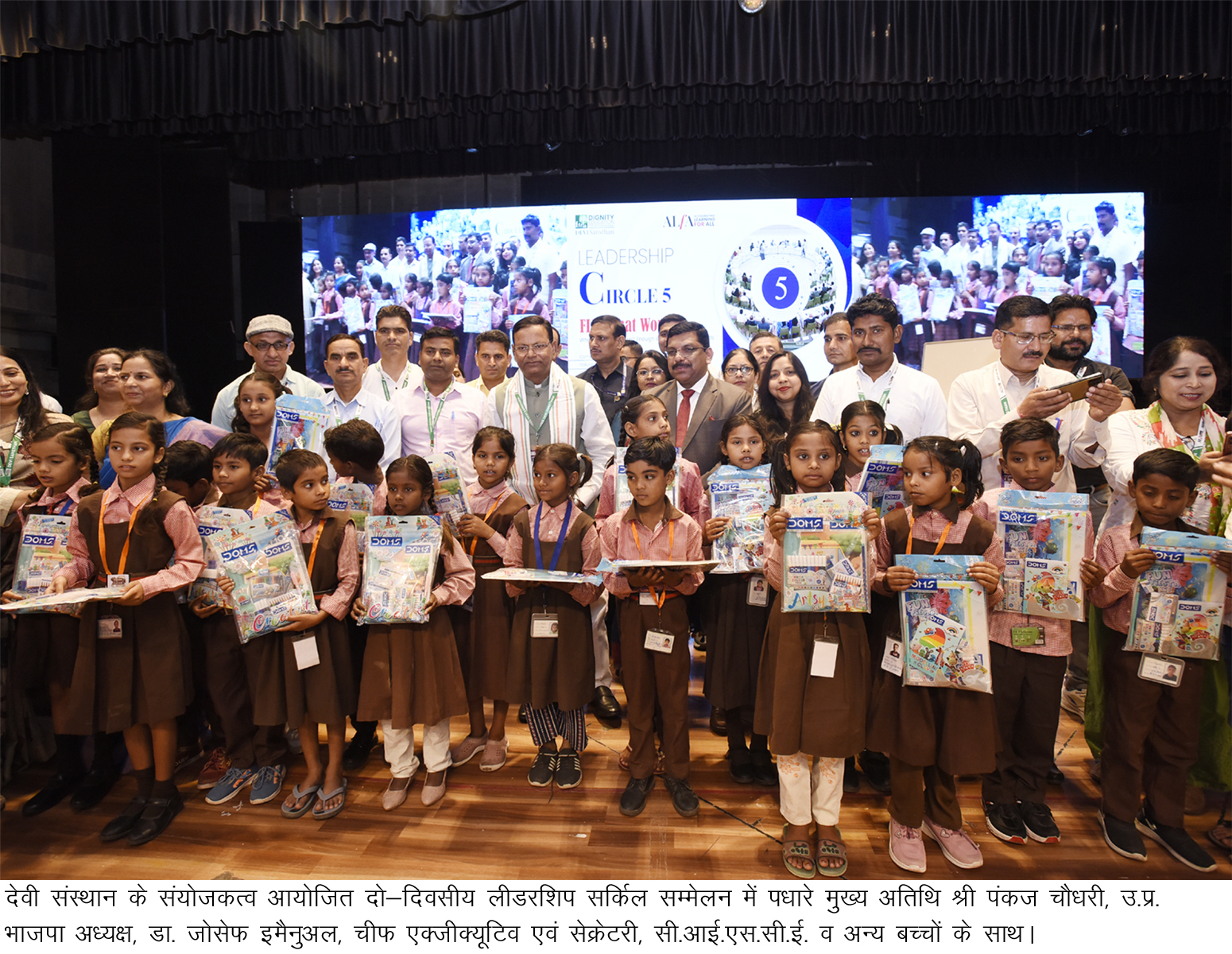
The closing session was attended by Chief Guest Pankaj Chaudhary, who also serves as the State President of BJP, along with Guest of Honour Dr. Joseph Emmanuel, Chief Executive of the Council for the Indian School Certificate Examinations.
Addressing the gathering, Pankaj Chaudhary praised the efforts of DEVI Sansthan and emphasized the importance of strengthening foundational education at the earliest stage of a child’s development. He remarked that literacy and numeracy are not merely academic skills but essential life foundations that shape a child’s future learning journey and overall confidence.
During his visit, the minister also observed live demonstrations of the teaching methodology developed and implemented by DEVI Sansthan. He interacted warmly with young children participating in learning sessions and appreciated the effectiveness of the innovative approach.
He noted that the “Accelerating Learning for All” pedagogy, popularly known as ALfA, appeared both fast-paced and holistic in nature, helping children grasp concepts quickly while maintaining comprehension and engagement.
The conference placed significant focus on the ALfA methodology, which has increasingly gained recognition in education circles for its ability to accelerate learning outcomes within a relatively short period. According to educators present at the conference, the approach enables children to develop reading, writing, and numeracy skills more effectively by making learning interactive, meaningful, and easy to understand.
Earlier in the programme, Nixon Joseph, Group Executive of DEVI Sansthan, formally welcomed the distinguished guests and participants while outlining the broader vision behind the Leadership Circle initiative.
He explained that the conference was designed to create a nationwide dialogue around foundational literacy and numeracy and to encourage stronger collaboration between governments, educators, institutions, and social organizations.
Highlighting the impact of the ALfA pedagogy, Nixon Joseph said that the approach helps children read with understanding and enables them to comprehend even difficult subjects with greater ease and confidence. He stressed that meaningful learning, rather than rote memorization, remains central to the methodology.
Guest of Honour Dr. Joseph Emmanuel also addressed the gathering and underlined the importance of maintaining quality standards in education at every level. He stated that quality in education can never be compromised and expressed appreciation for DEVI Sansthan’s efforts in introducing innovative learning approaches that produce measurable outcomes.
Dr. Emmanuel specifically highlighted the effectiveness of the ALfA pedagogy, noting that the methodology has demonstrated the ability to accelerate learning significantly within a span of just 45 days. He described such initiatives as important contributors toward strengthening India’s educational ecosystem and ensuring that children develop strong foundational competencies early in life.
The conference featured extensive panel discussions on several contemporary and policy-relevant issues linked to foundational learning and educational development. Experts, policymakers, education leaders, and social sector representatives exchanged ideas and explored solutions aimed at improving learning outcomes at scale.

One of the major discussion themes focused on “The World’s Best Investment: Education Versus Other Development Priorities,” where speakers emphasized that investing in education generates long-term social and economic benefits that extend far beyond classrooms.
Another panel discussion explored “Data to Delivery: How Government Systems Can Accelerate FLN Outcomes,” examining how governance structures, technology, and data-driven decision-making can help improve foundational literacy and numeracy across public education systems.
The conference also hosted an important conversation on corporate participation in education through a session titled “Multiplying Impact: CSR Beyond Cheques – Embedding FLN in Corporate Giving Strategies.” Speakers stressed that corporate social responsibility initiatives should move beyond financial support alone and focus on long-term educational partnerships capable of delivering measurable impact.
Adding an engaging and interactive dimension to the event, organizers also conducted a quiz competition based on the ALfA Education Methodology, encouraging participants to deepen their understanding of innovative learning practices and teaching approaches.
The conference atmosphere reflected both urgency and optimism. Participants from different parts of the country shared experiences, success stories, and challenges related to foundational learning in diverse educational settings. The exchange of ideas reinforced the growing national consensus that foundational literacy and numeracy must become a priority if India is to achieve meaningful educational transformation.
Educationists present at the conference observed that children who lack strong foundational skills often struggle throughout their academic journey. As a result, interventions at the early learning stage are increasingly being viewed as critical to improving overall educational quality and reducing long-term learning gaps.
The event also aligned closely with the objectives of the Government of India’s NIPUN Bharat Mission, which seeks to ensure that every child attains foundational literacy and numeracy skills by the end of Grade 3.
Speaking on the occasion, Dr. Sunita Gandhi, Founder of DEVI Sansthan, expressed heartfelt gratitude to all guests, experts, participants, and education leaders who attended the conference from across the country.
She described the gathering as an important national step toward strengthening foundational learning and supporting the vision of the NIPUN Bharat Mission. Dr. Gandhi remarked that the participation of representatives from “literally half of India” reflected the growing seriousness and commitment toward improving early education outcomes nationwide.
She emphasized that ensuring foundational literacy and numeracy for every child is not solely the responsibility of schools or governments, but a collective social mission that requires cooperation between educators, families, institutions, policymakers, and communities.
As the conference concluded, participants left with renewed determination to expand the reach of effective foundational learning strategies and accelerate educational transformation at the grassroots level.
Beyond speeches and discussions, the Leadership Circle Conference reinforced a powerful message — that strong foundations in literacy and numeracy have the potential to transform not only classrooms, but the future of millions of children across India.