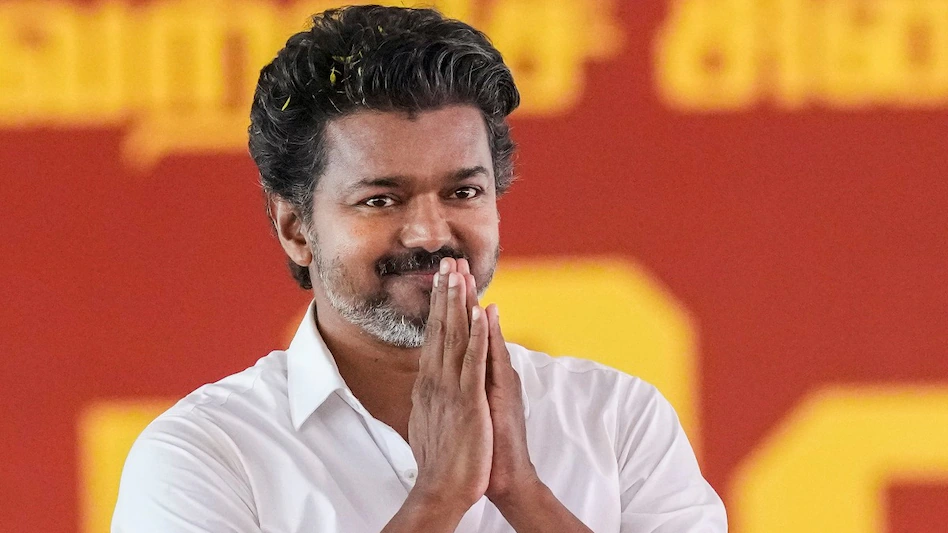
Chennai | In the long and dramatic history of Tamil Nadu politics—where cinema and public life have often blurred into one—few moments have been as electrifying as the events of May 4, 2026. As votes were counted for the Assembly elections held on April 23, actor-turned-politician Joseph Vijay, popularly known as Thalapathy, delivered what many are calling a “real-life blockbuster.” His newly formed party, Tamilaga Vettri Kazhagam (TVK), surged dramatically to emerge as the single largest party in its electoral debut, leading in over 100 of the state’s 234 seats in early trends, with a vote share nearing 34%.
The scale and speed of this rise have stunned observers, effectively breaking the decades-old dominance of the Dravida Munnetra Kazhagam (DMK) and All India Anna Dravida Munnetra Kazhagam (AIADMK). More significantly, it has propelled Vijay into the rarefied league of Tamil cinema icons who successfully transitioned into mass political leaders—a lineage that includes M. G. Ramachandran and J. Jayalalithaa. Yet Vijay’s ascent stands apart for its independence, generational appeal, and astonishing velocity.
From Silver Screen to Political Stage
Born in 1974, Vijay’s journey to political prominence began in the Tamil film industry, where he rose through the 1990s and 2000s as one of the most bankable stars. His films—Ghilli, Thuppakki, Mersal, Sarkar, and Master—cemented his image as a charismatic hero who often took on corruption, inequality, and entrenched power structures.
This on-screen persona was not incidental. In Sarkar (2018), Vijay portrayed a disruptive political outsider challenging a corrupt establishment—a narrative that now appears strikingly prophetic. Over time, his films cultivated a pan-Tamil, cross-caste following that extended across urban and rural divides.
Unlike many actors who make sporadic political forays, Vijay built a sustained grassroots network through the Vijay Makkal Iyakkam, his fan club organization. These networks, originally formed for film promotions and social service, gradually evolved into a proto-political structure capable of mobilizing voters.
A Calculated Political Entry
Vijay’s formal political plunge came on February 2, 2024, with the launch of Tamilaga Vettri Kazhagam. The party’s public unveiling later that year drew massive crowds, signaling strong grassroots enthusiasm.
By late 2025, TVK announced a bold strategy: it would contest the 2026 Assembly elections independently, with Vijay as its Chief Ministerial candidate. This decision—to avoid alliances with established Dravidian parties—marked a clear departure from past precedents.
Where leaders like M. G. Ramachandran had first built their base within existing political frameworks before breaking away, Vijay chose to construct an entirely new platform from scratch. The gamble, though risky, ultimately proved transformative.
The Campaign: Cinema Meets Strategy
TVK’s campaign fused cinematic spectacle with modern political outreach. Vijay’s rallies, infused with his trademark “Whistle Podu” energy, attracted massive crowds, often resembling film celebrations rather than traditional political meetings.
The campaign leaned heavily on:
- Social media engagement targeting Gen Z and first-time voters
- Direct outreach to women and urban middle classes
- Messaging centered on anti-corruption, welfare, and youth empowerment
Importantly, Vijay positioned TVK as a fresh alternative—unburdened by the ideological baggage of Dravidian politics, yet rooted in Tamil identity and social justice themes.
This narrative resonated strongly in a state experiencing generational and aspirational shifts. For many voters, especially younger demographics, the choice was no longer about legacy parties but about performance and change.
Election Results: A Tectonic Shift
As counting progressed on May 4, TVK’s performance exceeded even optimistic projections. Leading in over 100 seats, the party came within striking distance of the 118-seat majority mark in the 234-member Assembly.
The results:
- Dislodged the ruling Dravida Munnetra Kazhagam from its dominant position
- Pushed All India Anna Dravida Munnetra Kazhagam further into the margins
- Established TVK as a formidable new political force
Political analysts described the outcome as a “tectonic shift,” comparing it to the most dramatic electoral upsets in Tamil Nadu’s history.
Echoes of the Past: MGR and Jayalalithaa
Tamil Nadu’s political culture has long been intertwined with cinema. M. G. Ramachandran, or MGR, set the template in the 1970s by leveraging his cinematic persona as a benevolent hero to build a mass political movement. After splitting from the DMK, he founded the AIADMK and became Chief Minister in 1977.
His protégé, J. Jayalalithaa, carried forward this legacy, transforming herself into a towering political figure with a strong welfare-oriented governance model.
Other actors, such as Vijayakanth, attempted similar transitions with mixed success, while figures like Kamal Haasan struggled to convert cinematic popularity into electoral dominance.
Vijay’s rise shares elements with these predecessors but differs in key ways:

- He launched his party at the peak of his film career
- He avoided alliances and contested independently
- His rise unfolded within a compressed timeframe
Why Vijay Succeeded
Several factors explain TVK’s breakthrough:
1. Mass Appeal and Fan Mobilization
Vijay’s extensive fan base translated directly into political capital. Campaign events often mirrored fan gatherings, blurring the line between entertainment and politics.
2. Youth Surge
A significant portion of TVK’s support came from younger voters seeking alternatives to established political narratives.
3. Strategic Independence
By avoiding alliances, TVK retained a distinct identity—unlike smaller parties that often get subsumed within larger coalitions.
4. Anti-Incumbency
Voter fatigue with existing parties created fertile ground for disruption.
5. Narrative Simplicity
TVK’s messaging—clean governance, welfare, and opportunity—resonated across demographic groups without heavy ideological framing.
Beyond Victory: The Larger Significance
Vijay’s ascent marks more than an electoral upset—it signals a structural shift in Tamil Nadu politics.
Breaking the Duopoly
For decades, power alternated between DMK and AIADMK. TVK’s emergence disrupts this binary, potentially ushering in a multi-polar political landscape.
Generational Change
The 2026 verdict reflects a shift toward aspirational politics, driven by urbanization, digital connectivity, and changing voter expectations.
Celebrity Power in Democracy
Vijay’s success reinforces the enduring influence of cinema in South Indian politics—but also raises questions about sustainability beyond charisma.
National Implications
Tamil Nadu plays a critical role in India’s federal structure. A new political force could reshape alliances, policy priorities, and centre-state dynamics.
Challenges Ahead
Despite the dramatic debut, significant challenges remain for Tamilaga Vettri Kazhagam:
- Transitioning from campaign rhetoric to governance
- Building a stable party organization
- Managing internal factions and expectations
- Delivering on promises related to jobs, welfare, and transparency
History offers cautionary tales. The rapid rise and decline of Vijayakanth’s political experiment underscores the difficulty of sustaining momentum without institutional depth.
Critics also question whether Vijay’s appeal extends beyond charisma to policy clarity and administrative capability—tests that will define his long-term political legacy.
A New Chapter Begins
As Tamil Nadu awaits the final results and potential government formation, one thing is clear: the 2026 elections mark a turning point.
Vijay’s journey—from film icon to political frontrunner—captures the enduring fusion of cinema and politics in the state. Yet it also reflects a broader transformation, driven by new voters, new aspirations, and a demand for change.
For now, Thalapathy has delivered his biggest hit yet—not on the silver screen, but in the political arena. Whether this debut evolves into a lasting legacy will depend on the next act: governance, institution-building, and the ability to meet the expectations of millions who have placed their faith in a new kind of leadership.
In Tamil Nadu, where politics often mirrors cinema, the audience has applauded the opening act. The sequel, however, will determine whether this blockbuster becomes a classic.