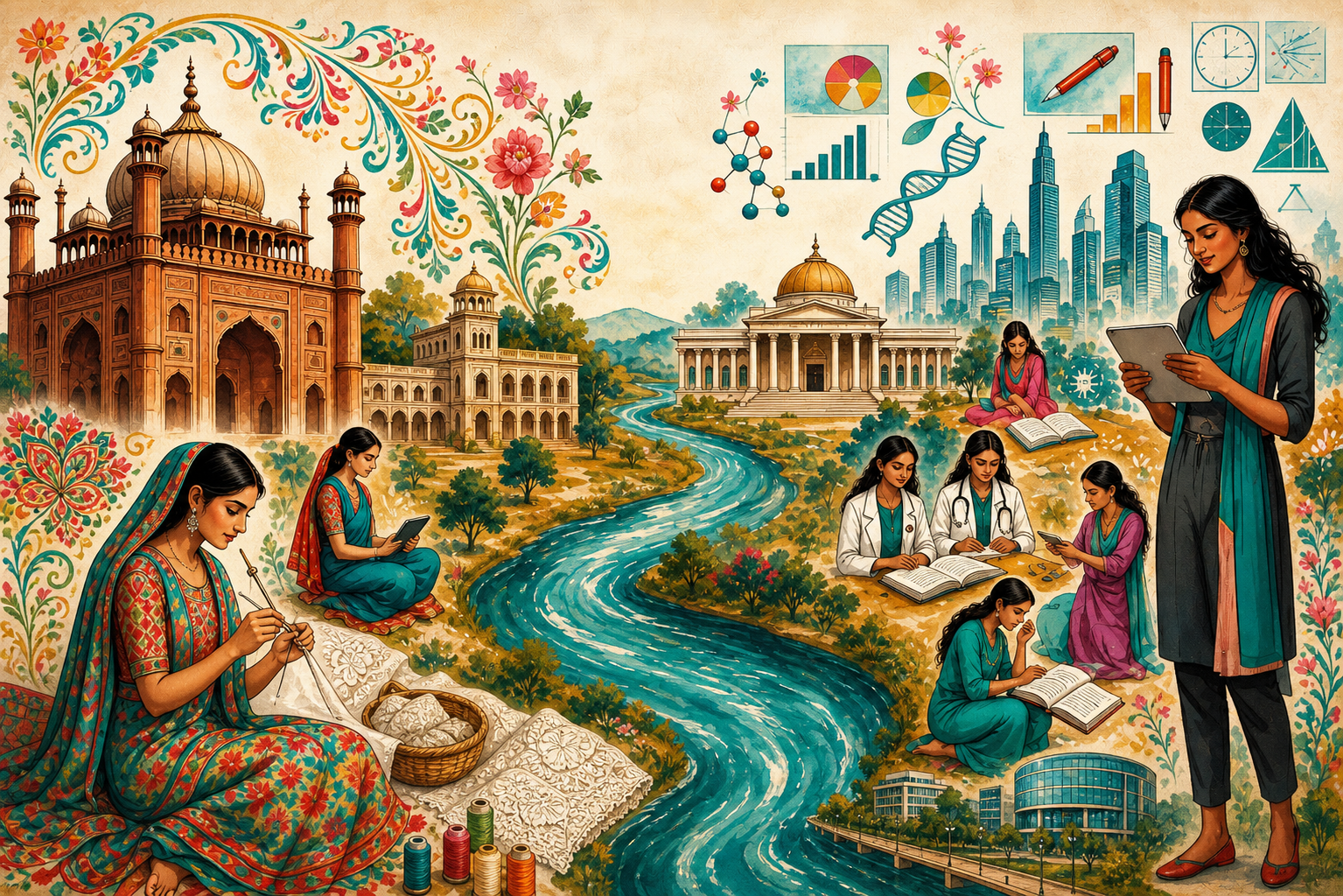
Lucknow: Lucknow, long celebrated for its Ganga-Jamuni tehzeeb, refined chikankari, and lingering Nawabi grace, is often narrated through its monuments, cuisine, and courtly etiquette. Yet beneath this elegant surface lies a layered, powerful cartography shaped by women—teachers, doctors, writers, revolutionaries, artisans, journalists, and policymakers—who have continuously expanded the city’s moral and intellectual boundaries. This feminist map of Lucknow traces both physical landmarks and invisible networks where women forged access, articulated dissent, and built institutions of equity. From 19th-century classrooms to 21st-century innovation hubs, it reveals a living legacy—one that connects pioneers like Rasheed Jahan and Savitri Sahni to contemporary leaders reshaping the city’s future.
The journey begins in the colonial heart of education at Isabella Thoburn College, founded in 1886 in Lal Bagh. As one of Asia’s earliest institutions for women’s higher education, it disrupted rigid social hierarchies by opening intellectual doors to women across communities. Here, Rasheed Jahan encountered ideas that would later inform her bold contributions to literature and progressive politics. Alongside it, Lucknow Christian College played a complementary role in democratizing knowledge. These institutions were not merely academic spaces; they were incubators of awakening, where women began to claim voice and agency in public life. Today, their campuses still echo with debates on gender, identity, and rights—bridging colonial beginnings with contemporary feminist scholarship.

From classrooms, the map moves into medicine—another arena where women transformed both practice and perception. Lady Dufferin Hospital stands as a historic site where women doctors like Rasheed Jahan practiced, bringing healthcare to women who had long been excluded due to social constraints. This legacy expands powerfully at King George’s Medical University (KGMC), one of North India’s premier medical institutions. Under the leadership of Soniya Nityanand, KGMC has evolved into a hub of inclusive healthcare innovation, emphasizing women’s health, telemedicine outreach, and gender-sensitive medical education. Here, medicine becomes more than healing—it becomes a feminist practice, addressing systemic inequalities while embracing cutting-edge research.
Science, too, finds a significant place in this map at the Birbal Sahni Institute of Palaeosciences on University Road. After the death of its founder, Birbal Sahni, it was Savitri Sahni who steered the institution through a crucial transitional phase. Her administrative acumen ensured its survival and growth, laying the foundation for its current global stature in paleosciences and climate research. Today, the institute stands not only as a scientific powerhouse but also as a symbol of women’s leadership in STEM—quiet yet transformative.
The cultural map of Lucknow reveals another dimension of feminist history, embedded in its old quarters—Chowk, Kaiserbagh, and residential enclaves like Gulistan Colony. These spaces once hosted the famed tawaif culture, where women performers were custodians of music, dance, and refined etiquette. Far from marginal figures, they shaped Lucknow’s artistic identity. Later, literary voices such as Shivani drew inspiration from these cultural milieus, weaving narratives that foregrounded women’s inner worlds. Today, the legacy continues through chikankari clusters in areas like Kakori, where thousands of women artisans sustain livelihoods through embroidery. These craft ecosystems represent economic resilience—transforming traditional skills into global markets while fostering financial independence.
Political assertion forms another critical layer of this feminist map. The imposing Uttar Pradesh Legislative Assembly has witnessed the contributions of pioneering women leaders such as Begum Aizaz Rasul and Sucheta Kriplani. Their presence in legislative spaces challenged gender norms and paved the way for future generations of women in governance. The Assembly remains a living arena where debates on policy, rights, and representation continue to unfold—reflecting both progress and the ongoing struggle for parity.
Interwoven with these institutional spaces are the quieter, often hidden sites of resistance. The revolutionary networks of figures like Prakashvati Pal remind us that Lucknow’s lanes once sheltered radical movements against colonial rule. These safe houses and meeting points, though less visible today, are integral to understanding how women participated in—and shaped—political resistance. Their courage adds a layer of urgency and defiance to the city’s feminist narrative.
As the map extends into the 21st century, it expands into new academic and intellectual hubs such as University of Lucknow and Babasaheb Bhimrao Ambedkar University. These institutions carry forward the legacy of early colleges while embedding it within frameworks of social justice and intersectionality. Departments of gender studies, Dalit studies, and environmental policy here are actively redefining feminist discourse. Women scholars and students engage with pressing issues—from climate change to digital rights—ensuring that academic inquiry remains connected to lived realities.
Parallel to academia, Lucknow’s media landscape has emerged as a dynamic space for feminist intervention. Journalists like Sunita Aron have long shaped public discourse through incisive commentary on governance and gender issues. Meanwhile, investigative reporters such as Neha Dixit bring national and global attention to stories of trafficking, labor exploitation, and communal tensions. Their work extends beyond traditional newsrooms into digital platforms, podcasts, and independent media ventures—transforming cafés in Hazratganj and Gomti Nagar into informal hubs of collaboration and storytelling.

Economic empowerment finds renewed expression through organizations like SEWA Chikan, which have revolutionized the chikankari sector. By providing fair wages, skill training, and market access, such initiatives enable women artisans to transition from piece-rate labor to entrepreneurship. Boutiques and design studios in Indira Nagar and Gomti Nagar now blend traditional embroidery with contemporary fashion, reaching international markets. These spaces exemplify how heritage and modernity can coexist, creating sustainable economic ecosystems led by women.
Cultural revival and reinterpretation are also central to this evolving map. Events like the Sanatkada Lucknow Festival celebrate crafts, cuisine, and performing arts while foregrounding women’s contributions. Held across heritage zones near Rumi Darwaza and newer venues, the festival creates platforms for dialogue on gender, identity, and tradition. Women curators, performers, and scholars use these spaces to challenge stereotypes and reimagine cultural narratives. Increasingly, these engagements extend online, ensuring wider accessibility and participation.
Civil society and policy spaces further enrich Lucknow’s feminist geography. NGOs and think tanks operating in Hazratganj and Gomti Nagar address issues ranging from legal aid to environmental justice. Initiatives along the Gomti Riverfront emphasize gender-sensitive urban planning—advocating for safer public spaces, better lighting, and inclusive infrastructure. These efforts demonstrate how grassroots activism can intersect with governance, influencing policy and urban design.
Reading this map as a whole reveals a complex web of continuities and transformations. Education flows seamlessly from the classrooms of Isabella Thoburn College to the research corridors of modern universities. Medicine evolves from the wards of Lady Dufferin Hospital to the advanced facilities of King George’s Medical University. Science progresses from Savitri Sahni’s stewardship at BSIP to contemporary climate research. Art and culture move from the salons of Chowk to global fashion platforms and digital archives. Politics extends from early trailblazers like Sucheta Kriplani to today’s legislators and journalists shaping public opinion. Resistance transforms from underground networks to digital activism.
Yet, this map is not without its tensions. Challenges of safety, representation, and work-life balance persist. Public spaces remain unevenly accessible; leadership positions are still disproportionately male. However, what stands out is the persistence with which women in Lucknow carve out equitable spaces—often within existing structures, sometimes by creating entirely new ones.
In contemporary Lucknow, particularly in rapidly developing areas like Gomti Nagar, women navigate globalization while staying rooted in tehzeeb. Entrepreneurs blend chikankari with e-commerce; scientists integrate traditional knowledge with biotechnology; journalists combine narrative storytelling with data-driven analysis. This synthesis of past and present is what gives Lucknow’s feminist map its distinct character—it is not a rupture from tradition but a reworking of it.
Ultimately, this map is not static. It invites participation, urging residents and visitors alike to recognize and contribute to the ongoing story of women’s empowerment in the city. Every classroom discussion, medical breakthrough, artistic performance, investigative report, and policy initiative adds a new marker. Lucknow’s women are not merely inhabitants of history; they are its cartographers—continuously redrawing boundaries, expanding horizons, and shaping a more just urban future.
In tracing their footprints, one does not just see a city; one witnesses a movement—layered, resilient, and profoundly transformative.




 ---------------------------------------------------------------------------------------------------