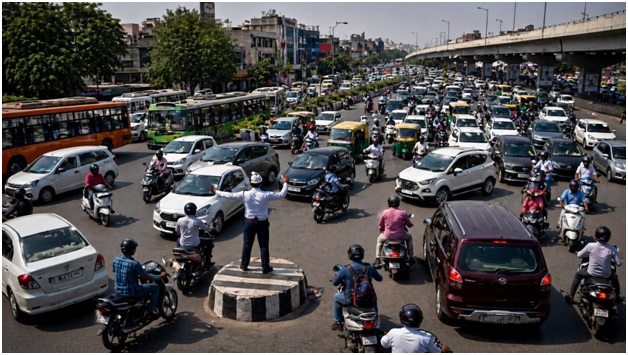
Lucknow: One of the city’s most notorious traffic choke points—Kamta Tiraha—is once again at the centre of an ambitious experiment. A 15-day U-turn diversion trial, rolled out over the weekend, has offered a glimpse of hope during morning hours but exposed persistent challenges by evening, underlining the complexity of managing traffic in a rapidly expanding city.
Located on the busy Ayodhya Road (Faizabad Road), Kamta Tiraha is a critical junction linking key routes to Gomti Nagar, Chinhat, Polytechnic, the High Court, and beyond. For years, commuters have battled severe congestion here, particularly during peak hours. The latest intervention, introduced by Lucknow Police, aims to streamline movement by reducing conflict points and ensuring continuous traffic flow.
Deputy Commissioner of Police (Traffic) Raveena Tyagi, who has been personally supervising the trial on the ground, highlighted the inherent complexity of the junction. “Even though it is called a ‘tiraha’, traffic actually comes from six different directions, which creates the choke point. Our first move is to turn it into a zero-conflict zone where vehicles do not clash. The second is to ensure traffic does not stop and keeps moving,” she explained.
The results so far have been mixed. On the first working day following the rollout, commuters experienced noticeably smoother traffic during the morning rush. Active enforcement, removal of roadside obstructions, and disciplined vehicle movement helped ease congestion. However, by evening, the situation deteriorated sharply. Traffic jams stretched up to three kilometres along Ayodhya Road, with vehicles crawling until late in the night.
Tyagi acknowledged the experimental nature of the intervention. “It’s a 15-day trial and I’m closely monitoring it by being present here. We first tried to manage it through routine traffic regulation, but it did not work. Then we introduced this U-turn system,” she said.
The new plan enforces designated U-turns and strict no-parking and no-stoppage rules within 100 to 150 metres of the junction. Traffic from Chinhat heading towards Polytechnic, the High Court, and Dr. Ram Manohar Lohia Institute of Medical Sciences is diverted via service roads and underpasses. Vehicles bound for Gomti Nagar and Ahimamau are rerouted through Shaheed Path, while buses from Barabanki, Ayodhya, and Gorakhpur follow alternate corridors to reduce load at the crossing.

Despite these measures, evening congestion revealed underlying issues—heavy traffic convergence, spillover from diverted routes, and behavioural factors such as unauthorised stopping and lane indiscipline. For many commuters, the extended travel time during peak evening hours remains a major concern.
The urgency to resolve the issue has been heightened by judicial intervention. Earlier this month, the Lucknow bench of the Allahabad High Court, while hearing a Public Interest Litigation, expressed dissatisfaction over the lack of a long-term solution for congestion along this crucial corridor. The court has directed senior officials, including traffic and municipal authorities, to inspect the site and present concrete proposals, with the next hearing scheduled for May 1.
The current trial is widely seen as a direct response to this judicial scrutiny. Officials say the system will be reviewed daily, with adjustments made based on real-time observations. If successful, it could pave the way for more permanent measures such as improved signage, better road markings, and coordinated infrastructure upgrades.
However, Kamta Tiraha’s recurring traffic woes also reflect a larger urban challenge. As Lucknow continues to grow, vehicle numbers are rising faster than road capacity, making traditional traffic management methods increasingly ineffective. The need of the hour is not just infrastructure expansion but smarter, adaptive solutions backed by strict enforcement and public cooperation.