Lucknow: The Kalpa sutras form one of the Vedangas, consisting of Vedic rituals pertaining to everyday life and normal ceremonies such as marriage, childbirth and inauguration of new house. They are compiled from a larger corpus of Vedic (Shrauta) rituals, which address all types of yajna, which include special requirements such as obtaining rain, or victory over an enemy or progeny for the childless. Different types of yajna require different arrangements and procedures, and even different types of sacrificial altars. Hence geometry was a highly developed subject in India from Vedic times.
The Shulba sutras are the portion of Shrauta sutras that explain extensively the measurements and calculations required to construct vedikas, or altars. These are our earliest sources of mathematics, and we have four major branches, named after the Rishis or chief exponents – Baudhayana, Manava, Apastambha and Katyayana. Altars of different shapes were recommended; for example, the seeker of Heaven was to use an altar shaped like a falcon, the seeker of Brahman to use one shaped like a tortoise and one who wished to destroy the enemy was to use arhombus shape. When the size of the altar increased with more participants, for instance, the proportions were to be calculated with precision.
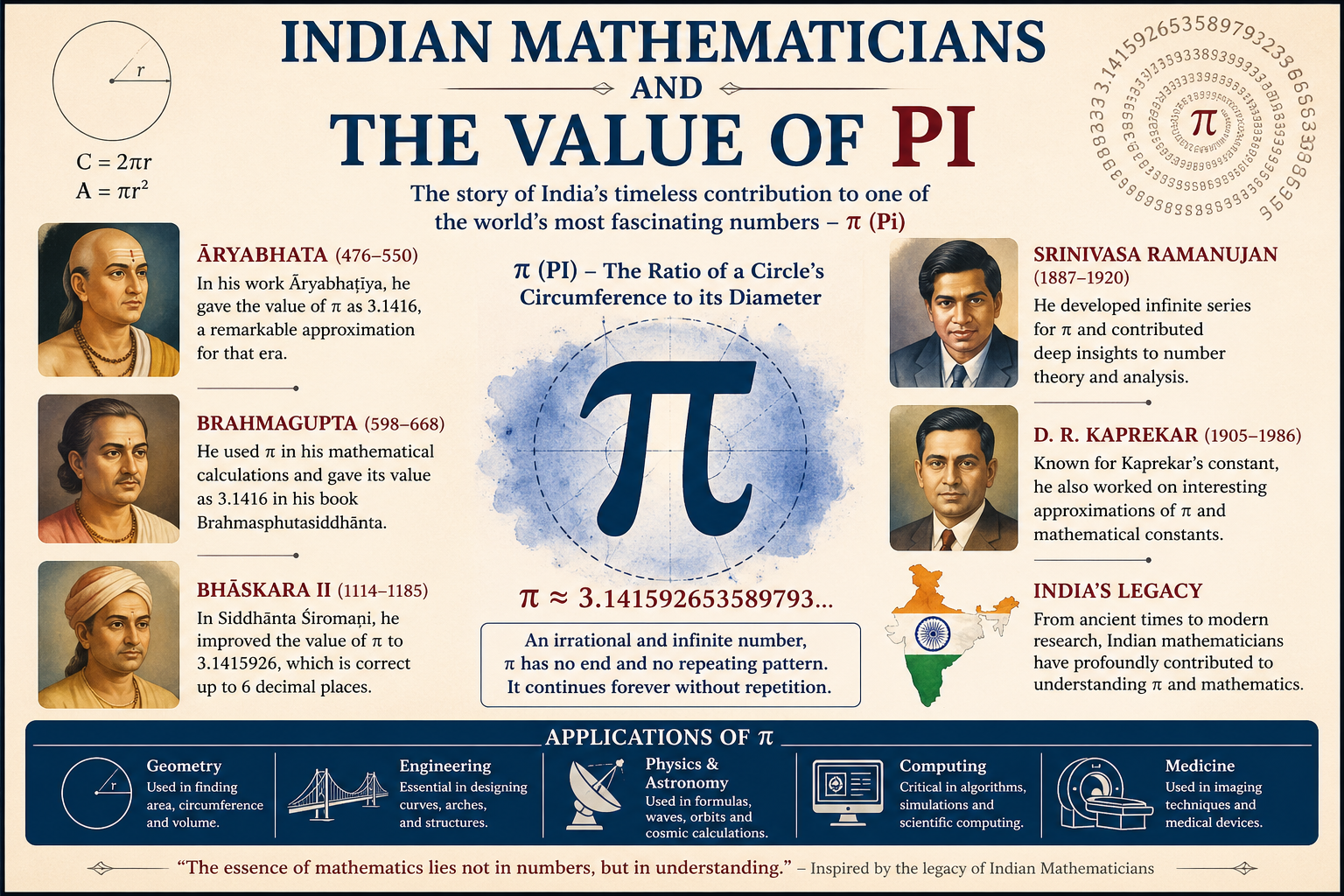
The value of Pi, attributed to Greek mathematics, was well-known in ancient India, as the ratio of the circumference to the diameter of a circle. This was even used by cart-makers; the iron rim of the wooden wheel for carts was taken in the proportion of 22/7 to the diameter of the wheel: that is, a strip of iron of 22 units was taken for a wheel of diameter 7 units. This strip was heated to expand, wrapped around the wooden wheel and when it cooled, it gripped the wheel to perfection. In Vedic mathematics, Pi was approximated as the square root of 10 in calculations; taking the square of Pi as 10 serves very well as a close approximation. What we now term as the Pythagoras principle in right angled triangles, was also well known in ancient India, as well as the values of square roots of 2 and 3. Pi plays a crucial role in various fields: geometry, trigonometry, engineering, physics, and even computer science. With the advent of modern algorithms, such as those used by ŚrīnivāsaRāmānuja, the quest for π has evolved, allowing computations to reach trillions of decimal places.
India, a cradle of civilization, has made remarkable contributions to mathematics and astronomy. While much of this heritage remains underappreciated, a deeper exploration reveals the significant advancements made by Indian mathematicians, particularly in the understanding of π (pi).The journey of Indian mathematics can be divided into three key eras: i) Vedic or Pre-Siddhāntic Era, ii) Siddhāntic or Classical Era and iii) Post-Siddhāntic or Medieval Era. Early on, Indian mathematicians engaged extensively with the geometry of circles, striving to approximate π as the ratio of a circle’s circumference to its diameter. The ancient texts like the Śulvasūtrasor Shulbasutras(circa 800 BCE) provided early approximations, estimating π at around 3.088, while the ŚatapathaBrāhmaṇa (before 600 BCE) offered a value of 3.125.
As we have seen, ancient texts survive to our time in the form of verses. While it is easy for a teacher to explain the concepts and calculations in person to students standing before him, it is more complicated to communicate through texts, keeping clarity and precision in mind. We find the expression of π through verses in several texts, in order to preserve and transmit the knowledge.
A significant milestone came with Āryabhaṭa in 499 CE, whose work, the Āryabhaṭīya, presented an approximation of π as 3.1416, accurate to four decimal places. His formula emphasized that this value was āsanna (approximate), indicating an awareness of the complexity and irrationality of π—an insight only proven in Europe centuries later.
Āryabhaṭīya:
चतुरधिकं शतमष्टगुणं द्वाषष्टिस्तथा सहस्राणाम ।

अयुतद्वयविष्कम्भस्य आसन्नो वृत्तपरिणाहः ।।
This also indicates that the decimal system was established in India long before other parts of the world. In modern India, Sanskrit language is not well understood by most people. Mathematical and other scientific literature use specialised terminology that is even more difficult for the general public to decipher. But these are rich areas of research for scholars that can open up India’s vast treasures of scientific and technical knowledge that at one time placed us at the apex of the world’s cultures.
Team Siddhanta Knowledge Foundation