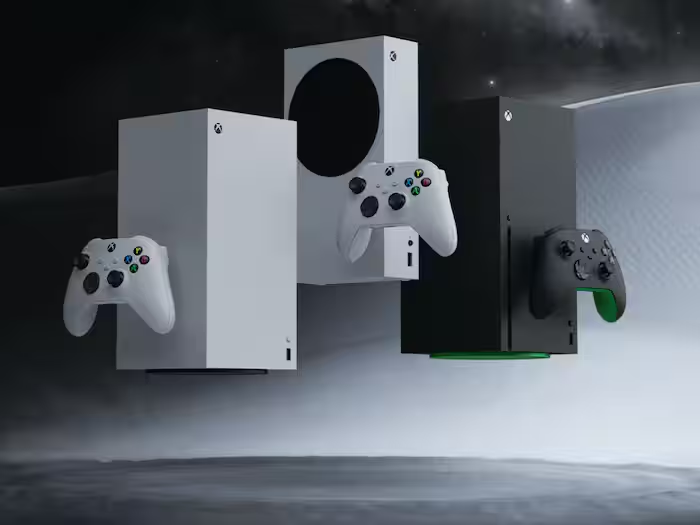
New Delhi: Xbox Series X and Xbox Series S have defined Microsoft’s current generation of console gaming, but the company has already begun preparing for the future. Microsoft has officially confirmed that it is developing its next-generation Xbox console under the codename Project Helix, signalling a potential shift in how console gaming will evolve over the next decade. Early information suggests that the upcoming hardware may blur the boundaries between traditional consoles and PC gaming platforms.
A New Step in Xbox Hardware Evolution
The confirmation of Project Helix marks Microsoft’s first official acknowledgment of its next Xbox console. The information surfaced through a post by Asha Sharma, who revealed that development is underway on the new hardware platform.

While Microsoft has not yet shared detailed specifications or design features, the announcement itself is significant. It indicates that the company is already working on a successor to the current Xbox generation and exploring new ways to enhance gaming performance, flexibility, and accessibility.
Microsoft has traditionally followed a multi-year console cycle, and Project Helix appears poised to become the next milestone in the Xbox ecosystem.
Toward a Hybrid Console–PC Experience
The most intriguing aspect of Project Helix is its possible hybrid approach to gaming. According to early statements, the console may support both Xbox and PC games, suggesting a deeper integration between Microsoft’s console platform and the Windows gaming ecosystem.
Such a move would represent a major strategic shift. Historically, consoles and PCs have operated as separate gaming environments. Console games were designed specifically for fixed hardware, while PC titles relied on customizable systems and different distribution platforms.
Project Helix appears to be challenging that divide.
If the rumours hold true, the new Xbox console could run titles developed for the Xbox platform alongside PC-compatible games. This would effectively transform the console into a versatile gaming hub, bringing together the strengths of both ecosystems.
Microsoft’s Long-Term Vision
The concept of merging console and PC gaming aligns closely with the broader strategy articulated by Satya Nadella, who has previously suggested that the traditional separation between gaming platforms may eventually disappear.
Under this vision, future Xbox hardware could operate more like a specialized gaming PC powered by Windows. Such a device could allow players to access a wider range of titles while maintaining the ease of use and plug-and-play simplicity associated with consoles.
For gamers, this could mean fewer restrictions on where games are purchased or played. A unified ecosystem would also allow developers to design titles that work seamlessly across console and PC environments.
Possible Support for PC Game Stores
Another intriguing possibility surrounding Project Helix involves compatibility with major PC storefronts.
Industry speculation suggests that Microsoft may allow the console to run games from platforms such as Steam and Epic Games Store. If implemented, this would represent one of the most open approaches ever taken by a console manufacturer.
However, Microsoft has not confirmed these features, and it remains unclear whether such support will be included at launch or added later.
Still, even the possibility reflects a broader industry trend toward open ecosystems and cross-platform compatibility.
Implications for Developers
Project Helix could also reshape the development landscape.

Game creators often face technical limitations when designing titles for multiple platforms. A hybrid console that shares architecture with PC systems could simplify the development process, making it easier to bring games to both platforms simultaneously.
Developers attending the upcoming Game Developers Conference in San Francisco may learn more about the system. Microsoft representatives are expected to discuss future Xbox strategies and partnerships during the event.
If Project Helix does indeed align closely with Windows-based development environments, it could streamline game production and expand opportunities for independent studios.
Performance Expectations
Although Microsoft has not revealed hardware specifications, expectations for Project Helix are naturally high.
The current flagship console, the Xbox Series X, already delivers powerful performance with advanced graphics capabilities, fast load times, and support for high-resolution gaming.
A next-generation system will likely aim to push these capabilities even further, potentially introducing improved graphics processing, faster storage technologies, and enhanced AI-driven features.
Given Microsoft’s growing focus on cloud gaming and subscription services, the console may also integrate more closely with Xbox Game Pass, allowing players to access a vast library of titles across multiple devices.
Release Timeline Remains Uncertain
Despite the confirmation of Project Helix, Microsoft has not announced an official release date.
Industry analysts speculate that the console could arrive sometime between 2026 and 2027, though the company has yet to verify these timelines.
The development cycle for major gaming hardware typically spans several years, involving extensive testing, developer support programs, and software ecosystem preparation. As a result, more information is likely to emerge gradually over the coming months and years.
A Potential Turning Point for Consoles
Project Helix represents more than just another console upgrade—it could signal a broader transformation in the gaming industry.
For decades, the console model has relied on fixed hardware generations and tightly controlled ecosystems. Microsoft’s apparent interest in blending console and PC experiences suggests a future where gaming platforms are less rigid and more interconnected.
If successful, the next Xbox console could redefine expectations for how games are played, purchased, and developed.
For now, Project Helix remains largely shrouded in mystery. Yet the early hints already point toward an ambitious vision—one where the boundaries between console and PC gaming may finally begin to disappear.