Lucknow: Although the 2027 Uttar Pradesh Assembly elections are still several months away, political preparations have already gathered momentum. With 403 Assembly seats, Uttar Pradesh remains one of the most politically significant states in the country, and the outcome is expected to have implications for national politics.
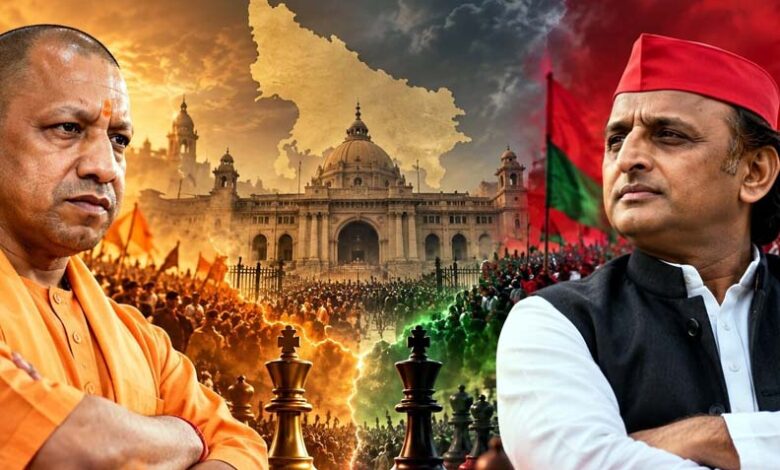
The political contest is taking shape around Chief Minister Yogi Adityanath’s leadership, the BJP’s organisational strategy, Samajwadi Party president Akhilesh Yadav’s political calculations, possible opposition alliances and changing voter preferences. The central question is whether the BJP can retain its political dominance or whether the opposition can build a coalition capable of challenging the ruling party.
BJP banks on Yogi’s leadership and governance record
The BJP’s biggest electoral advantage is expected to be the leadership of Yogi Adityanath and the government’s claims of progress in law and order, infrastructure, expressways, religious and cultural centres, and implementation of central and state welfare schemes.
Yogi has projected the 2027 contest through the political narrative of ’80 versus 20′ and expressed confidence that the BJP-led alliance will win more than 300 seats.
However, electoral claims do not always translate into public support. The BJP will have to address possible anti-incumbency and ensure that dissatisfaction over employment, inflation, agriculture and local governance does not weaken its traditional support base.
BJP attempts to expand its outreach among Muslim voters
Another aspect of the BJP’s strategy is its effort to strengthen its presence among sections of the Muslim community.
In August 2026, the party appointed former Aligarh Muslim University Vice-Chancellor Professor Tariq Mansoor as its national vice-president and Kunwar Basit Ali as the national president of the BJP Minority Morcha.
These appointments have been viewed by political observers as part of the party’s effort to reach Pasmanda Muslims and other sections of the community ahead of the 2027 elections.
According to the 2011 Census, Muslims account for 19.26 per cent of Uttar Pradesh’s population. Their electoral influence is significant in several constituencies, particularly in western Uttar Pradesh and certain other regions.
However, the BJP faces the challenge of expanding its support among Muslim voters while maintaining cohesion among its existing Hindu voter base.
Changing voter preferences could shape the contest
The electoral outcome will also depend on changing priorities among Hindu voters and other social groups. Voting decisions are influenced by several factors, including employment, inflation, farmers’ concerns, education, opportunities for young people, the performance of local legislators and access to development schemes.
Consequently, the 2027 election may not be determined solely by religious or caste-based polarisation.
This presents an opportunity for the Samajwadi Party. Akhilesh Yadav is expected to build on the social coalition that contributed to the opposition’s performance in the 2024 Lok Sabha elections.
The party’s PDA formula, representing Pichhda, Dalit and Alpsankhyak (backward classes, Dalits and minorities), is aimed at attracting non-Yadav OBC and Dalit voters who have traditionally supported the BJP.
The challenge for the SP will be to convert this social coalition into a functioning electoral organisation through effective candidate selection and booth-level mobilisation.
BSP and Congress could influence results
The role of the Bahujan Samaj Party cannot be overlooked. If Mayawati succeeds in reactivating her traditional Dalit support base, the BSP could influence electoral outcomes in several constituencies by turning direct contests into triangular battles.
Congress, meanwhile, has a comparatively limited organisational presence in the state. However, an understanding with the Samajwadi Party could help prevent the division of opposition votes.
Past alliance experiences are likely to make the SP cautious while negotiating seat-sharing arrangements with Congress.

BJP faces challenge of keeping alliance partners together
The BJP will also need to manage its relationships with alliance partners, including the Nishad Party, Suheldev Bharatiya Samaj Party and other regional outfits.
Their expectations regarding seat distribution, political representation and regional leadership could become important during candidate selection.
Although the BJP has a strong organisational structure, disagreements over tickets or local political arrangements could affect its prospects in certain constituencies.
Union Home Minister Amit Shah is also expected to play an important role in shaping the party’s electoral strategy. The BJP’s preparations are likely to involve close coordination between its central leadership in Delhi and the state organisation.
The key question will be how effectively Yogi Adityanath’s administrative image and popularity are aligned with the organisational strategy led by the central leadership.
Yogi-Shah coordination will be important
One of the significant political challenges for the BJP will be maintaining coordination between Yogi Adityanath and Amit Shah.
Shah’s electoral approach has generally focused on expanding social coalitions, strengthening booth-level organisation and managing relationships with alliance partners.
If these organisational efforts complement Yogi’s leadership and administrative standing, the BJP could be better positioned to counter the opposition’s challenge.
However, differences in strategic priorities between the central and state leaderships could create opportunities for opposition parties.
The BJP’s ability to maintain internal discipline while projecting Yogi as its principal state-level electoral face will therefore be an important factor in the campaign.
Stability or change: What will voters choose in 2027?
The 2027 Assembly election will ultimately test whether voters prefer political continuity and stability or want a change in government.
The BJP enters the contest with the advantages of incumbency, an established organisational network, Yogi Adityanath’s leadership and a nationwide political machinery.
The opposition, meanwhile, can draw on anti-incumbency, social justice issues and the possibility of bringing different social groups together against the ruling party.
A BJP victory with more than 300 seats, as projected by Yogi, cannot be taken for granted. At the same time, underestimating the party’s organisational strength would be a mistake for its opponents.
The Samajwadi Party has an opportunity to expand its political influence, but it will need to combine its PDA strategy with stronger grassroots organisation. The BSP and Congress could also influence the outcome in a number of constituencies.
The election will therefore extend beyond a BJP-versus-SP contest or a political rivalry between Yogi Adityanath and Akhilesh Yadav. Voters’ assessment of governance, development, social representation, economic concerns and future opportunities will all shape the result.
With the political alignments still evolving, the final electoral picture remains uncertain. Uttar Pradesh is heading towards a complex, multi-layered contest in 2027, making the state one of the most closely watched political battlegrounds in the country.











 https://www.youtube.com/watch?si=RtToJsBhYBatUrym&v=mOuYNSdhjHA&feature=youtu.be