Bareilly: The Department of Plant Science at Mahatma Jyotiba Phule Rohilkhand University has achieved a significant milestone in environmental protection and soil improvement, with research exploring a natural approach to tackling heavy metal pollution.
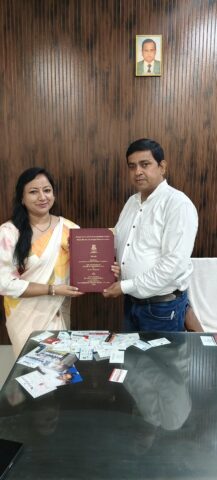
Research scholar Amita has been awarded a PhD for her work conducted under the guidance of Dr Vijay Kumar Sinhal, Associate Professor in the Department of Plant Science. The research explores the use of moringa leaf extract to produce zinc oxide nanoparticles and their potential to enhance the ability of sunflower plants to remove toxic metals from contaminated soil.

Natural Approach to Heavy Metal Pollution
The study focuses on phytoremediation, a process in which plants absorb and accumulate pollutants from soil. Researchers used moringa, also known as drumstick tree, as a natural source for preparing zinc oxide nanoparticles.
These nanoparticles were then applied to sunflower plants to investigate whether their ability to absorb heavy metals could be improved.
According to the findings highlighted by the university department, the treatment increased the plants’ heavy metal removal efficiency by up to 2.5 times compared with untreated plants.
Potential for Soil Restoration
The research could offer a promising direction for addressing heavy metal contamination in agricultural land, a growing environmental concern associated with industrial activity and excessive use of chemical inputs.
The reported results suggest that nanoparticle-treated sunflowers absorbed substantially more heavy metals from polluted soil than untreated plants. The approach combines plant-based materials with nanotechnology and may support the development of more environmentally conscious methods of soil remediation.
However, further research and field-level evaluation would be necessary to establish the technology’s practical effectiveness, safety and scalability.

Green Nanotechnology and Phytoremediation
The use of moringa leaf extract in nanoparticle production is a key feature of the research. The approach seeks to reduce dependence on potentially harmful chemicals used in conventional nanoparticle synthesis.
By combining green synthesis with phytoremediation, the study opens up possibilities for further research in agricultural science, environmental biotechnology and sustainable land management.
The findings may be particularly relevant to efforts aimed at restoring polluted land and improving soil quality through nature-based technologies.
Faculty and Researchers Congratulate Amita
Several academics and experts congratulated Amita and Dr Vijay Kumar Sinhal on the research achievement.
Those extending their congratulations included Professor R.S. Sengar, examiner from Meerut Agricultural University; Professor V.P. Singh, former Pro-Vice-Chancellor of Mahatma Jyotiba Phule Rohilkhand University; and Plant Science Department faculty members Professor Alok Srivastava, Professor Sanjay Garg, Professor J.N. Maurya, Professor Upendra Kumar, Professor Pankaj Kumar Arora and Dr Lalit Kumar Pandey.
The achievement highlights the contribution of the university’s Plant Science Department to research in environmental conservation and sustainable soil management.
Report from Bareilly by Akhilesh Chandra Saxena