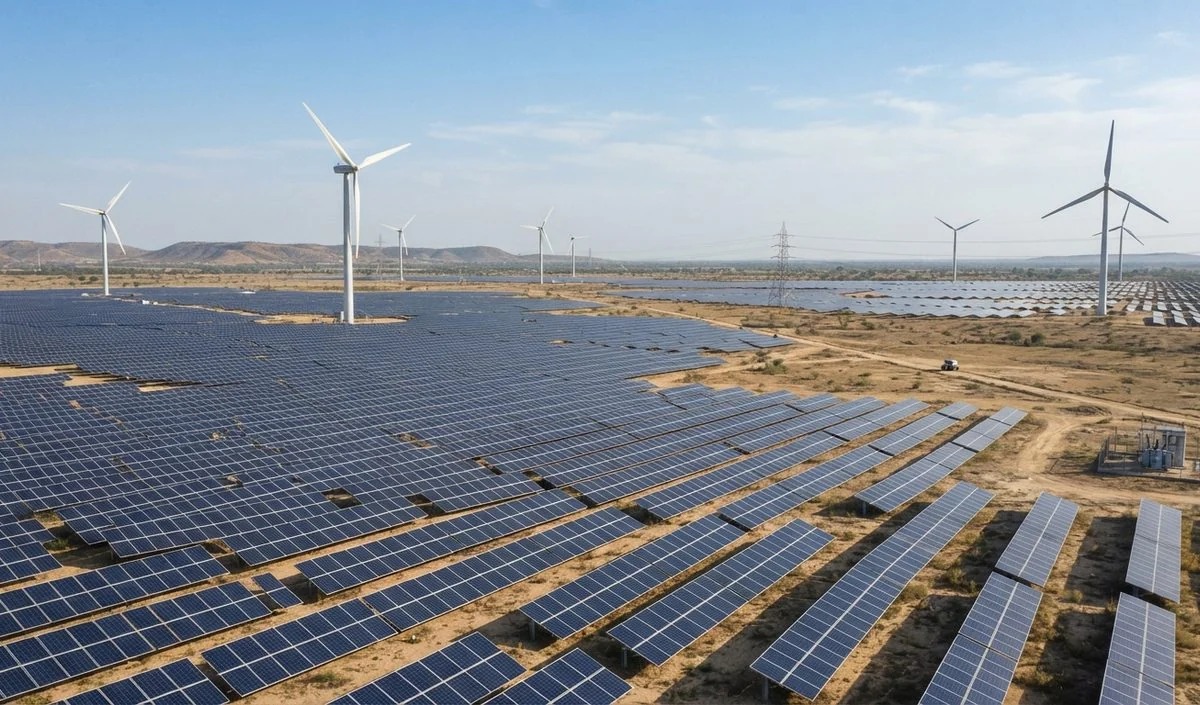
Renewable power growth has reduced dependence on imported coal and natural gas; cumulative savings could reach $240 billion by 2030
New Delhi: India’s rapid expansion of renewable energy has strengthened its energy security while reducing the country’s dependence on imported fossil fuels. According to the International Energy Agency’s (IEA) India Renewable Energy Market Report 2026, India saved more than $100 billion (approximately Rs 9.4 lakh crore) in coal and natural gas import expenditure through renewable electricity generation between 2011 and 2025.
The report estimates that without the solar, wind and bioenergy capacity added since 2010, India would have needed to import an additional 110 million tonnes of coal in 2025 alone.
The savings underline the economic benefits of expanding domestic clean energy production and reducing exposure to international fuel prices.
Renewable capacity nearly quadruples in a decade
India’s renewable energy capacity has almost quadrupled over the past decade, crossing 300 GW in 2026. Between March 2014 and September 2026, the country added 168 GW of solar and 38 GW of wind power capacity. Installed bioenergy capacity reached nearly 12 GW by September 2026.
The IEA has identified India as the world’s second-fastest-growing renewable energy market and the second-largest manufacturer of solar photovoltaic modules.
India achieved its target of sourcing 50 per cent of installed electricity capacity from non-fossil fuel sources in 2025, five years ahead of the 2030 deadline. Renewable electricity generation exceeded 500 terawatt-hours in 2025, accounting for approximately one-fourth of the country’s total electricity supply.
Fuel import savings could reach $240 billion by 2030
The IEA estimates that cumulative savings on coal and natural gas imports could reach nearly $240 billion (approximately Rs 22.6 lakh crore) by 2030, assuming international fuel prices remain broadly around their 2024-25 average levels.
Annual savings are projected to reach approximately $35 billion (Rs 3.3 lakh crore) by 2030. This would exceed India’s total expenditure on non-coking coal and natural gas imports in the financial year 2024-25.
These savings could ease pressure on foreign exchange reserves, reduce import dependence and protect the economy from fluctuations in international energy prices.


Government schemes expand solar access
The expansion of renewable energy is also reaching households and the agricultural sector through targeted government programmes.
The IEA has highlighted the PM Surya Ghar: Muft Bijli Yojana for encouraging residential rooftop solar installations. The scheme enables households to generate their own electricity and reduce power bills.
Similarly, the PM-KUSUM scheme supports solar-powered irrigation pumps and the solarisation of agricultural power supply, helping farmers meet their energy requirements through renewable sources.
Production-linked incentive (PLI) schemes and domestic manufacturing policies are also supporting investment in solar equipment production and strengthening India’s manufacturing base.
Solar power becomes increasingly competitive
India’s competitive bidding system has helped bring down renewable energy costs. According to the IEA, solar projects commissioned in 2025 offered electricity tariffs around 40 per cent below the average cost of coal-based power generation.
Solar photovoltaic power is expected to account for more than 80 per cent of India’s renewable capacity additions up to 2030. The country’s renewable power capacity is projected to reach around 530 GW by the end of the decade.
The IEA has also emphasised the need for greater investment in electricity transmission networks, energy storage and grid flexibility to accommodate the growing share of solar and wind power.
India’s renewable energy expansion is increasingly contributing to economic savings, domestic manufacturing and energy security. The IEA assessment indicates that investment in clean energy is helping reduce fossil fuel imports while supporting the country’s longer-term energy independence and climate objectives.











 https://www.youtube.com/watch?si=RtToJsBhYBatUrym&v=mOuYNSdhjHA&feature=youtu.be