Kunda’s Ram Katha, the politics of caste consolidation and the approaching 2027 Uttar Pradesh Assembly elections
By Arvind Singh Bisht
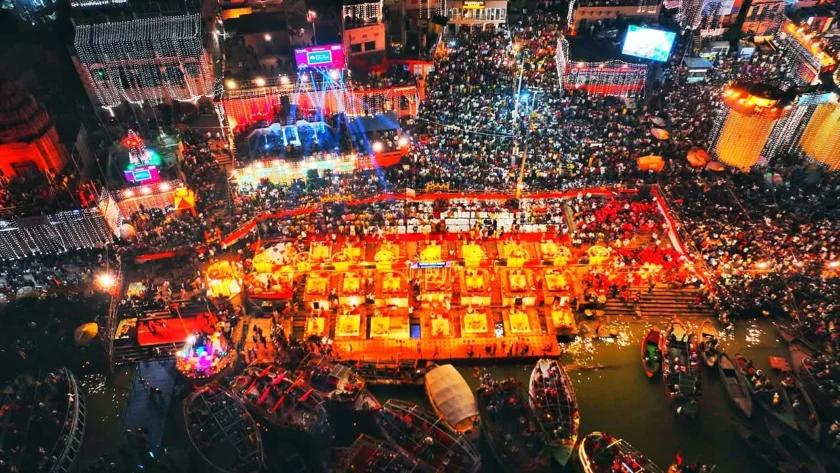
The road to the 2027 Uttar Pradesh Assembly elections is increasingly passing through religious congregations, caste conventions and competing claims of social representation. In this emerging political landscape, the Shri Ram Katha organised by Kunda MLA Raghuraj Pratap Singh, popularly known as Raja Bhaiya, from November 17 to 20, 2026, deserves attention beyond its religious significance.
The gathering brought together several prominent personalities belonging to the Kshatriya community, including Brij Bhushan Sharan Singh, Dhananjay Singh, Sanjeev Balyan, Brijesh Singh and Ravindra Singh Bhati, despite their different political affiliations and regional interests. The presence of Baba Ramdev and other public figures further enhanced its visibility.
Was this merely a religious congregation, or was Raja Bhaiya attempting to bring together a historically influential but politically fragmented community before the next Assembly election?
The controversy surrounding Bageshwar Dham’s Dhirendra Krishna Shastri, whose remarks comparing Lord Ram and Lord Krishna had invited objections from Samajwadi Party president Akhilesh Yadav, added another political dimension. Akhilesh had objected to Shastri’s proposed visit to Awadh and Braj, arguing that his remarks had hurt the sentiments of Yaduvanshis and Raghuvanshis. Raja Bhaiya nevertheless went ahead with the programme, giving the congregation additional political visibility.
It would be simplistic to describe the event merely as a counter to Akhilesh Yadav. Equally, it would be naive to overlook the political circumstances in which it took place. With the 2027 election approaching, such a gathering inevitably acquires an electoral dimension.
Raja Bhaiya deserves credit for bringing together personalities who do not necessarily share political affiliations or personal equations. But can this convergence evolve into something more enduring than a display of collective strength?
A GLORIOUS HISTORY, AN UNCOMFORTABLE CONTRADICTION
The Rajputs, traditionally associated with the Kshatriya order, have left an extraordinary imprint on Indian history. The Sisodias of Mewar, Rathores of Marwar, Chauhans of Ajmer, Kachhwahas of Amber, Paramaras of Malwa and Bundelas of Bundelkhand represent distinguished ruling traditions.
Maharana Pratap remains an enduring symbol of resistance, Rana Sanga demonstrated the possibility of bringing different Rajput chiefs together, while Prithviraj Chauhan and Raja Man Singh of Amber occupy important places in medieval Indian history.
Yet, alongside this glorious legacy lies an uncomfortable contradiction: extraordinary individual courage did not consistently translate into collective political strength.
Colonel James Tod, in his celebrated Annals and Antiquities of Rajasthan, observed:
“They were never capable of uniting, even for their own preservation: a breath, a scurrilous stanza of a bard, has severed their closest confederacies.”
Tod was writing from a colonial administrative perspective, and his observations must be read in that context. Nevertheless, his account identifies a recurring weakness: clan rivalries, dynastic ambitions, succession disputes and personal prestige frequently undermined political alliances.
The lesson is not that Rajputs lacked courage. It is that courage without strategic unity and durable institutions could not guarantee collective strength.
THE POLITICS OF COMMUNITY ASSERTION: A LESSON FROM THE BRAHMINS
Uttar Pradesh politics has always been shaped by caste, religion, leadership and regional interests. The BJP has built a broad social coalition, while the Samajwadi Party has sought to consolidate its traditional support base and expand through its PDA formulation.
The 2022 Assembly election saw 52 Brahmin and 49 Rajput MLAs, according to a social classification of elected representatives published by ThePrint. These are estimates, not official caste-wise figures. Nevertheless, they demonstrate the substantial legislative presence of both communities.
An interesting sociological comparison emerges here.
The Brahmin community is far from politically homogeneous. It has ideological differences, competing leadership ambitions and affiliations with different political parties. It has also faced sustained criticism from social reformers, particularly Dr B.R. Ambedkar, whose critique of caste hierarchy and graded inequality remains fundamental to India’s social discourse.
Yet, despite these differences and criticisms, Brahmin organisations have consistently articulated community concerns, demanded representation and maintained visibility in political and institutional life.
The important lesson is that collective belonging does not require political unanimity. People can disagree, compete and criticise one another while retaining a sense of shared identity.
This brings us to a more uncomfortable question concerning the Rajputs.
Governments of the day and political parties frequently demonstrate sensitivity towards Brahmin representation. Brahmin conventions are organised, community leaders are brought together, and political personalities are projected or accommodated in important positions in the name of social representation. The suitability and credibility of particular appointments may, of course, invite debate.
Why is comparable political attention not always visible in the case of Rajputs?
Is the community being taken for granted because of its traditional political loyalties? Is its support considered assured and therefore not worthy of the same political outreach? Or has it simply failed to develop a collective voice strong enough to command attention?
These questions deserve serious examination. They are not necessarily an allegation against any particular government, but reflect a perception that political accommodation and community outreach are not always equally visible.
The Rajputs have substantial representation in public life, but individual representation is not the same as collective recognition. A community may have ministers, legislators and influential personalities without its wider concerns receiving organised attention.
The Kunda congregation should therefore address this question directly. If it cannot articulate the community’s aspirations and seek a more meaningful place in public life, its impressive gathering may remain an exercise in glitter without purpose.
THE RAJPUT DILEMMA: UNITY WITHOUT UNIFORMITY
The most important lesson Rajputs need to learn is that community solidarity should not be confused with political uniformity.
There is no reason why every Rajput should support the same political party, follow the same leader or subscribe to the same ideology. A Rajput in the BJP, another in the Samajwadi Party and a third in the Congress need not surrender political convictions to establish a common social bond.
What they should share is a sense of belonging, mutual respect and willingness to stand together on issues concerning education, economic opportunity, social dignity and community welfare.
Unfortunately, individual prestige, clan affiliations, competing ambitions and personal equations often become obstacles to such solidarity. A disagreement over leadership can turn into lasting estrangement. Personal ego frequently takes precedence over collective interest.
This is where Colonel Tod’s observation acquires contemporary relevance.
A community can be proud without being exclusive, assertive without being aggressive, and conscious of its history without being imprisoned by it. Differences need not become divisions, and disagreement need not destroy belonging.

YOGI ADITYANATH AND THE IRONY OF COMMUNITY LOYALTY
The discussion cannot avoid Chief Minister Yogi Adityanath, who is frequently accused by political opponents of favouring Thakurs in administration and political appointments.
His Thakur background, however, has not ensured unanimous support among influential Kshatriya personalities. Some have asserted independent political identities, others have criticised aspects of his administration, while several have pursued their own political ambitions.
This is not unusual in a democracy. But it exposes an important contradiction: a common social identity does not automatically produce common political loyalty.
A community cannot expect political representation to be judged exclusively through caste identity while its own prominent members remain guided primarily by individual political interests.
THE PARASHURAM PARADOX: HISTORY SHOULD NOT BECOME A CASTE BATTLEGROUND
Another curious feature of contemporary caste mobilisation is the selective interpretation of religious traditions.
Parashuram Jayanti is celebrated with considerable enthusiasm, particularly among sections of the Brahmin community. Yet the Puranic narratives associated with Parashuram also describe his destruction of Kshatriya rulers on twenty-one occasions. This creates an interesting paradox when religious traditions are interpreted through the narrow lens of contemporary caste identity.
Parashuram occupies a distinctive place in Hindu tradition. His encounter with Lord Ram after the breaking of Shiva’s bow, and his association with Bhishma, Drona and Karna in the Mahabharata tradition, make him a figure who connects different strands of India’s religious and cultural imagination.
But these narratives should not become instruments of contemporary caste antagonism. Neither Brahmins nor Kshatriyas should claim exclusive ownership of religious figures or interpret mythology as a contest of inherited superiority.
The deeper lesson is that power without restraint, pride without humility and authority without moral responsibility can invite their own downfall.
The Kshatriya community should be confident enough in its historical legacy not to feel threatened by the celebration of Parashuram. Equally, religious celebrations should promote social harmony rather than revive historical antagonisms.
The relationship between Brahmin and Kshatriya traditions has been complex, but Indian civilisation has also been shaped by their intellectual, spiritual and political interactions. That shared inheritance deserves greater emphasis than inherited rivalries.
THE REAL WEAKNESS: PRIDE WITHOUT REFINEMENT
Perhaps the most important issue that Kunda should bring into public discussion is behavioural reform within the community.
The Kshatriya tradition celebrates courage, self-respect, loyalty and martial discipline. But these qualities lose their nobility when distorted into excessive pride, personal ego, aggression and unwillingness to accommodate differences.
There is a difference between self-respect and an exaggerated expectation of deference. Assertiveness should not become arrogance, and every disagreement should not become a question of personal honour.
These are not inherent characteristics of any caste, but behavioural tendencies that deserve introspection wherever they occur.
Rajputs must recognise that a glorious ancestry does not automatically confer contemporary social respect. Respect has to be earned afresh through conduct, achievement and contribution.
The traditional Kshatriya ideal was not simply to command. It was to protect, administer justice and exercise authority with restraint.
A true Kshatriya should be able to disagree without humiliating another person, negotiate without feeling diminished and exercise influence without demanding submission.
The community must rediscover the value of a sweet tongue. Courtesy is not cowardice, humility is not weakness, and accommodation is not surrender. In a modern democracy, the ability to persuade is far more valuable than the ability to intimidate.
WHAT SHOULD KUNDA LEAD TO?
If Raja Bhaiya’s initiative is to acquire lasting significance, it must move beyond political personalities and ceremonial solidarity.
It should develop a practical programme centred on education, economic empowerment, professional opportunities for young people, public service and social accommodation.
Kshatriya organisations must learn to work with Brahmin, Yadav, Nishad, Dalit, OBC and other organisations on common social objectives. Women and young people must have an equal role in this process.
Above all, the initiative must not become an instrument for claiming social superiority or political entitlement. Its credibility will depend on whether it contributes to society beyond the boundaries of its own community.
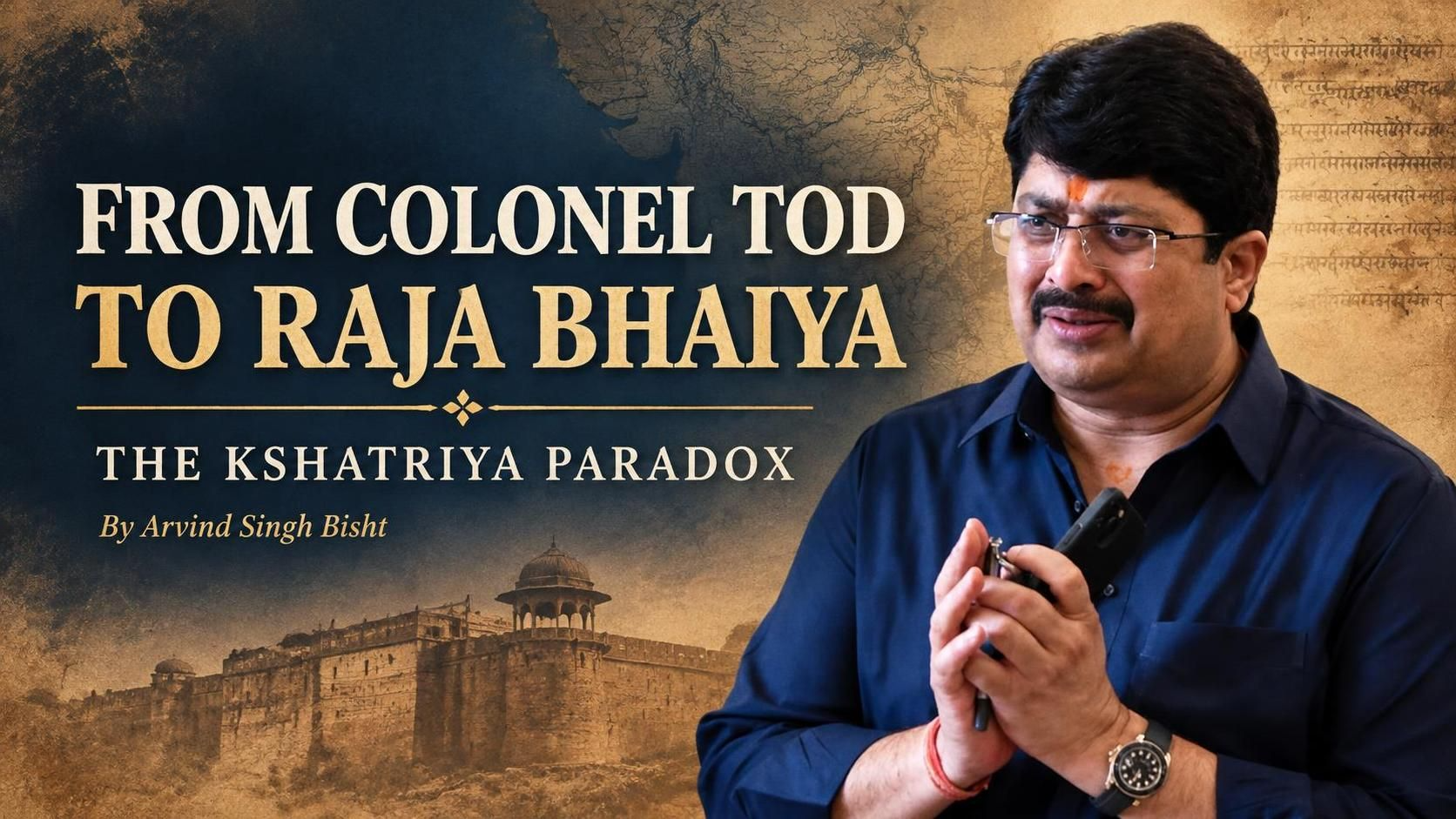
FROM COLONEL TOD TO RAJA BHAIYA: A HISTORICAL OPPORTUNITY
Nearly two centuries ago, Colonel Tod identified the inability of Rajput rulers to maintain lasting alliances as a major weakness. Today, Raja Bhaiya has provided a platform on which people from different political and social backgrounds have assembled.
The historical distance between the two events is considerable, but the underlying question remains remarkably similar.
Can a community with such a distinguished legacy overcome its internal divisions and develop a collective sense of responsibility?
The Kshatriya community does not suffer from a shortage of historical heroes, political personalities or social influence. What it needs is a common vision that places collective progress above individual ambition.
It must also understand that unity does not demand uniformity. A community can have multiple political loyalties and still preserve its social bonds. It can disagree over leadership without allowing those differences to become permanent hostility.
A congregation is not a movement. A photograph of political leaders standing together is not proof of solidarity. And common ancestry does not automatically create a common purpose.
Raja Bhaiya deserves credit for opening a door. But the real test will be whether those who assembled at Kunda can walk through it together.
A sword may command obedience, but character earns respect. Ancestry may provide identity, but achievement gives it meaning. A sharp tongue may win an argument, but a sweet tongue can build relationships.
The real challenge before the Kshatriya community is not merely to demand recognition from those in power, but to develop the collective strength, social refinement and organisational maturity that make such recognition meaningful. Otherwise, Kunda will remain a spectacular congregation, remembered for its personalities and spectacle, but not for any lasting purpose.












 https://www.youtube.com/watch?si=RtToJsBhYBatUrym&v=mOuYNSdhjHA&feature=youtu.be