At Haridwar, Yogi Adityanath’s tears revealed the human being behind the robes of renunciation and the mantle of power
BY ARVIND SINGH BISHT
There are moments when power falls silent, public stature becomes irrelevant and the human being emerges in his most vulnerable form. On November 21, 2026, at Haridwar, Yogi Adityanath was neither the Chief Minister of Uttar Pradesh nor a revered monk. He was simply a son mourning his mother.
The contrast was almost overwhelming. A man known for his stern exterior, commanding personality and assertive voice stood helpless before the funeral pyre of his 91-year-old mother, Savitri Devi. At Chandi Ghat in Haridwar, the authority of his office, the discipline of his monastic life and the formidable public image associated with him seemed to dissolve in the intensity of his grief. Tears rolled continuously down his face. For those witnessing the scene, it was difficult not to be moved.
I had travelled from Lucknow to Haridwar by chartered aircraft, accompanied by my daughter, Aparna Yadav, and my son, Aman. Two Uttar Pradesh ministers, Dinesh Pratap Singh, Minister for Horticulture, and Satish Tewari, Minister for Food and Civil Supplies, were also part of the group. We left Lucknow at around 7 pm and reached Haridwar at approximately 9 pm. After paying our respects, we returned to Lucknow, reaching there at around 4 pm the following day.
A Sea of Humanity
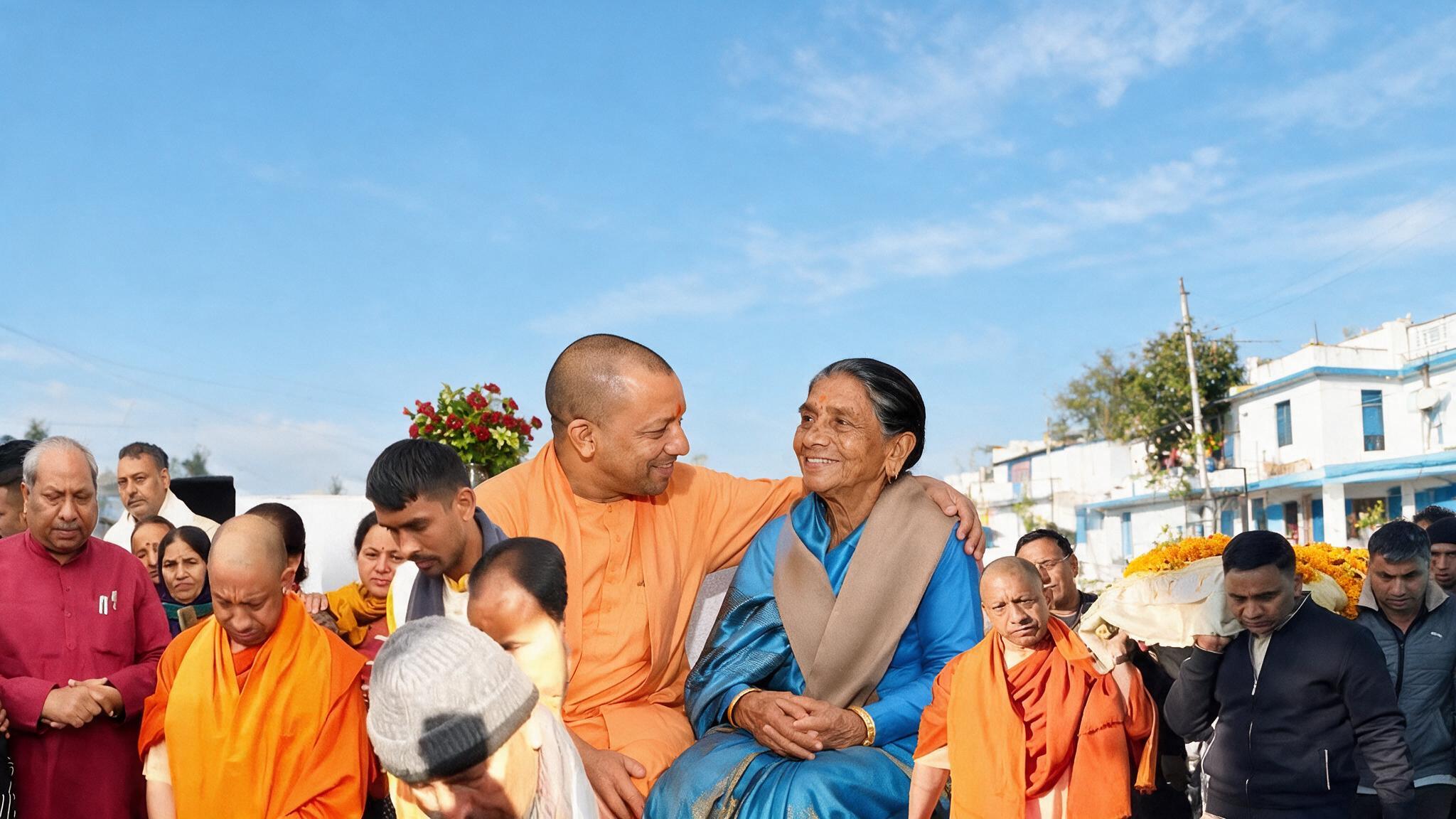
The scene at Haridwar was extraordinary. Crowds upon crowds had gathered. Ministers, senior bureaucrats, relatives, well-wishers, political associates and a large number of people who had come simply to pay their last respects filled the premises. When the mortal remains were made accessible for floral tributes, the situation became tense, with the gathering coming perilously close to a stampede. Yet, amid the surge of emotion, things passed smoothly, under the chanting of mantras and the guidance of well-known spiritual leaders and seers of Haridwar.
But beyond the crowds, the dignitaries and the solemn rituals, it was the sight of Yogi Adityanath that remained etched in the mind. A person accustomed to exercising authority over an entire state was confronting a loss before which authority had no meaning.
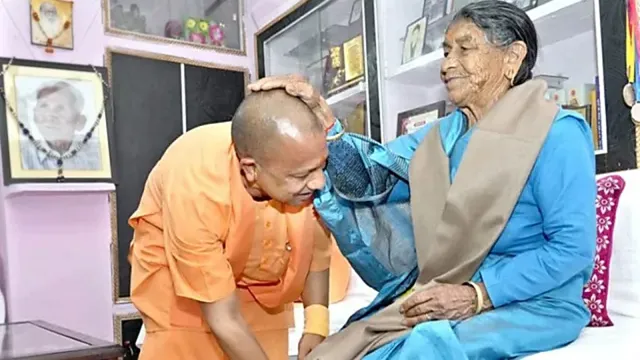
Perhaps the poignancy of his loss lay in something deeper than the death of a parent. His mother was, in many ways, his last living link to his native village, Panchur, in the Pauri Garhwal district of Uttarakhand. She connected him to his childhood, his family and the landscape in which his earliest memories had taken shape. One can only imagine the memories that must have crowded his mind — the village home, the childhood days and the day he left home to embrace the life of a renunciate.
The Last Farewell
There is another deeply personal dimension to this relationship. When Yogi Adityanath chose the path of renunciation, he had to leave behind not merely a home but also the familiar world of family ties. In the traditions associated with Sanatan Dharma, the transition to sanyas involves a profound separation from one’s former household identity. One can only imagine what that moment of farewell to his mother must have meant to both of them.
Yet renunciation does not necessarily mean the extinction of love. A spiritual journey may alter one’s relationship with the world, but it cannot erase the emotional history that shaped a person. A mother’s affection is not an ordinary possession that can be surrendered through a religious ceremony.
Perhaps this is why, at the ghat, nobody could truly console him. There were countless people around him, many of them holding positions of power and influence. But there was no one who could occupy the place his mother had held in his life. His public stature was immense; her place in his personal world was beyond comparison.
There is a peculiar loneliness in being a person before whom others hesitate, or are unable, to speak freely. At that moment, the Chief Minister needed no protocol, and the monk needed no spiritual counsel. He needed his mother.
A Son’s Vigil
Reports that he remained awake through the night beside his mother’s mortal remains at his ancestral home in Panchur add another poignant dimension to the story. He is also understood to have shouldered her body and carried it for some distance before the nearly four-hour road journey to Haridwar. He remained at the cremation ground until the completion of the final rites, including the kapal kriya.

These were not merely ritual obligations. They were the final acts of a son accompanying his mother on her last journey
The image of a monk carrying his mother’s body is perhaps more eloquent than any public statement could have been. It reminds us that the outward discipline of renunciation and the inward bonds of human affection can coexist. One does not necessarily cancel the other.
Toughness and Tenderness
What happened after the funeral was equally revealing, though in a different way. Yogi Adityanath returned to Lucknow and received Prime Minister Narendra Modi, who was there to inaugurate a skill development programme. Within hours, he had moved from the intimate grief of a son to the public responsibilities of a Chief Minister.
This was not evidence that his sorrow had disappeared, nor should it be mistaken for emotional detachment. It reflected an extraordinary capacity to compartmentalise personal pain and discharge public duty. The discipline of his monastic life and the responsibilities of his constitutional office may have helped him do so, but neither can make the loss of a mother any less profound.
There is a psychological dimension to this response. Human beings often draw upon an inner reserve of discipline when circumstances demand that they function despite overwhelming personal distress. The ability to continue one’s responsibilities does not mean that grief is absent. Sometimes, it is precisely the depth of grief that makes the effort to carry on so difficult.
The Child Within the Man
William Wordsworth’s celebrated line, “The Child is father of the Man”, acquires special resonance in this context. It suggests that the child we once were never entirely disappears; the memories, emotions and relationships of childhood continue to shape the adult we become.
At Haridwar, perhaps that child briefly emerged from beneath the robes of the monk and the authority of the Chief Minister. The man who has addressed vast gatherings, taken difficult decisions and commanded the machinery of government was, for a few moments, simply a son who had lost his mother.
A son may rise to the highest seat of power, but before his mother, he remains only a child. No office, no honour and no achievement can ever outgrow the debt of a mother’s love.
True greatness is not measured by the power one commands, but by the humility with which one bows before the memory of those who gave us life. A mother’s blessings remain a son’s greatest wealth, even when she is no longer there.
A mother may give birth to a future Chief Minister, a monk or a ruler, but to her, he remains her child. No political office can confer a greater identity, and no spiritual achievement can diminish that bond.
At the cremation ghat, the monk had tears in his eyes, the Chief Minister had responsibilities to fulfil, but above all, there was a son saying goodbye to the one person before whom he had never needed to be powerful.












 https://www.youtube.com/watch?si=RtToJsBhYBatUrym&v=mOuYNSdhjHA&feature=youtu.be