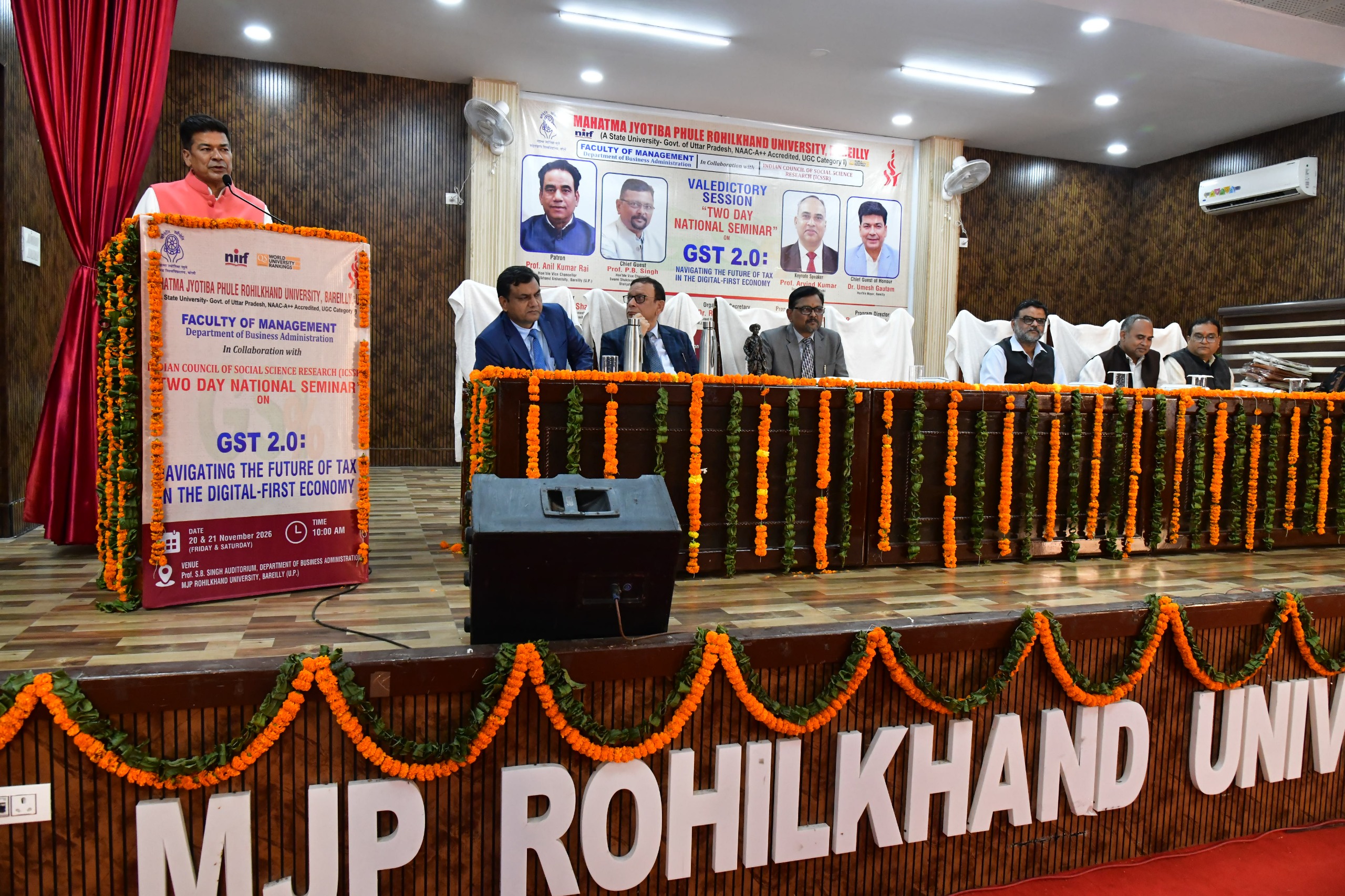
Bareilly: A two-day national seminar on “GST 2.0: Navigating the Future of Tax in the Digital-First Economy” concluded at Mahatma Jyotiba Phule Rohilkhand University (MJPRU), Bareilly, on Saturday, with experts discussing the changing tax framework, digital governance, artificial intelligence and the future of India’s taxation system.
The seminar was organised by the Department of Business Administration, Faculty of Management, in collaboration with the Indian Council of Social Science Research (ICSSR). The concluding ceremony was presided over by Vice-Chancellor Prof. Anil Kumar Rai and attended by academicians, industry experts, researchers and students.
Dean of the Faculty of Management and seminar convenor Prof. Trilochan Sharma welcomed the participants and highlighted the objectives of the seminar, recent developments in the GST framework and its academic and practical relevance.
Chief guest and Bareilly Mayor Dr Umesh Gautam encouraged students to learn from experienced teachers and experts. He said good friends help individuals progress and urged students to develop the ability to identify problems and find solutions. Referring to Swami Vivekananda’s teachings, he stressed the importance of learning and self-development.
Prof. P.B. Singh, Vice-Chancellor of Swami Shukdevanand University, Shahjahanpur, highlighted the importance of digitalisation and transparency in GST 2.0. He explained how digital technology and artificial intelligence could improve tax administration, data analysis, compliance and the overall efficiency of the taxation system. He also discussed the challenges and future possibilities associated with GST reforms.
Special guest CA Kapil Vaishya, founder of Kapil and Vaishya Company, discussed the difficulties businesses faced under the earlier VAT system. He explained how multiple taxes and complicated procedures created challenges for traders and businesses, emphasising the need for GST to establish a more transparent and organised taxation framework.
The keynote speaker, Prof. Arvind Kumar of Jawaharlal Nehru University, New Delhi, examined the historical evolution of GST and the scope for further reforms. He discussed digital governance, the progress of the GST system and changing business models. Referring to developments in the agricultural sector, he stressed the need for tax policies that encourage economic activity, including appropriate exemptions on essential goods and services to support consumption and trade.
Prof. Sanjay Mishra spoke about the achievements of GST 2.0, highlighting improvements in transparency, simplification and the promotion of a digital economy. He described the reforms as an important step towards India’s economic progress.

During the seminar, Prof. A.K. Sarkar and Prof. Rajkamal were honoured with Lifetime Achievement Awards in recognition of their contributions.
Before the concluding ceremony, technical sessions III and IV were organised, providing researchers and academicians from different universities and states an opportunity to present their research papers. Prof. J.K. Sharma, Prof. Ritu Sapra and Prof. Aarti Gaur chaired the sessions, while Dr Pramod Kumar Verma, Dr Raghavendra Verma and Dr Ravi Prakash served as co-chairs.
Resource persons included Prof. Shalini Gupta, Dr Pankaj Kumar Tripathi, Vijay Kumar Verma, Arvind Kumar and Prof. Pradipta Banerjee, who shared their insights and participated in academic discussions on the research presentations.
Outstanding research papers presented during the technical sessions were selected for Best Paper Awards to encourage research quality, innovation and academic excellence.
Dr Priyanka Rastogi delivered the vote of thanks, expressing gratitude to the chief guest, distinguished guests, keynote speaker, experts, university officials, faculty members, researchers and students.
Prof. Shalini Gupta of Delhi, Dr Ritu Sapra, Prof. Sanjay Mishra, Dr Saurabh Verma, Dr Romita Khurana, Dr Manjula, Dr Bhavana, Dr Varsha, Dr Nandita and Dr Namrata, along with other faculty members and research scholars, attended the programme.
The two-day seminar provided an academic platform to examine the present framework of GST 2.0, emerging challenges, digital taxation, economic reforms and their implications for industry and agriculture.











 https://www.youtube.com/watch?si=RtToJsBhYBatUrym&v=mOuYNSdhjHA&feature=youtu.be