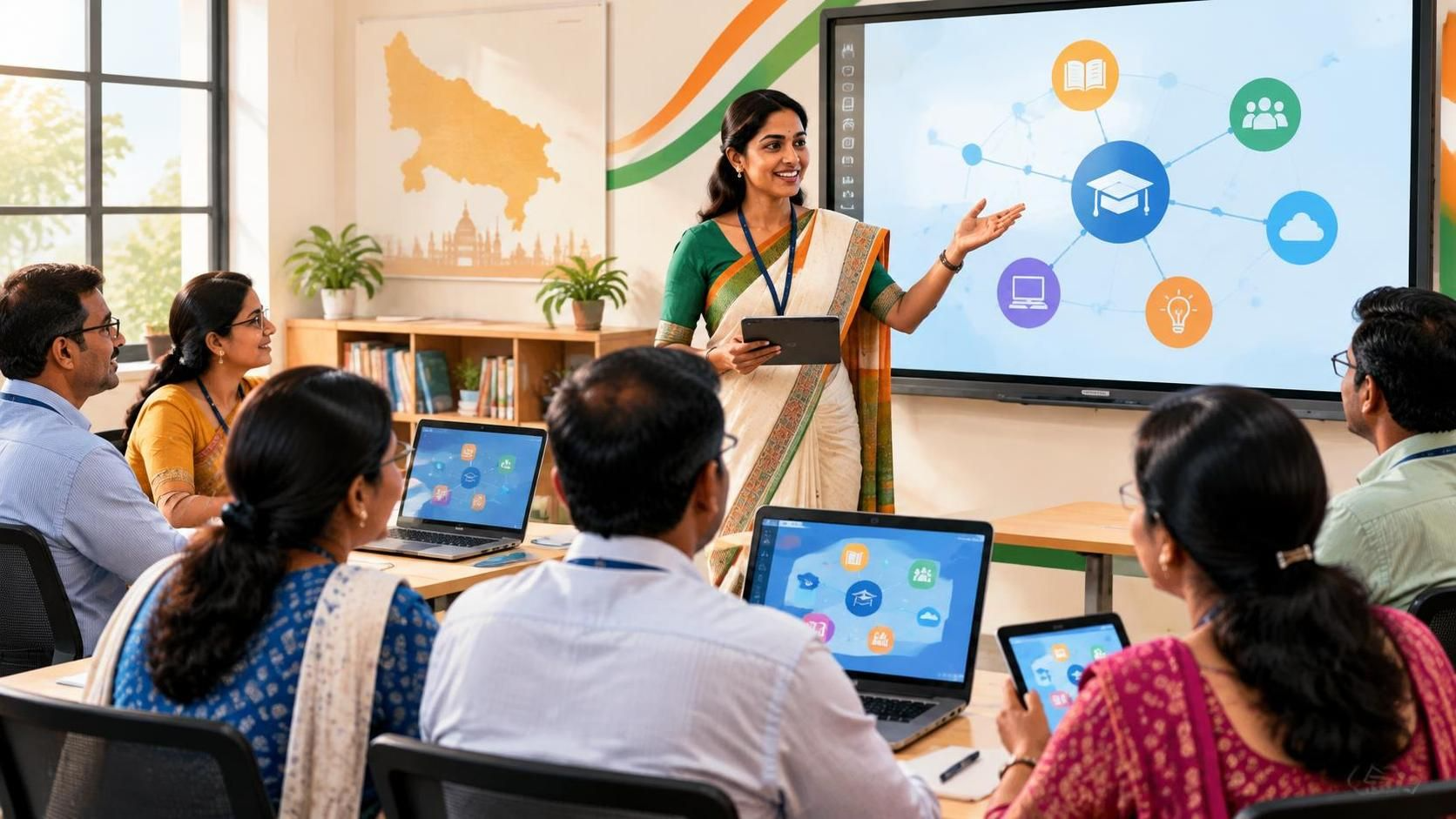
Lucknow: The Uttar Pradesh government, led by Chief Minister Yogi Adityanath, is taking steps to strengthen digital education in government-run primary and upper-primary schools. As part of this initiative, Samagra Shiksha, Uttar Pradesh, has developed the ‘Uttar Pradesh Digital Skills Guide’ for block-level teacher training.
The guide aims to help teachers use digital resources effectively, identify learning gaps among students and provide academic support according to individual learning needs.
It provides practical instructions on identifying, operating and using equipment available in school smart classrooms, ICT laboratories and digital libraries. These include Interactive Flat Panels (IFPs), OPS, UPS, desktop computers, Wi-Fi routers, printers and webcams. Teachers will also receive guidance on the correct sequence for switching equipment on and off, safe handling and maintaining an inventory of school devices.
The guide explains how teachers can access class-wise and subject-specific learning materials through Learning Management Systems (LMS) and the DIKSHA platform. It also covers the use of PM e-Vidya and Khan Academy.
According to the guide, DIKSHA offers 82 energised textbooks for Classes 1 to 8 and more than 16,000 educational videos. Teachers can scan QR codes printed in textbooks to access related videos and classroom activities. PM e-Vidya will provide additional learning resources through television, radio and offline platforms. Teachers have been advised to use digital content for at least 10 minutes in every teaching period.
In areas with limited or no internet connectivity, teachers can use previously downloaded resources, DIKSHA’s offline content and educational material stored on pen drives.
The digital library facility provides access to more than 5,000 e-books, digital editions of newspapers and magazines, and audiobooks. Its academic mode will help teachers assess students’ understanding of classroom lessons, identify difficult topics and address learning gaps through remedial catch-up content.
The guide also places emphasis on technology-based student assessment and independent practice. Teachers can conduct assessments using LMS and DIKSHA question banks and record results through the NIPUN Plus app. If more than half the students answer a particular question incorrectly, teachers are advised to revisit the concept in the next teaching period.

Reports generated through Khan Academy and LMS will help teachers track students’ practice and progress and organise additional lessons wherever required. The guide also recommends a three-stage scaffolding approach to teaching: ‘I do, we do and you do’, in which teachers first demonstrate a task, then practise it with students before encouraging independent learning.
Another key component is the responsible use of Artificial Intelligence (AI) in education. Teachers can use AI tools to prepare lesson plans, questions, worksheets and activities at different difficulty levels. However, they must independently verify the factual accuracy and curriculum relevance of AI-generated content.
The guide specifically prohibits sharing students’ names, photographs, U-DISE codes or other personal and confidential information on AI platforms.
It also provides instructions for maintaining digital equipment, including protecting devices from dust, moisture and excessive temperatures. Teachers have been advised against installing unauthorised applications or attempting repairs themselves in case of technical faults.
For technical assistance, complaints can be registered through the Vidya Samiksha Kendra toll-free number and the complaint module on the Prerna Portal. The guide explains the prescribed procedure for reporting and escalating technical issues.
Monika Rani, Director General, School Education, Uttar Pradesh, said the guide would provide teachers with practical training in the use of digital devices, educational platforms, student assessment, progress tracking and responsible AI applications.
She said the objective was to improve students’ learning levels through the effective use of digital resources. Smart classrooms, ICT laboratories and digital libraries, she added, would make the teaching-learning process more engaging and outcome-oriented.











 https://www.youtube.com/watch?si=RtToJsBhYBatUrym&v=mOuYNSdhjHA&feature=youtu.be